

If you prefer listening, there’s an original audio recording here. 👆

Sitting on the attic floor, my lanky teenage legs stretched out alongside the paper-wrapped cylinder, I could peel back enough of the covering to see just the first few inches of the quilt. Marveling at its rich colors and textures, its delicate needlework and diverse motifs, I loved the tiny spectacles most of all.
The house of my youth suffered from no lack of storage space; my mother manifested it as she worked with the architect on its design. Closets, cabinets, built-in pantries and china cupboards, a roughly finished basement and an attic with enough head room for an adult to stand upright. For her, everything had its place, even if she was the only one who fully understood what that meant. The home was her territory.
The lower level was where my father kept his desk, hunting gear, and guns. It’s where the upright freezer held the spoils of his outings in plastic wrap and white butcher paper. The basement was for vintage train sets, rowdy grandchildren, Little Tykes rides, Legos and Lincoln Logs. The attic held seasonal decorations, retired dishware, and keepsakes that were too precious to discard but had no place to land in the rest of the house.

I am the namesake of my great-great-grandmother, Elizabeth Doran Essex Wright, affectionately known as “Elizza” and the fourth in line to inherit a crazy quilt that spent a quarter of my life in my parents’ attic. Fitting together whose handiwork might be represented in its careful stitching is like sewing together a quilt of my own, a piece of history here, a splash of color there, and creative adornments throughout. I like to imagine her sitting with her mother and two sisters, working in the interstices, between chores and childcare, by daylight or lamplight.
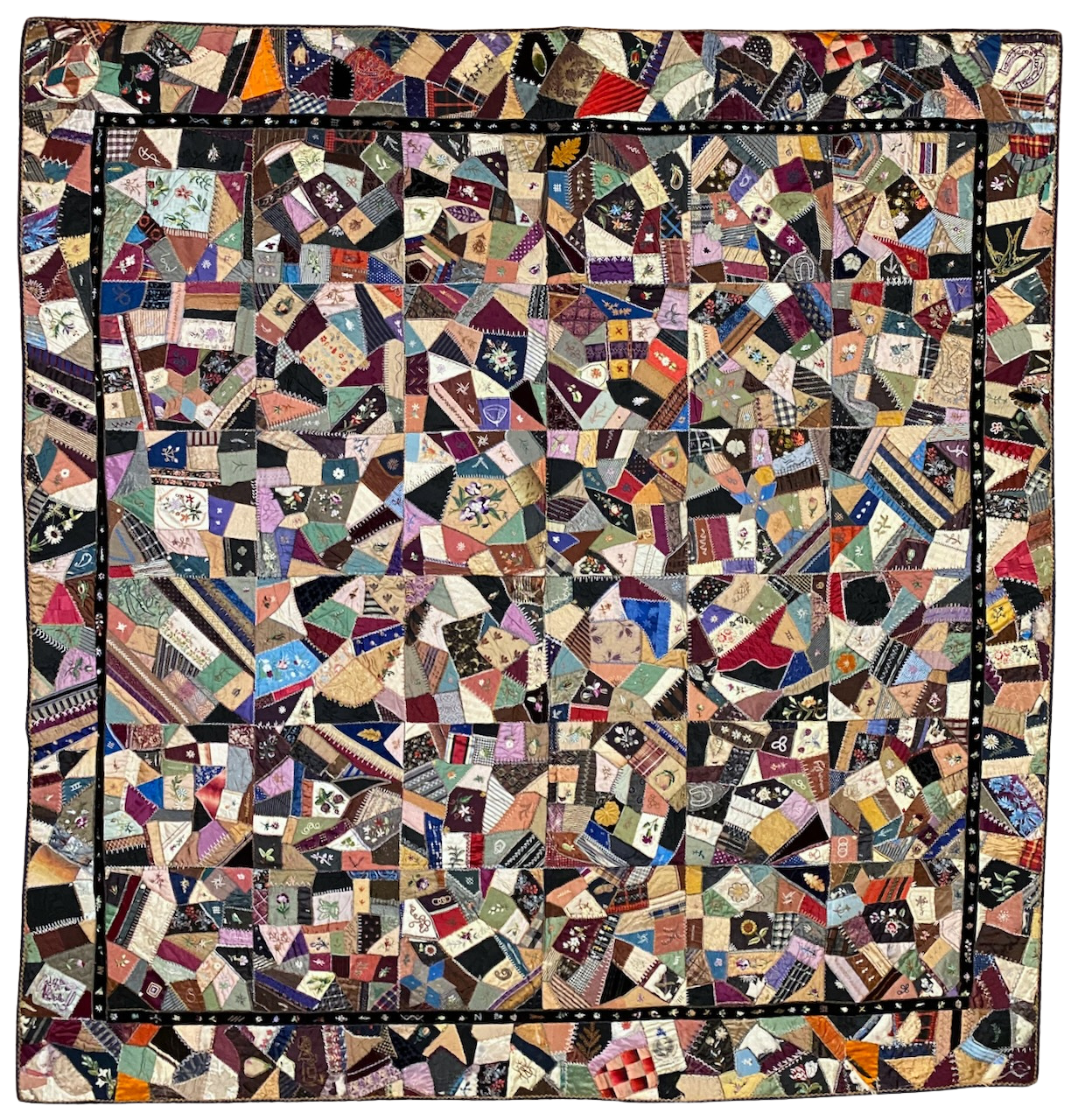
Quilts like these are documented in the U.S. as early as 1870, but it was the 1876 Centennial Exhibition in Philadelphia—better known as the first World’s Fair—and its introduction to American people of Japanese-inspired concepts like asymmetry and cracked-ice designs that catalyzed the “crazies” craze.
Women across the nation, from a spectrum of wealth and religious backgrounds, stitched remnants of silk, velvet, and ribbon into deliciously irregular works of art. A crazy quilt might preserve a piece of a formal dress, an everyday garment, a man’s vest pocket or necktie, a family memory or a political moment—so becoming a kind of scrapbook. The results could be extravagant or restrained, fashionable or frugal, showcasing embroidery skills and providing an outlet for personal expression not readily available to Victorian women.
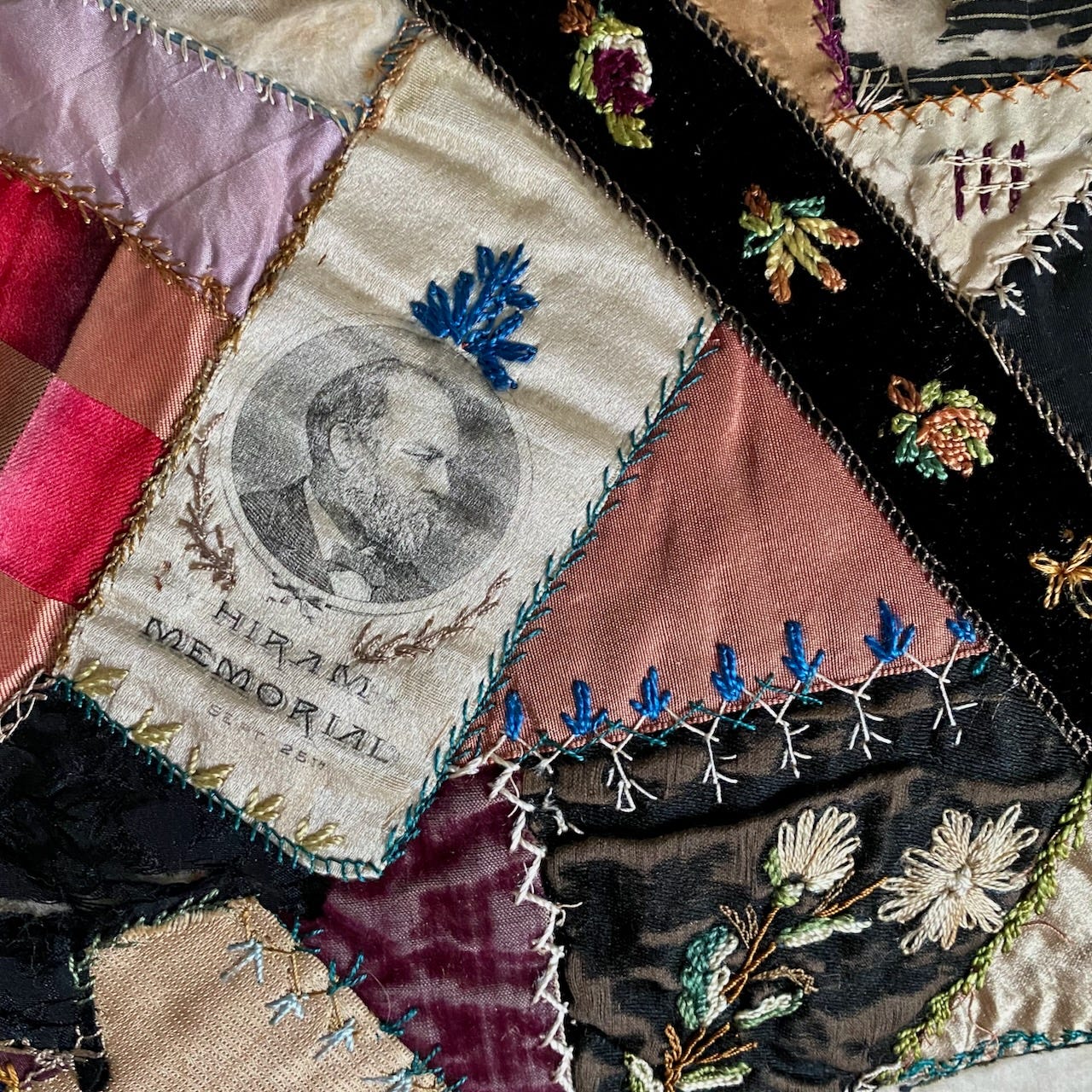
Sewn into my great-great-grandmother’s quilt and adorned with embroidered laurel-like sprigs in threads of blue and bronze, is a small silk ribbon bearing a portrait of President James A. Garfield, the words “Hiram Memorial,” and a date: September 25th.
After two excruciating months fighting infection from an assassin’s gunshot wound, Garfield had passed away six days earlier, on September 19, 1881. The funeral procession drew mourners from Washington, D.C. to his birthplace in Ohio. When his body arrived on September 24th, crowds gathered to pay their last respects, townspeople lined the railroad tracks, bells tolled, and buildings were draped in black mourning cloth. Hiram College (then Western Reserve Eclectic Institute), the small school where Garfield had studied, taught, met his wife, Lucretia, and served as principal, held its own memorial service that Sunday, a day before he would be buried in Cleveland.
Sixteen years earlier, near the end of the Civil War, Abraham Lincoln had been murdered. Peace in the country was still tenuous. The Reconstruction had collapsed, and the South was reasserting the white supremacy the era was supposed to end. The spoils system, which rewarded party loyalty over merit, had turned the federal government into a patronage machine corrupt enough that a disgruntled lawyer named Charles Guiteau shot Garfield over a position he felt he deserved.
The week the funeral train made its way to Ohio, the nation mourned together while bearing witness to Lucretia “Crete” Garfield’s immense loss. Her marriage to James had been rocky early on, owing to his extended absences and infidelity, but after the death of their first child in 1863, the pair became devoted partners.
After the shooting, Lucretia, who had then lost two of her seven children and was prone to illness herself, stayed at her husband’s bedside though she was still weak from a bout with malaria that spring.
Crete was her husband’s confidant and moral compass, expressing support and determination in the thousands of letters they exchanged. Though she tempered them publicly, she held strong views on women’s rights, penning them into letters to her husband:
“It is horrible to be a man. But the grinding misery of being a woman between the upper and nether millstone of household cares and training children is almost as bad. To be half civilized with some aspirations for enlightenment, and obliged to spend the largest part of the time the victim of young barbarians keeps one in a perpetual ferment.”
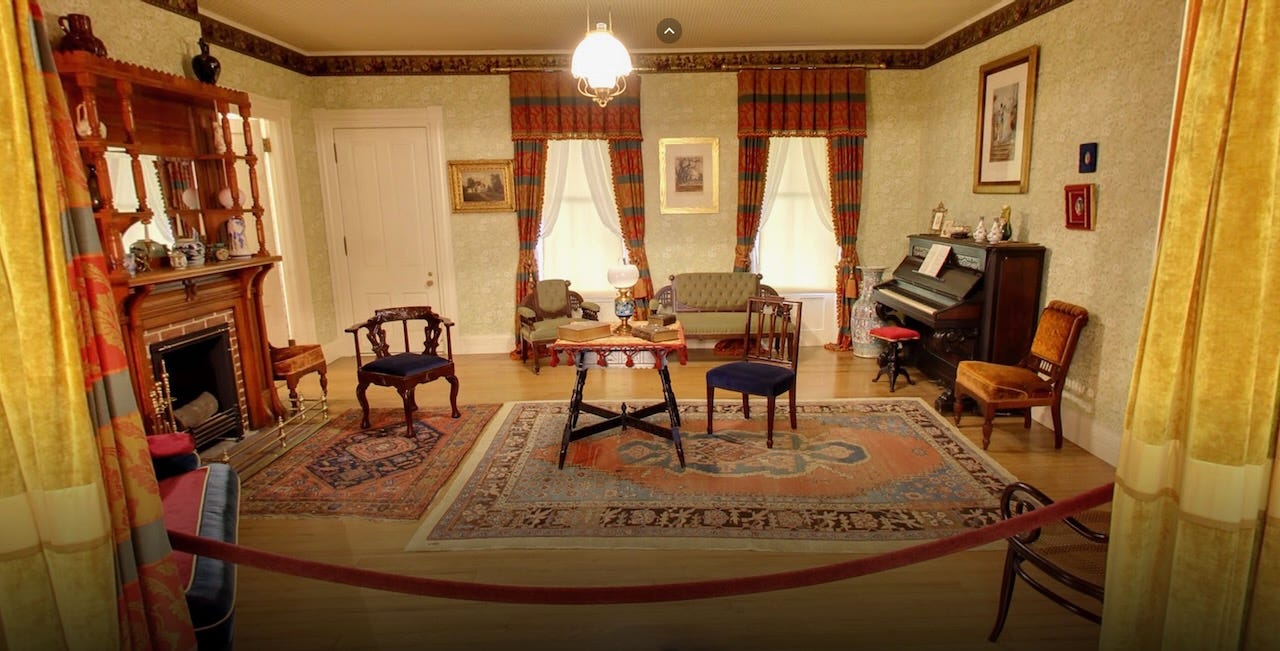
In the year following James’s death, at the family home in Ohio, the widowed Mrs. Garfield oversaw the construction of what would become the first presidential library. She went on to maintain a vast collection of books and presidential papers for the remaining thirty-two years of her life.

Married to Joseph Thomas Wright at nineteen, the census lists my great-great-grandmother’s occupation as house keeper and his as farm hand, eventually farmer. The eldest of her four children would become my great grandfather. She died in 1889 at thirty-eight. Though it appears they all reached adulthood, her parents buried three of their six children and they outlived Elizza by a decade.


How the Hiram Memorial ribbon reached a woman in rural Kentucky who, according to the 1860 census, could neither read nor write, I don’t know. It’s possible, though improbable, that someone from the family took the 24-hour train ride to Ohio to pay respects in person to the slain president. More likely, the ribbon was shared by a neighbor, a church, or perhaps it was a treasure that turned up in a bag of scraps promoted by silk manufacturers and available for purchase at local stores. Whatever its provenance, its inclusion in the quilt tells me much about how the tragedy affected the family.
Elizza and Crete lived different lives. One had a nation’s sympathy, money, and an archive. The other had a census line. But both were charged with holding things together: households, then grief, then legacy. One built a library of books and letters. The other made a quilt.
Consider what was on offer: A Kentucky farm woman in 1881 could work alongside her husband, keep house, raise children, and bury them. She could sew or teach if she were educated and a job existed. Her legal identity was folded into her husband’s. Politics, wages, and public speech were mostly closed to her. Needlework was among her few forms of expression, and it could carry ambition, feeling, even civic pride. A women’s group in Hiram made a flag of fifteen by twenty-six feet for Garfield’s 1880 presidential nomination, and it was displayed again after his assassination. Women stitched public memory.
Did my female kin cry and laugh together, telling stories with their hands and voices, skeins of silk thread and sharp needles nearby? Did Elizza D. imagine that the quilt would last through five more generations? I don’t know. She left no letters and probably couldn’t write them. I could tell you she made the quilt hoping to say something important about her time on the planet, and that would be a story I made up.
I can’t know what she thought about the country. I can’t know what she thought about its leaders or what she said when the news came. But she saved the ribbon.
~Elizabeth

They say history doesn’t repeat itself, but it rhymes. September 19, 2026 marked the 145th anniversary of Garfield’s death, amid a political climate still echoing today. Here, I set out to consider an heirloom from a woman I never met, someone who lived with a lot of turmoil and tragedy. I don’t think you can write honestly about grief and division in the past without the present pulling up a chair beside you.
Elizza left no letters. Lucretia left something in the realm of 55,000 documents. Most of us land somewhere in between, hoping whoever comes after knows what to do with what’s left.
I wonder…
What skill ran in your family that was never written down?
If a stranger inherited something from you, what would they get right about you, and what might they get completely wrong?
I read every comment, and treasure the opportunity to get to know each of you more completely. The community of readers there is just wonderful!
And if this kind of rummaging through the scraps and archives of life is something you look forward to, paid subscriptions are what keep the creative energy flowing. If you’ve been waiting to join in, I hope today might be the day. To those who already do, thank you, truly. Tapped out on paid subscriptions but still feel moved to acknowledge the experience today? You can “buy me a coffee” with a one-time contribution.
To everyone who spends time with me at Chicken Scratch, I extend my sincere gratitude. You are part of the tapestry of my life, and I appreciate you. 🧵🪡 💚
AFTERWARD:
Each week, I share one small, concrete way to take action, this time toward the kind of remembering this piece is about.
TRY THIS:
Memories held by one person are fragile and easily broken. This week, try writing down one piece of family history that might otherwise be forgotten and send it to someone who’ll keep it safe on your behalf.
See you soon!
Resources:
American Patchwork and Quilting
A Fairyland of Fabrics
Fueled by Silk: Victorian Crazy Quilt Mania
First Ladies: Influence & Image
National Park Service: Country Mourns as President is Laid to Rest
UVA Miller Center: Lucretia Garfield
Thanks for this rich and thoughtful remembrance, Elizabeth. I have a quilt made from the floral ribbons from the funeral of my husband's uncle, a beloved physician who died early from ALS, and another made of the various rough wool patches of my banker grandfather's worn-out suits. May I recommend to you and your readers the 4-part Netflix mini-series Death by Lightning which tells the story of Garfield's assassination, but really brings to light his remarkable marriage and family. What an under-appreciated man he was! I'm sure his untimely death was as significant to those who loved him as Kennedy's was to my generation. In the words of Faulkner, "The past is never dead. It's not even past."
I love this piece and your family heirloom quilt! I come from a long line of southern women who made quilts and I cherish each one I own! Quick story to share; I was contacted by a women via ancestry.com whose 2nd great grandmother was a sister to mine. I have a quilt my great great grandmother made and shared a pic with her. She then shared a pic of one she had and they both contained some of the same fabric! Priceless look into the past. These sisters lived through the civil war and were of Scottish descent. My quilt has large hand appliquéd tulips on it. I took it to the Antique road show where they valued it around $450 priceless to me.