

Prefer to listen? You’ll find an original audio recording here. ⬆️
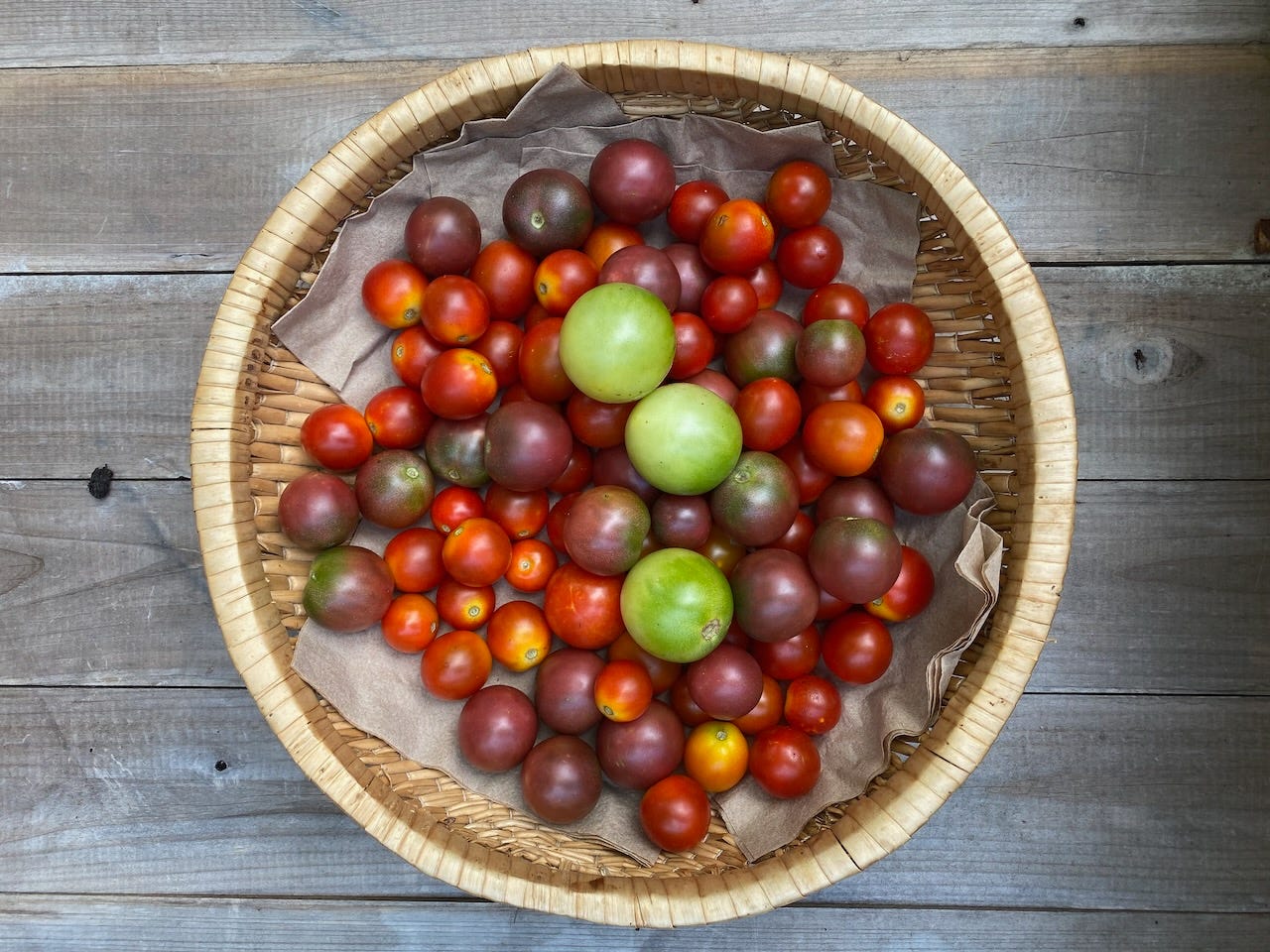
I’m thinking about plump and tumbled cherry tomatoes, how they sit within arms reach of my favorite chair. I fill my mouth with round bursts of summer, acid-sweet, half hoping they make up for the water I’m always forgetting to drink.
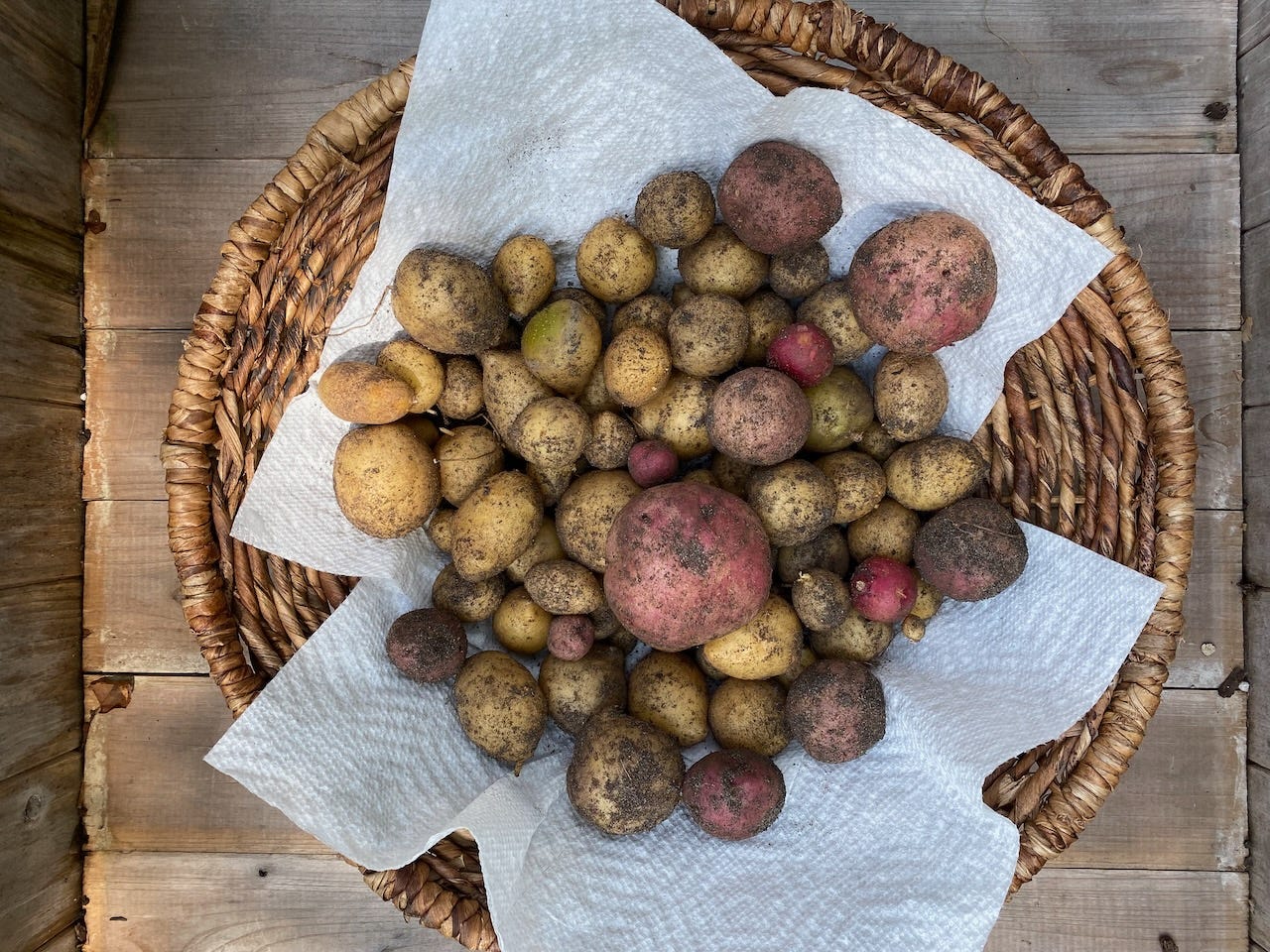
I’m thinking about freshly harvested potatoes in a basket under the cupboard with the cracked pane of glass, broken the day my husband ferried the newly constructed piece home. Starchy orbs of all sizes, and gritty as the fingernails used for digging.
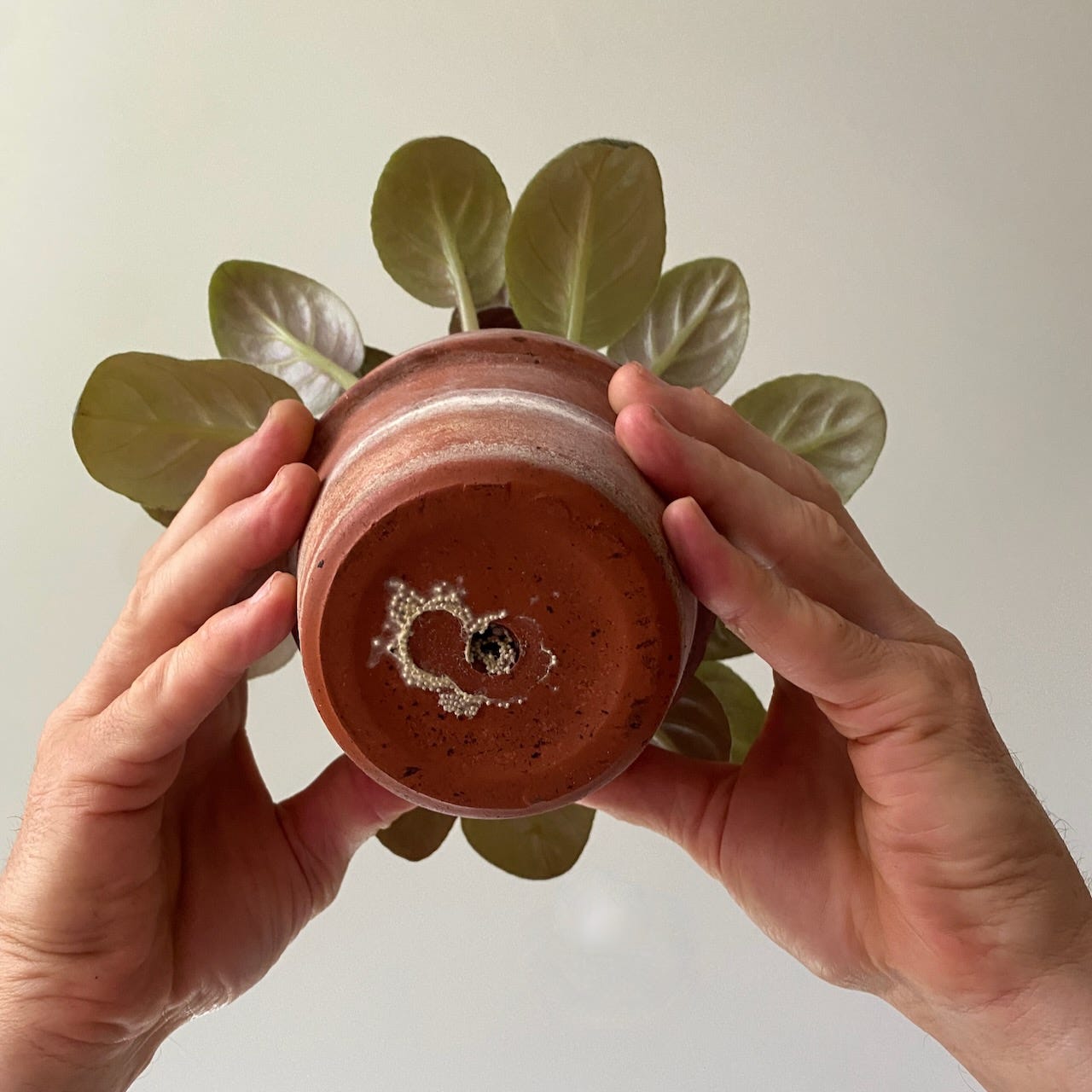
I bottom-water a potted plant (go ahead, laugh—twelve-year-old me sure is), and am met soon after with two nubby rafts floating across the dish. White, pinhead spheres held together in cottony clusters, all hobnail bedspread and remnants of childhood.
Eggs, I think, because it’s always eggs, someone ready to hatch out and crawl all over my world, but research proves me wrong. They are a saprophytic fungus, vultures of the plant world, here to make something useful out of what is otherwise finished. Baby mushrooms, more staff than guest, not only do they do no harm, they occupy the intersection between arriving and departing.
I’m thinking of circles and spheres, of roundness and rotation, of how their starting points meet you wherever you are.
No matter where the journey originates, a circle comes around to its own beginning and ending, and I’m thinking about how that makes it feel resolved, no loose ends, complete but not finished. The tomato delivers its seeds from one place to the next, the potato comes from versions of itself, last year’s plants getting ready to be this year’s. The fungi are moments inside a movement, caught mid-sentence and shaped like a collection of periods, but only for now.
A dot is a fixed point; a line moves forward or backward, up or down; an angle is a line that changes its mind; a circle goes somewhere and comes back again. Exist, travel, turn, return. Living is all lines and angles, beings on their paths from birth to death. Life, though, is a circle, a perpetual recycling of energy into energy, of necessary reciprocity. How heartening to remember to see the geometry of being as soft and cyclical, like seasons, like days.
Roundness is comforting. Humans are among many species drawn to it, with explanations ranging from an evolved fondness for the gentle curves of our own offspring to the round shape of our own eyes. The lens through which we view our part of the universe is, itself, circular. Teeth cut, edges constrain. Is it surprising, then, that we find tension in sharp corners, in hard angles? A line asks that we consider an endpoint. A circle invites continuation.
I’m thinking of rounds of drinks and applause, of sunny cheeks and soft bellies, of pillowy breasts and generous bottoms, of melons, and marbles, of peaches, and planets, of timelines and deadlines imposed because they’re better at shaping the stories of what might otherwise be timeless, of atoms, of cells, of seeds, of eggs, of wombs, of moons, of orbits, of galaxies, of love.
~Elizabeth
Now for the best part: I get to turn the thoughts over to you. Thanks for coming along with me today, and I hope you’ll spend some time with others in this fine community by joining in on the comments.
What’s the roundest thing in your kitchen right now?
Do you have an uncanny tendency to end up with wonky-wheeled shopping carts? I refuse to believe I’m the only one.
Ever had an egg situation that got out of hand, like the multitudes of praying mantids that hatched on my kitchen counter one year?
If this piece earned a like, please click the heart 💚 button. It doesn’t seem like much, but it does help Chicken Scratch find its way to more readers. A restack ♻️ does that even better. And if you’ve been thinking about upgrading from free to paid, or just want to toss a little something in the tip jar without the commitment of a monthly contribution, both options are below. It all circles back to keeping this space open and growing, so thank you in advance.
Afterward:
Systems run on the assumption that every piece is doing its part, a lot of ordinary folks doing the same work, reliably, over and over. Staff, not heroes. I like to end each week with small ideas that I hope bring us closer to thinking collectively and caring deeply.
Try this:
Grab a pen and piece of paper. Without lifting the pen, draw one slow circle in a continuous loop. Take your time. Do it again, and again, ten or twenty times, without trying trying to make one better than the last. You’re not going for perfect circles. All you’re doing is watching the process, seeing your hand come back around, and noticing, when you do, whether it feels like an ending, a beginning, or both.
See you next time around!
What a wonderful *well rounded* essay to read first thing! A friend of mine once said that little babies always have the heels of a cherry tomato - a poetic observation and this is too!
Such a lovely, poetic meditation, perfect for the waning days of summer. So many round things in the kitchen right now: tomatoes and onions from our garden, peaches, each tiny sphere that makes up a blackberry, radishes, cantaloupe, canning jar lids (for the tomato sauce we're making). I think I've been eating my way through August. Not a bad way to live. Thanks for helping me see my kitchen and garden more deeply.