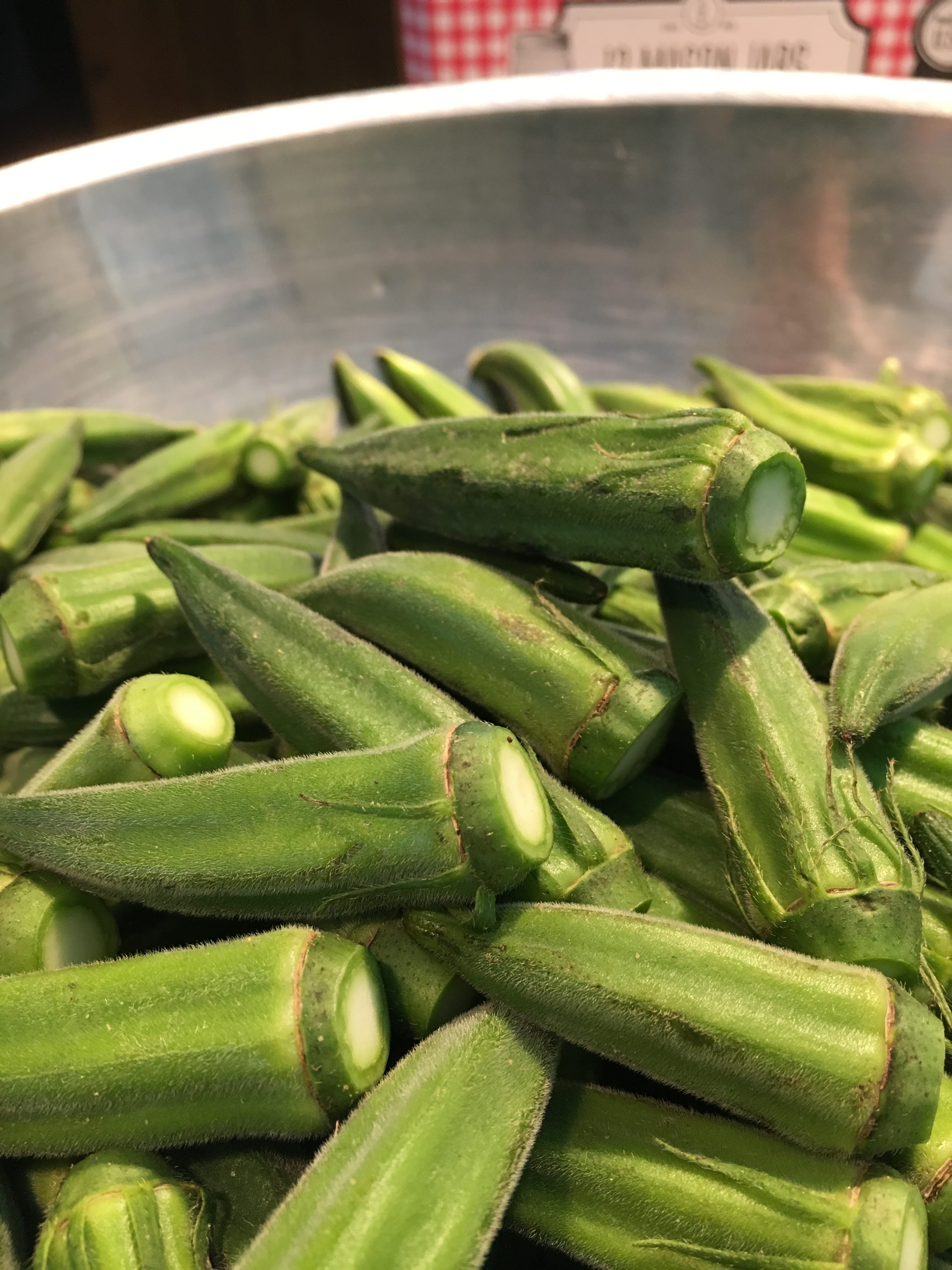
It was before 9:00 AM on a spring Saturday and I was already going on about okra. This is a story about assumptions—mine, yours, a fictional witch’s—and it starts, as these things do, with a vegetable.
The truth is, it was a set up. Moments before, the farmers market in my town had reopened for its 25th season and folks were queued up at various stalls, making their selections. I’d landed at Dave’s. Dave is a meat producer, a guy whose outsize heart often calls the bluff on his cantankerousness. The conversation had been spotlighting sausage, and Dave’s eyes lit up as he described a recent batch of jambalaya he’d made with his own andouille. I know him well enough to know he’s not big on vegetables, so when I asked if he’d added okra to his stew it didn’t matter that okra isn’t necessarily traditional in jambalaya.
I figured I’d get Dave going, but it was Eric, the next person in line, who took the bait. I learned that Eric can only tolerate okra in gumbo, or if it’s been fried to the brink of incineration. Otherwise – his upper lip shooting toward his crinkled nose as he grew more invested in his response – the goo-factor was a deal breaker.
And, there it was - slime. Okra’s lead balloon.
Standing beside Eric was his wife, Patty, who taught my kids’ music classes when they were wee tots, introducing them to instruments and songs from many cultures. Though there is absolutely no logic in it at all, I somehow assumed her international awareness would have oozed into their kitchen, and by association, the family’s food choices. I’m funny, aren’t I?
I met Eric’s diatribe with my standard rebuttal: “You’re not cooking it right.”
Here’s the thing about okra’s goo: it’s not a flaw, it’s a feature. You’ve just been asking it to do the wrong job. In a gumbo or a stew, that same slime is a thickener, the quality that makes the broth cling to your spoon instead of running off it. The problem is the cooking technique. Slow-cooked in liquid, okra thickens. Hit with high heat or something acidic—a hot pan, a splash of vinegar, a dose of tomatoes—it tightens up and disappears. Eric wasn’t wrong about the goo, but he never gave okra the conditions it needed to behave differently.
The guys remained unconvinced. They knew what they knew. Okra was gross and green. End of story.
“The world unwraps itself to you again and again, as soon as you are ready to see it anew.” ~Gregory Maguire
Gregory Maguire’s novel, Wicked, tells a similar story, just with higher stakes: Baby Elphaba comes out green, and the world decides what that means about her. She isn’t born wicked; she’s made that way by everyone who takes one look and assumes the worst.
I think a lot about assumptions. In life, we build off what we think we know, so it’s natural to layer that onto our perceptions of the people and events around us. It saves our brains time, helps us organize our thoughts more efficiently. But, it also affects the way we receive information and how we react to what we experience.
Our stories are influenced by an immeasurable mix of ingredients. Did we grow up in a safe or scary place? Did our teachers expect us to succeed or fail? Who supports us when we need help? Is there anyone out there who understands our situation? How long has it been since we had a good night’s sleep, a home cooked meal, a compassionate lover?
If the metaphorical okra in your life has always been handled improperly, it stands to reason you’d relegate it to boxes marked “DO NOT TOUCH!” Emotionally, it’s easier to store those containers in the basement than it is to haul them out, unpack their contents, and test out whether there is another way to manage them.
“Your assumptions are your windows on the world. Scrub them off every once in a while, or the light won’t come in.” ~Isaac Asimov
And you thought we were just going to talk about food!
All right. Getting back to okra and that lead balloon, let’s see if we can knock a few pounds off its undeserved burden. First, there are cultural influences at play that decrease the chances of some of us having an appreciation for neba-neba foods. And, I think you’d agree, lack of experience says more about the people than it does the dish itself.
Next, consider that there are other foods on the slimy spectrum that elicit far less loathing: mango, Jell-O, banana, raw oysters. Okay, sure, that last one is in a league of its own, but you get the idea. It’s worth noting that none of them are green, which I suspect makes them less suspect.
Finally, I will pop in the reminder that viscosity has its place and purpose. You just have to be in the right frame of mind. Say what you will about how things that go in your mouth shouldn’t be slippery, and I’ll raise an eyebrow suggesting that you give that justification a closer look.
“It’s not about changing who you are, it’s about changing what you expect.” ~Elizabeth Beggins
If, like me, you were practically born eating okra - fried, pickled, stewed (hello, Bubba Gump) - join me in my mission to right the wrongs in the life of this much-maligned food by spreading the good word.
If, for you, okra has simply become evil, banished as a result of your lack of understanding, you have an open door and the light to the basement has been turned on. I’ll even hold your hand if it helps. Here’s a simple recipe to get you started.
You have time. Okra growth doesn’t really take off until high summer, well after the Fourth of July where I live. The freshest options will likely be at the farmers market, in a stall near a guy like Dave. Unless you want to grow some of your own.
~Elizabeth