

Original voiceover coming soon! 😅
I stayed up half the night trying to coax a new, weighty piece into shape, but it’s just not ready. It needed a touch more light. My hat is off to folks like Ally Hamilton who consistently manage to dig deep while also leaving us with reasons to be hopeful.
In the meantime, here’s a piece shared previously about words and why I fuss over them. That feels fitting with the week I had.
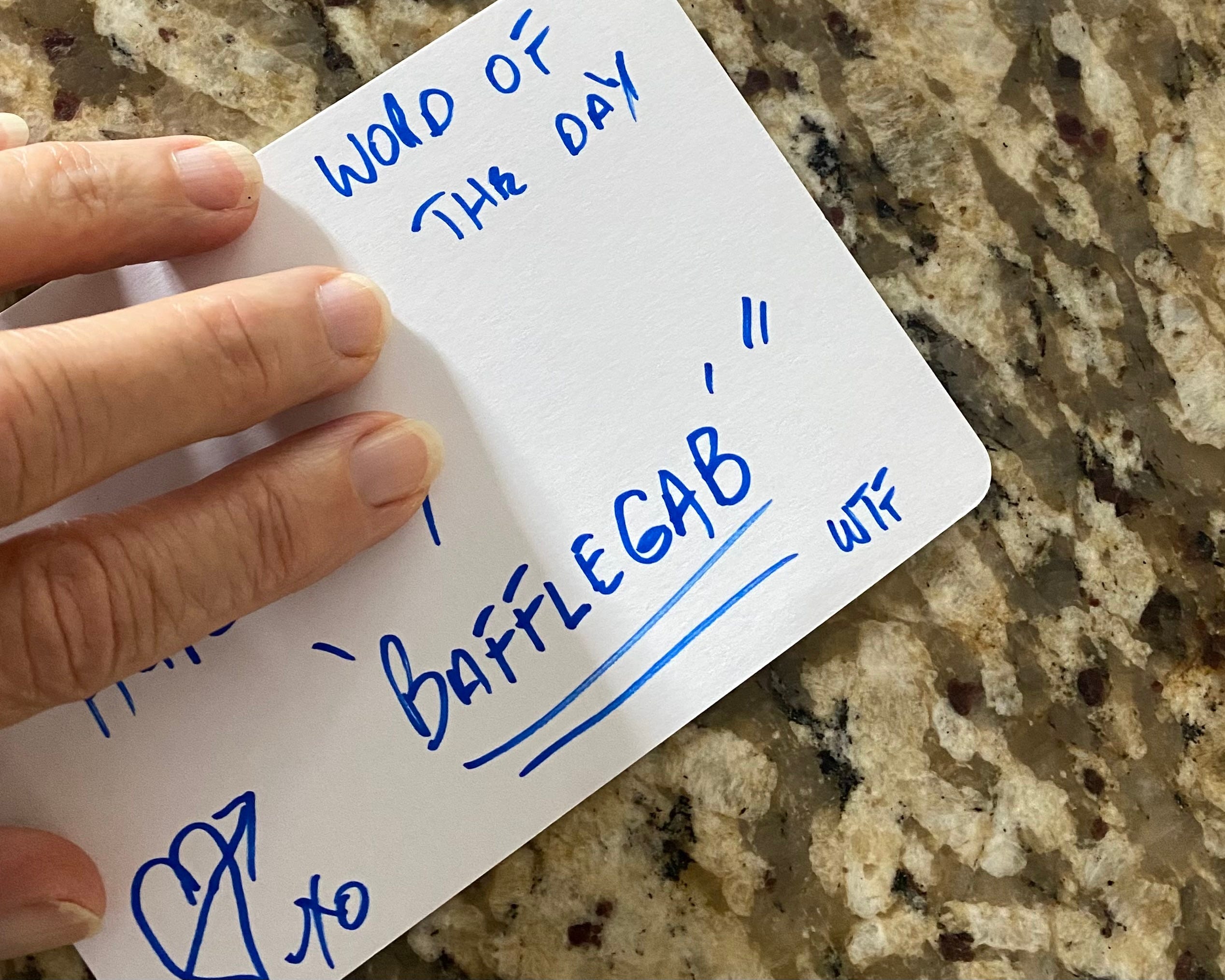
It also comes with a fresh anchor. My husband recently came across the word “bafflegab” in a news article and couldn’t resist leaving it on a handwritten note for me to contemplate when I returned home that morning. (For the uninitiated, it means language so wordy, vague, or jargon-heavy that it confuses more than it explains.) I consider it a sign.
Enjoy!
I am a fool for a good word. In conversation, it’s not uncommon for me to pause mid-sentence and search audibly. “What’s the word?” I don’t always find what I’m looking for, my brain less brisk than I wish, but the instinct abides.
I admire those who choose words meticulously, and I imagine most writers do, though I’ve seen examples to suggest otherwise. Poets are the bomb squad of wordsmiths, every decision tactical, while politicians are magicians, crafting marvelous illusions. And teenagers? They’re wayfarers, blazing trails to unexplored linguistic destinations that distinguish them from others.
Words create worlds. Words shape identities and outcomes. And sometimes a single word can make all the difference.
Like the time a guy went on about a new enzyme diet, which foods had the right sort, which the wrong sort, and how he wanted to maximize his well-being with all the best choices. Even if he had to go out of his way to find them, he was dedicated to the method.
When asked where he’d learned about the program, he offered the example of another man whose health was imperiled following a motorcycle accident. He’d been terribly compromised, failing to thrive.
“I mean, this guy was EMANCIPATED!” my acquaintance emphasized.
He was sick. But free! And…enzymes.
Words are hard.

Sometimes, it’s not that we can’t find the right word. It’s that the one we need doesn’t exist, as anyone multilingual can attest. What applies in this language might not apply in that one.
Take French, for example, the study of which once absorbed great hunks my life, fat lot of good that did me. Even a common word like voilà, literally “see there,” is too complex for a simple translation. Used to present, introduce, draw attention, note accomplishment, convey agreement, or end a conversation, it’s far easier for us English speakers to just rip off the whole word, merci bein. Et voilà.
I asked my nephew’s mother-in-law for input. Karen Hill Anton and her husband, both originally from New York City, have lived in rural Japan since 1975, raising four children there. An award winning writer, coach, and columnist, I assumed she could readily name countless kotoba with no English counterparts. I thought she might choose a term in the vein of those we Americans co-opt in our westernized pursuit of mindfulness and meaningful living: shinrinyoku (forest bathing), ikigai (living with purpose), or wabi-sabi (the beauty of imperfection and impermanence). She didn’t.
“Wow,” she said, “there are so many words. Off the top of my head, I'd say: chotto. [It] can be translated as: a little, slightly, just a little, for a moment, briefly, wait a minute—even, I don't want to talk about it now. And it can be used to stop a conversation, or inquiry, in its tracks.”
Chotto. Like voilà, only better. Who hasn’t longed for a more diplomatic way to tell someone to buzz off? I’m reminded of a Mennonite farmer I worked with who never participated in meetings. Instead of admitting he wouldn’t attend, which might be rude, or that he couldn't attend, which would be untrue, he'd say, "I don't believe I'll be there." I think chotto is the word he needed. So versatile.
Broad and contextual works well in some circumstances, but there are times you want specificity, something that takes out all the guesswork. I was introduced years ago, by my friend Carita, to the delightful utility of Swedish grandparent names: mormor (mother’s mother), morfar (mother’s father), farfar (father’s father), farmor (father’s mother). It’s a wonderfully efficient system.
But when I asked her recently about Swedish words that have no English equivalent she sailed right past those options into the sort of language I’d thought might turn up in Japanese, even offering a stunning companion photo, taken from her kayak in late July.

She wrote, “Mångata (moon road) is what Swedes call the light of the moon on the water, in a path like this. Kind of a stairway to heaven word…”
‘Cause you know sometimes words have two meanings.
Similarly rich and descriptive are Arabic expressions of endearment. Noha Beshir, who writes Letters from a Muslim Woman offered two:
“…I'll give you a couple,” she begins. “They seem all wrong in English, like they're flattened, like their depth disappears.
"Ya 'uyoony - this literally translates to ‘oh my eyes.’ What it's really about is expressing your love for someone. So if you're calling out to someone you love, and you call them, ‘my eyes,’ you're expressing the depth of your love for them. People could use this to refer to their romantic love, or to family members, or to dear, dear friends.
“Another one is Ya rohy - this one is ‘oh, my soul’ - you'd use it the same way as ya 'uyoony. So again, to express your love to someone in pet name or endearment format.
“The soul is referred to frequently in Arabic, separate from the heart, separate from the mind. I'm not sure if this is because, through the lens of Islamic spirituality, these are seen as three separate components of a person's being.”
Fascinating. And she’s right, of course. Sorry, kids, but bae and pookie don’t have quite the same level of sophistication.
When I asked about untranslatable word ideas from a friend who spent his career as an international aid worker (find him at Switter’s World) he offered some lighthearted gems picked up during his many assignments.
“I immediately thought of a chiChewa word, katundu, Switter explains, “which is kind of like baggage but not. It’s more like all the junk we haul around in the back of our pickup. It is used in Malawi.
“They also have a much better word for mosquito than we do: udzuzu, which sounds like a mosquito when you say it.”
I live in a place where there are a lot of pickups and recall a fellow who had so much katundu that a tree sprouted in the bed of his truck and grew to be about four feet tall. Judging from the fact that he didn’t remove it, it seemed to bring him some pleasure, unlike udzuzu.

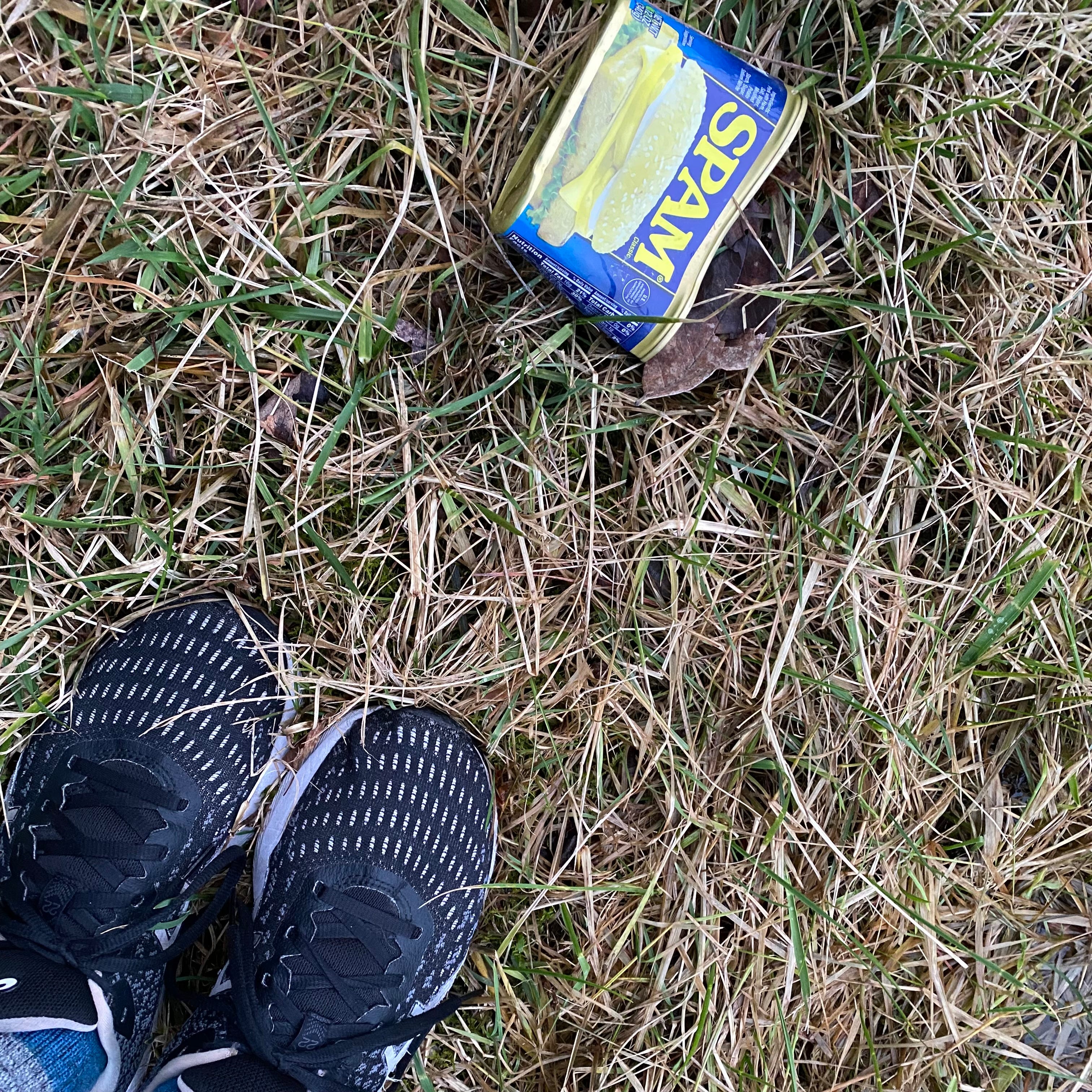
We could easily flip this discussion to focus on a collection of English terms that don't easily translate, words like awkward, serendipity, and nice (a story unto itself, in my head anyway). Instead, I’ll highlight just one: spam.
The word we use today to describe anything unwanted and ubiquitous, particularly electronic communication, got its start as a canned meat product back in the late 1930s. Spam was the winning contest name for a repackaged combination of spiced, cured pork and ham. As an edible product (hold forth on the translation of edible if you wish), it exists in at least 40 countries. But to refer to junk email, most countries just borrow our word, spam.
Given the changeable nature of language, and the rate at which new words find their way into the lexicon, I’m thinking of campaigning for a few additions to the modern dictionary. Tell me these wouldn’t come in handy:
Reirritate: Repeating the advice you weren’t asked to give the first time.
Whichth: Used when you don’t know which number you want, for example: This is our whichth anniversary?
Horridge: A hot breakfast cereal that can also be used as brick mortar.
Esthole: The assiest of asses, the superlative hole.
Also, I’m taking suggestions for a word we can employ when we’ve only half-listened to a partner’s riveting tale about enzyme diets but suddenly realize they’re looking at us in anticipation of a response. “I’m sorry…what?” we blink, admitting we’ve heard a mere fraction of the story but with no indication as to which portion we need repeated.
Collectively, I’m sure we can come up with something better than “what.”
And when we do, we will save relationships, mark my words.
~Elizabeth
Words and how we use them are recurring themes for me. For more like this, delve into the nuances of Making Love or check out I Give You My Word.
What’s missing from your vocabulary? Which terms found their way there on a trip abroad or from your teenager? Do you have any hacks for remembering new words? Let’s talk about it in the comments.
Your conversations, post likes, restacks and shares help me reach other readeres like you, so thanks in advance for taking a few extra moments to dial up that mojo. (Look for these buttons at the start and end of the essay!)

And finally, a gentle reminder that this work is free because I want everyone, regardless of means, to have access. Might you be in a position to become a paid subscriber? Folks who choose to show up for that help me keep the doors open for others, let me know that what they’re reading here has value, and helps me keep the creative fires burning—into the wee hours of the morning on occasion.
Paid subscriptions and one-time contributions make a world of difference, and your support is appreciated in every form.
My morning has started with this perfect wordy breakfast treat.
There are so many reasons that I try to read Chicken Scratch each week... I have told you and I have told many that you have a great gift of words... Honestly, I don't think it's an acquired result of a in depth study of a dictionary ..... It has to be a gift..... So when I read your post each week... the topics and the research impress me and entertain me.... But you word choice is the glue.. Some of your words send me to AI or Google faster than a hungry stomach does to the refrigerator..... So I'm here to say today.... You're a wordsmith.... and I have no words to describe.....