

I record my essays for those who prefer to listen. You can access that here. ⬆️
Our only appearance in print as a couple sits on page 28 of the August 1991 issue of Town & Country, a 180-year-old glossy magazine promoted as “the trusted source of inside information on access and influence, taste, elegant living, and unpretentious fun.” We could spend all day debating the unpretentious part, but I don’t think it would take us that long.
Along with 29 other newlyweds (yes, I counted), we were featured in the Weddings section, an orderly parade of flowers, frosting, and anticipatory joy. My mother-in-law, a faithful subscriber and our family’s resident stylist, mailed in a candid shot: the two of us mid–cake cutting, hands entwined, wearing expressions suited to the pomp and circumstance of the moment.
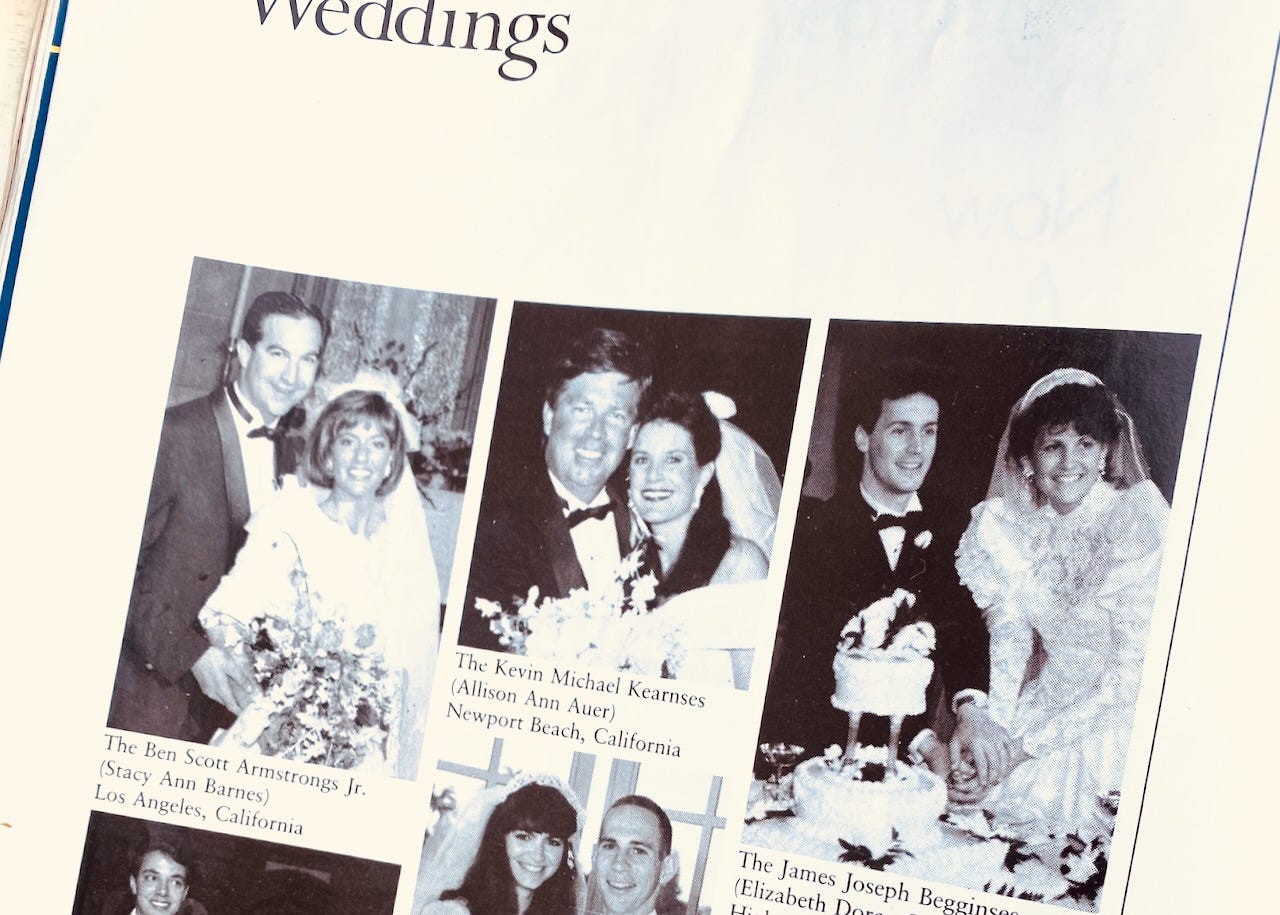
For the record, I had insisted on carrot cake. I could not, in good conscience, begin married life by publicly chewing a slab of sweetened shortening, dressed up as tradition.
We were such lovely, earnest nobodies. For another couple of decades, Town & Country continued to feature wedding photos of people without pedigrees or family compounds. But somewhere along the way, perhaps as printing costs burgeoned, the section evolved. The images grew more polished, the surnames acquired gravitas, the venues began to require passports. What is now branded “Very T&C Weddings” lives fully online and, by most accounts, operates as a pay-to-play affair. Matrimony, like everything else, found its luxury tier.
It’s easy to roll one’s eyes at that transition, but magazines are mirrors as much as they are makers. They print what they believe we linger over. If the pages changed, perhaps our gaze changed too.
A recognizable address, a philanthropic board seat, a private space company, anything called Yeezy: money functions as a signal, shorthand for assumed competence and stability. Rationally, we know that wealth cannot prevent divorce, addiction, loneliness, or deeply regrettable home designs. Celebrity headlines remind us daily that coin does not confer immunity to hardship. What it can do is make certain kinds of trouble less frightening. It can pay for lawyers, second chances, personal trainers, spa retreats, shopping sprees, and houses with a guest room, or seven. It reduces some of the fear around the edges of life. Perhaps what draws us is not the promise of bliss but of breathing room and a high-end espresso machine.
In our current gilded age, the spectacle sustains entire industries. I find myself wondering, with more than a tinge of anger, what any of it proves, exactly. Shouldn’t real success also bring satisfaction? If contentment were part of the equation, why the insatiable need for more? More land, more market shares, yachts that require support yachts—it all suggests hunger, the kind of hunger that leaves the all-you-can-eat buffet with a take-out box.
Still, I struggle with the tension of being repulsed and attracted. I can’t stand to look at it, but sometimes I want to know what they serve for brunch.

After I married my handsome sailor and moved away from the region I’d called home for twenty-three years, my mother kept me supplied with clippings from the local paper. Births, often accompanied by baby names she found mystifying (“Braxxton, with two x’s, imagine that!”), newsworthy events, and of course, wedding announcements. Most have vanished from memory, but I held onto one: “Romantic Wedding in Ravello, Italy.”
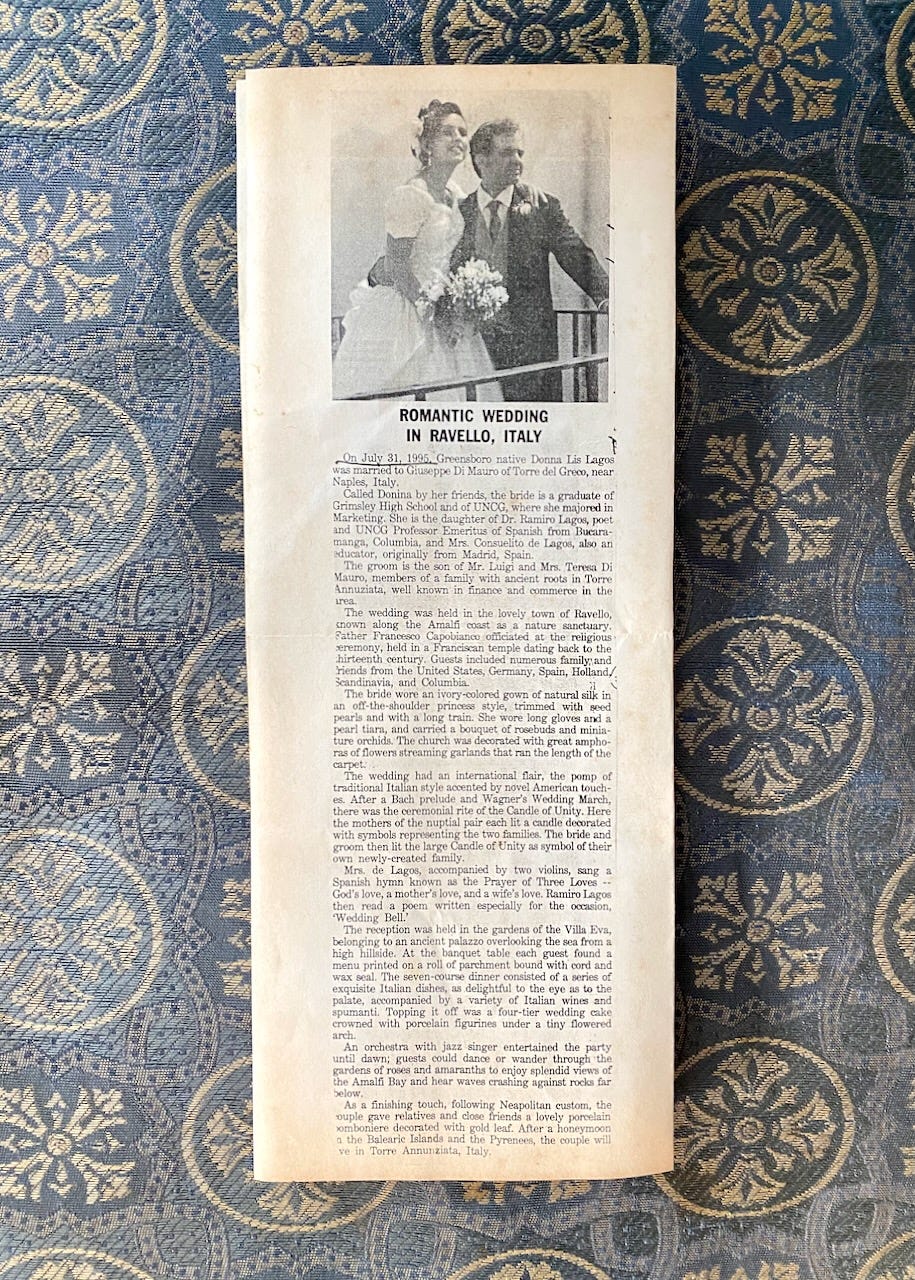
The write-up began, as all epoch-making events apparently must, with the professional accomplishments and status of both sets of parents, as though the Amalfi Coast had required character references. Readers were informed not simply that the ceremony took place in a thirteenth-century chapel overlooking the sea, but that the chapel overlooked the sea in a way that seemed personally invested in the couple’s future. The musical selections were classical, the garlands streamed the length of the carpet, the Candle of Unity, described as though they were the first to invent the ritual, was lit by both mothers, and the seven-course dinner was recounted “as delightful to the eye as to the palate.”
It all felt like prosperity as performance: parchment menus sealed with wax, a celebration that continued until dawn, an accompanying photograph of the couple on a balcony above the Mediterranean, gazing outward like Sophia Loren and Marcello Mastroianni.
But these were not celebrities. They were simply people whose nuptials were a notch above normal. I was so struck by the grandeur of it all, I wrote a counter-announcement that I passed along in my next letter home.
LACKLUSTER WEDDING IN SMALL-TOWN U.S.A.
On January 12, 1994, Betty Sue Poindexter, who has never left the city limits, was married to Herbert Ephram Potts, near the local Quik Stop.
Called Betty Sue by her friends, the bride once received a gold star from her second grade teacher for good spelling. Her parents, Thelma and Archibald Poindexter, still have the gold star on their bathroom mirror. The groom’s family originates from the southern part of the county, where all 96 of them still live.
The bride wore a dress, the groom wore a new pair of Dickies overalls. The ceremony was held in the parking lot of a church which was not open at the time. As a celebration of their marriage, the couple stomped on a Dr. Pepper can which must have blown over from the Quik Stop.
After a honeymoon drive down Main Street, the couple hopes to live happily ever after.
At twenty-something, I thought this was satire. Now I realize it lampooned circumstance more than extravagance. Privilege is a wily thing, isn’t it?
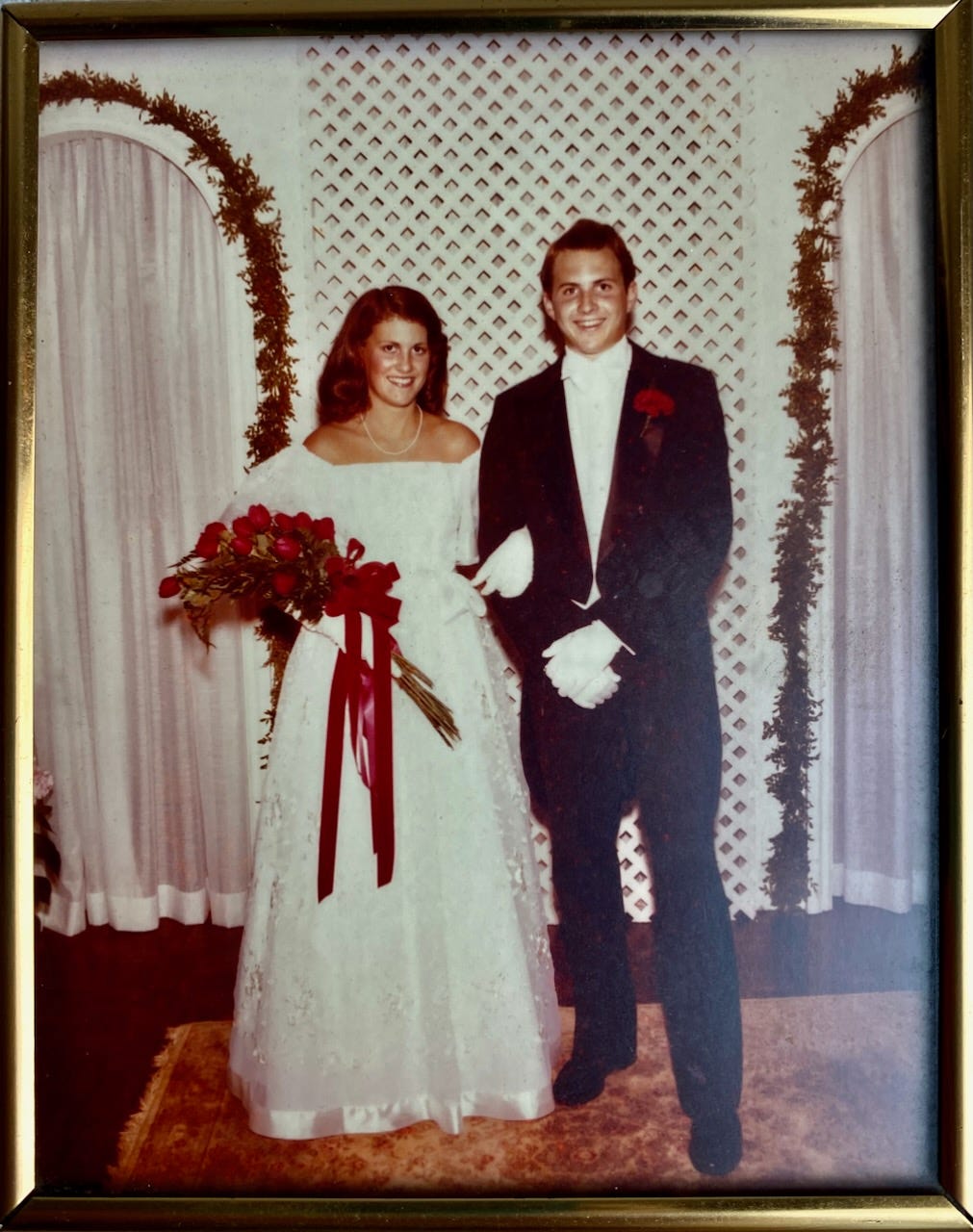
As a late teen, I was a debutante—all glamour, no grasp. The gown I wore for the final ball was antebellum-adjacent, something I didn’t think to question at the time. My brother served as one of my marshals, a title I accepted without once asking what, precisely, he was meant to be marshalling. Girls in white dresses? My virtue? The shrimp cocktail? He did a good job as a ceremonial escort whose chief duty was to not trip over his own feet, or mine. The whole enterprise felt vaguely like community theater for gentility. Looking back, I’m perplexed, a little embarrassed, and relieved that destiny took me a long way from all that.

Our brush with celebrity is fun to revisit, a small square of gloss among other small squares of gloss. A few days from now will mark thirty-five years since that photograph was taken. What stands out to me is not that we once appeared in a style magazine, but how little that appearance had to do with the life that followed. The marriage was no sturdier on account of the ink.
On Facebook, I found the bride from that Italian wedding. Her profile makes it clear that she’s the proud mother of two daughters, that she enjoys her friends, traveling, and spending time with her aging parents—and that she’s divorced. Gauging from her smiles, she looks happy.
Any inclination I once had to trade my life for someone else’s highlight reel is long gone. I can see grandeur for what it is without mistaking it for serenity, and I can appreciate a sea view from any vantage point, including the cover of a romance novel. Happiness is not a luxury good. It shows up where it is welcomed and well respected, chandeliers or not.
If we were to do it all again, and remarkably we would, I suspect the snapshot would look much the same: two people doing their best to appreciate the moment and marveling at what the world has to offer. The rest of it—the shoes that give us blisters, the arguments about how to salt the food, the private griefs, the stubborn devotion, the ordinary astonishment of sharing so much life with another human—was never going to fit on page 28 anyway. And frankly, thank the stars for that.
~Elizabeth
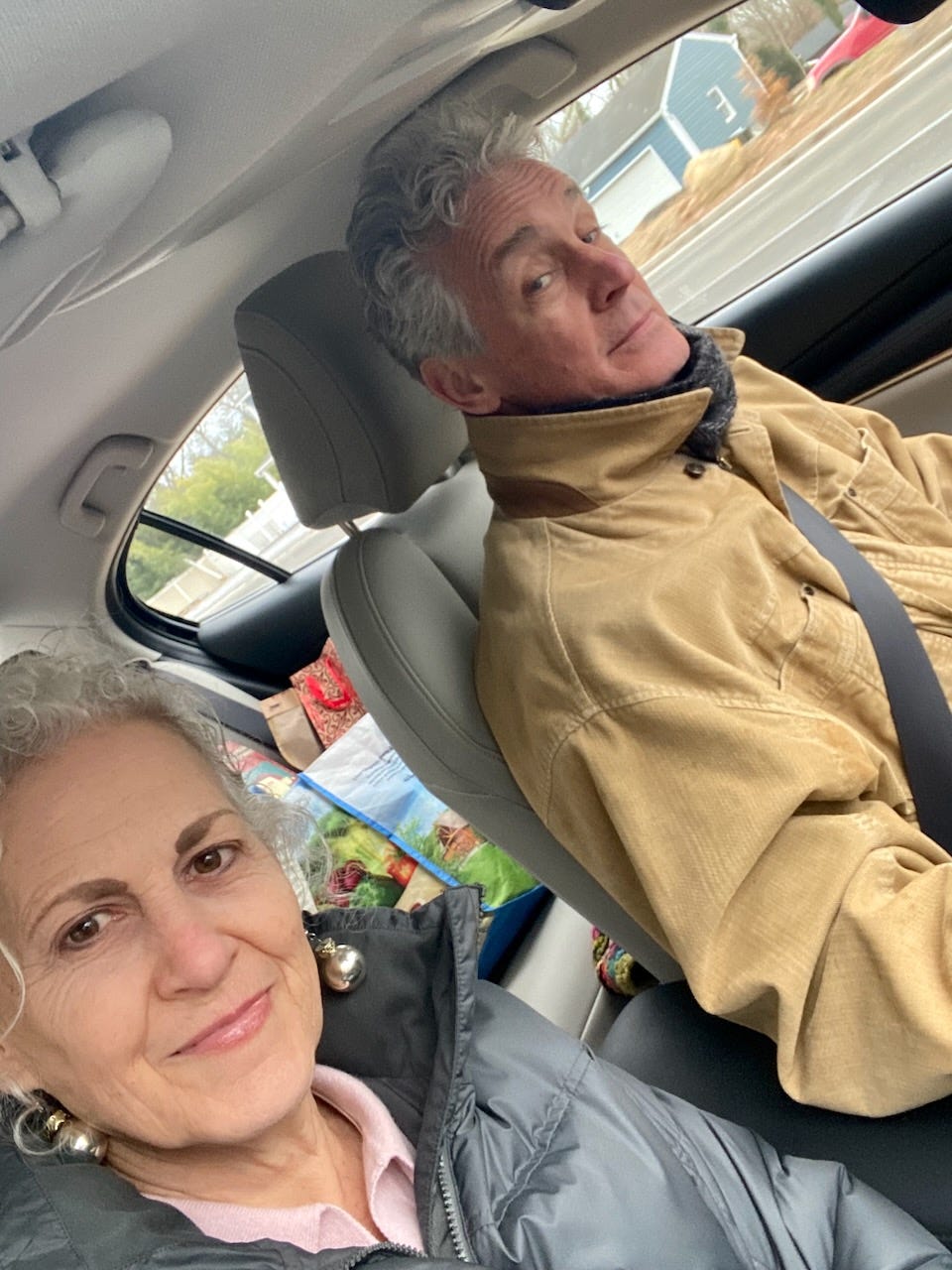

Thanks for reading. And now for the best part of all—comments! Do you know how great it is to get to know you a bit through what you choose to share here?
What wedding memory is most vivid for you?
Which celebrity headline made you roll your eyes this week?
And speaking of headlines, Chicken Scratch hit a Substack leaderboard yesterday—#67 Rising in Literature! These celebratory flashes in the pan are fun reminders that someone, somewhere, is enjoying a little Town & Country moment. Your likes 💚 comments, restacks ♻️ and subscriptions are what make that possible, and I’m genuinely grateful.
Remember, the real spectacle is in noticing the small, unphotographed moments—the ordinary gestures that actually hold life together. So when you walk away from this episode, maybe give one of those moments a nod. Or a smile. Or a tiny, quiet celebration of your own.
AFTERWARD:
I’m including this section as a way to turn reflection into action, if you want. Each week, I’m sharing one small, concrete way to raise your voice, because sustained, visible engagement is one of the few levers we still have to influence the world around us.
TRY THIS:
Write a short note—text, email, or card—to someone whose life doesn’t make headlines but steadies yours. Thank them for something specific and ordinary: how they show up, how they listen, how they salt the food.
I always heard the birth announcements, wedding announcements, and obituaries referred to as the hatched, latched, and snatched section of the newspaper, which pretty much sums up life’s progression.
Thank you for sharing your lovely voice and your memories. I do remember the T&C wedding photos. Though I never married and therefore never made it to those pages, I eagerly read my horoscope each month hoping for the best.