

If listening is best for you this week, an audio recording, read by me, can be accessed here. ⤵️

Some time ago, in a rushed attempt to put together a gift for a friend, I took a picture off my wall and repurposed its frame. It had been part of a collection of farm-centric art: a scene my mother painted in a class she took in her late seventies or early eighties, unsigned and undated, which she said she didn’t think was very good but had framed and hung on her wall anyway. Beside it, a scene I painted as a pre-teen in one of many art classes I took from then through college, signed but undated, clearly the product of a tutorial on perspective. I didn’t think it was very good either, but it hung on the wall of my childhood home all the same. The frame I reassigned held a pair of vintage seed packets that fit in well with the rest of it. The gap in the lower row is now entering its third year.
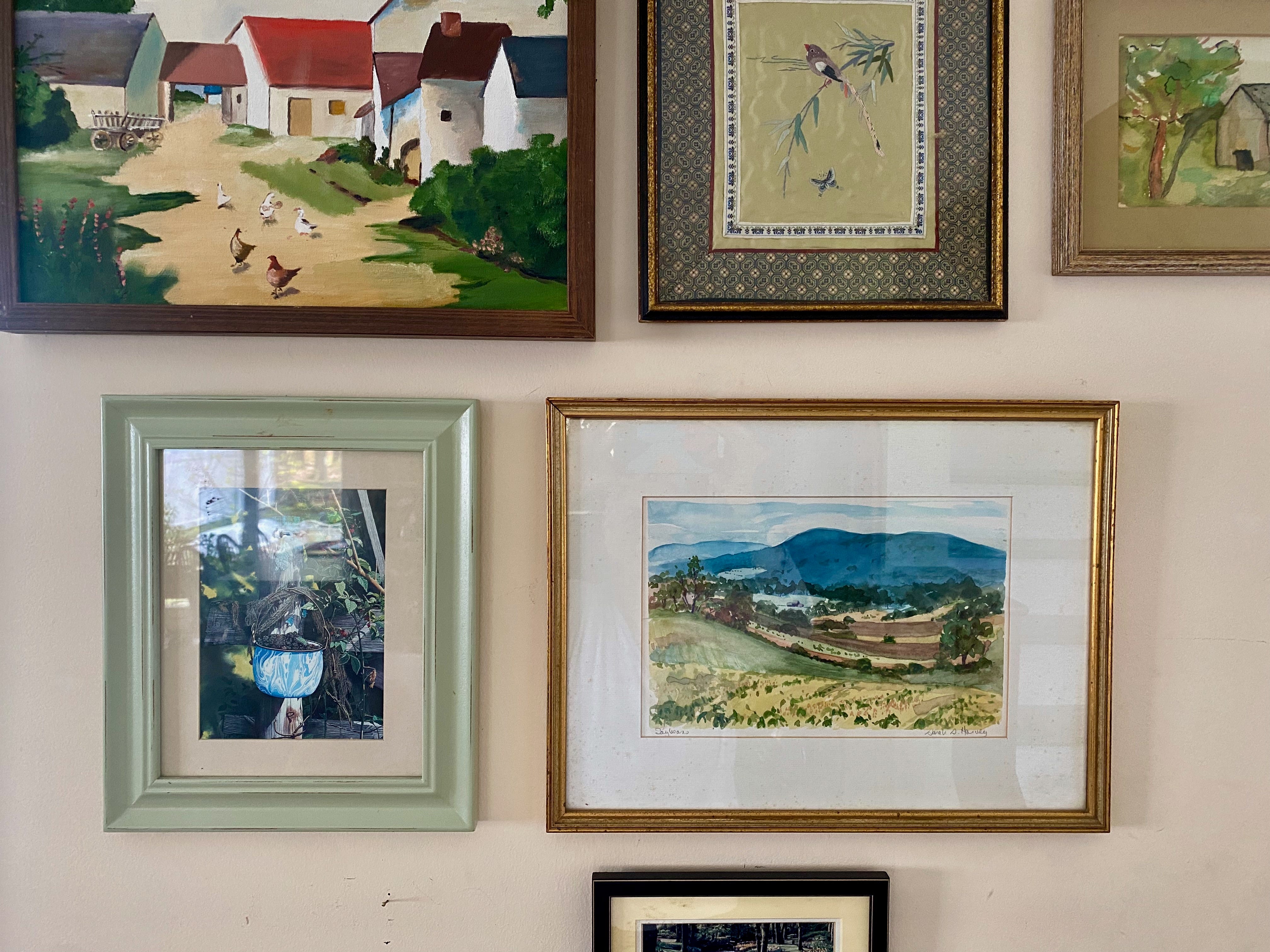
I ordered replacement frames, three of them, not realizing each item was a set of three, so I now have nine of them in storage, enough for all manner of last minute gifts. Don’t judge me if you get a framed photo for your next birthday. What I don’t have is the seed packets. I’ve looked everywhere I can think to look, including inside the four dozen cookbooks on the shelf nearby, because seeds, food, safekeeping—it seemed plausible. The search kept me occupied for a good while.
Many of these cookbooks are gathering dust, the internet having swallowed most of my day-to-day cooking reference needs, and my repertoire having settled into a rotation somewhere between habit and improvisation. But about a third of the books contain that one recipe I return to repeatedly, ignoring everything else the author has to offer: garlicky pasta with tomatoes, white beans and sage; a mushroom curry; pressure cooker potato and leek soup that served us well during the years we lived aboard our sailboat; popovers; a lamb and rice casserole I transcribed by hand from the verbal instructions of a cook at a natural food shop that has since shut down. I stood at the counter to write it while she talked, and it has outlasted both the store and the notebook I pasted it into.
There’s the book I won at a farmers market cook-off, there’s one about canning and preservation, one shared by a group of homeschooling mothers who wanted me to become a more relaxed entertainer. I didn’t. Deborah Madison, Fannie Farmer, Molly Katzen, Marion Cunningham, Julia Child, Rombauer and Becker, Nora Pouillon, Madhur Jaffrey, Anna Tasca Lanza, Craig Claiborne, Oprah Winfrey. I’ve never bothered to look at that last one. Before my mother gave it to me, her dog chewed off a quarter of the cover, and the repair—cardboard and a magazine cutout of the media mogul herself—is frankly an improvement.
Mom also passed along a worn copy of Kitchen Fun: A Cookbook for Children, published in 1952, the year her first child was born. Inside in her practiced cursive, is a purple sticky note. “This old book needs to stay with the new edition, which I hope you still have.” She signed it with a heart wrapped around the letter N, for Nancy. I do still have it, though I don't remember the kids and I trying any of the recipes. Maybe I've just forgotten. At only 26 pages, it doesn't take up much space.
The two editions make an interesting pair. The original Rules for Little Cooks instructs young chefs to “Have mother teach you how to heat the oven.” The 1988 version reads: “Be sure a grownup is nearby to help you.” Grownup, in the name of broader applicability. Several recipes are now removed from the stove rather than the fire, cooled in the refrigerator rather than the icebox. Mammy’s Corn Bread became Southern Corn Bread, a change that is not really about cornbread at all. “Mammy” is a caricature with a well-documented history constructed to make slavery something other than what it was, and kept alive afterward in advertising, entertainment, and the general décor of American domestic life. What a children’s cookbook published in 1988 was admitting is that certain stories are a dangerous kind of fiction. The recipe stayed the same. Whether you call the name change erasure or correction depends on what you think should be remembered, and who gets to decide.


Both editions contain far more sweet recipes than savory ones. The drinks section in each consists only of chocolate milk, hot chocolate, and in both cases, inexplicably, fudge sauce.
My mother hoped, I think, that the book would be special to both of us, and to my kids by association, a through-line, a connection, the pleasure of family, and food, and fudge sauce. In a way she got her wish, though not quite as intended. What I’m drawn to is her handwriting on the sticky note, her small anxiety about whether her legacy had transferred. That turns out to be more intimate than the book itself.
Meaning seems to travel this way—imperfectly, sideways, often without anyone’s explicit consent or intent. I have a lamb and rice casserole recipe because I happened to be standing at a counter when a friendly acquaintance felt like talking. The painting my mother framed without much confidence has been part of my life for decades. The seed packets are somewhere in this house, absorbed into the fabric of accumulated things, and I’ll find them eventually. Or not.
Harder to brush off are the flawed transmissions that aren’t accidental. The meals I ate as a child, in my North Carolina grandmother’s home, were shaped by Black women working in white households, carrying techniques and recipes across generations with no byline and no sticky note. In my case, the cornbread there came from another Nancy—Nancy Boyd—and before her, Lettie. I don’t know what either of them would have called it other than just cornbread.
That knowledge moved through kitchens and hands and was seldom written down, which is one way a history disappears. There are other ways: the gradual mutation of a word here, a name there, until the original contours are hard to make out. And there is the more deliberate kind, where someone with an interest in a particular version of the past decides which parts of it are permitted to come forward. That has happened in every era and is far from finished.
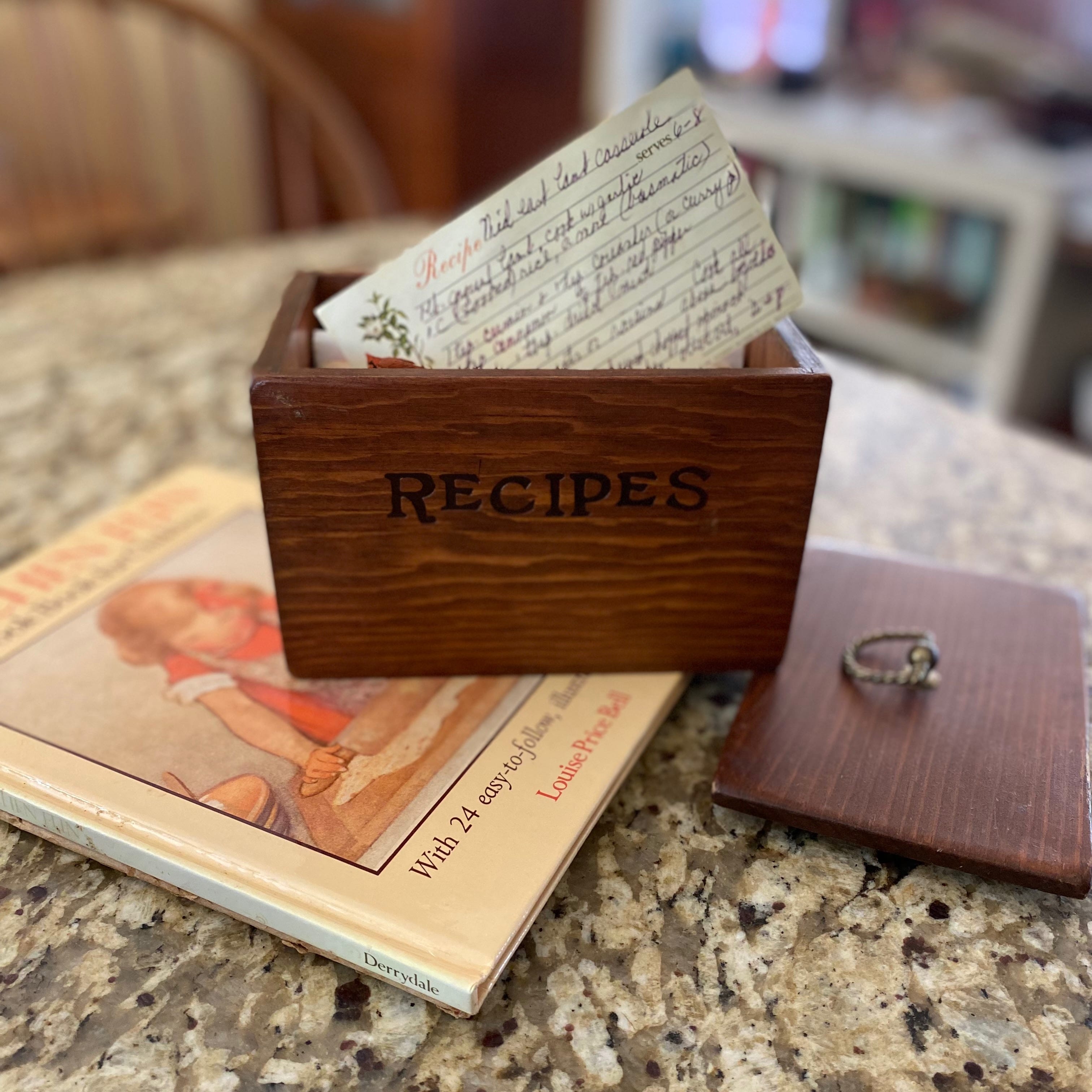
Looking for cornbread recipes, I checked my mother’s collection recently, in the lidded, wooden box that sits next to those four dozen cookbooks. I found an option attributed to her friend Corinne and another for broccoli cornbread, which she made often but not until we were older. I suspect the women who worked for my grandparents would have raised an eyebrow at that one, but I can’t say for certain.
Online, I found a record of Nancy Boyd’s burial in a church cemetery a mile and a half from the 1920s bungalow where my father grew up. They both lived in a town with fewer than 200 people. She was just a few months shy of 90 when she died. The specifics of what she and Lettie made in that kitchen all those years ago are lost to me now.
In the recipe box, I found a card for Mid-East Lamb Casserole, in mom’s familiar cursive, my name tucked in at the very bottom.
~Elizabeth

Afterward:
I’m including this section as a way to turn reflection into action, if you’re so inclined. Each week I share small, concrete ways to make a difference, because our spheres of influence are wider than we sometimes think, and even simple actions have a way of compounding.
Try this:
Share a food memory, one that comes easily, even if it feels small. When you do, name the person it comes from*, the person who cooked it, taught it, or fed it to you. If you’re with others, pause after the name and offer a quiet acknowledgment: “Thank you, Nancy…” or whoever it may be. If you don’t know a name, that’s okay. Name what you do know instead, like the role or the place, your grandmother’s kitchen, the school cafeteria, the neighbor down the street. Food memories are rarely just about food. They come from someone.
* This was a memorable and meaningful exercise I first encountered in a farm conference session led by D’Real Graham. Read more about him here.
And now…over to you, my friends. I’m excited to spend time with you in the comments. 💬
Does any of this made you think about Kathryn Stockett’s book The Help? That makes two of us! But also, tell me:
Is there a dish in your life with a complicated history whose origins you know, or wish you did?
Have you ever been given a memory just in time?
What’s something you’re carrying forward for someone who never got a byline for it?
If this one resonated, I hope you’ll like 💚 and share it. To me, it feels like the kind of piece that wants to find the right readers, so I’m glad you’re here for it.
Restacking is appreciated, and you can do that with the little recycle button. ♻️ Subscribers get weekly posts in their email inboxes, if they wish. And those who can see their way to a paid subscription or to a one-time tip truly help me keep the Chicken Scratch lights on.
My sincere gratitude to you all, no matter how you choose to show up here. See you next week!
Beautiful. I have been pulling handwritten recipes from loved ones I have lost and framing them to hang on my walls and keep those who wrote them a little closer for a little longer.
Memories are often rekindled "just in time"
Here's one! Sleeping in the loft at our old log cabin, my mother decided to start breakfast. She lit the wood stove directly beneath.
But she put the 'chamber pot' which had been in the outhouse, on the stove first!
Guess how quickly we rose!!!