

For those who prefer to listen, here’s ⬇️ an audio version read by me.
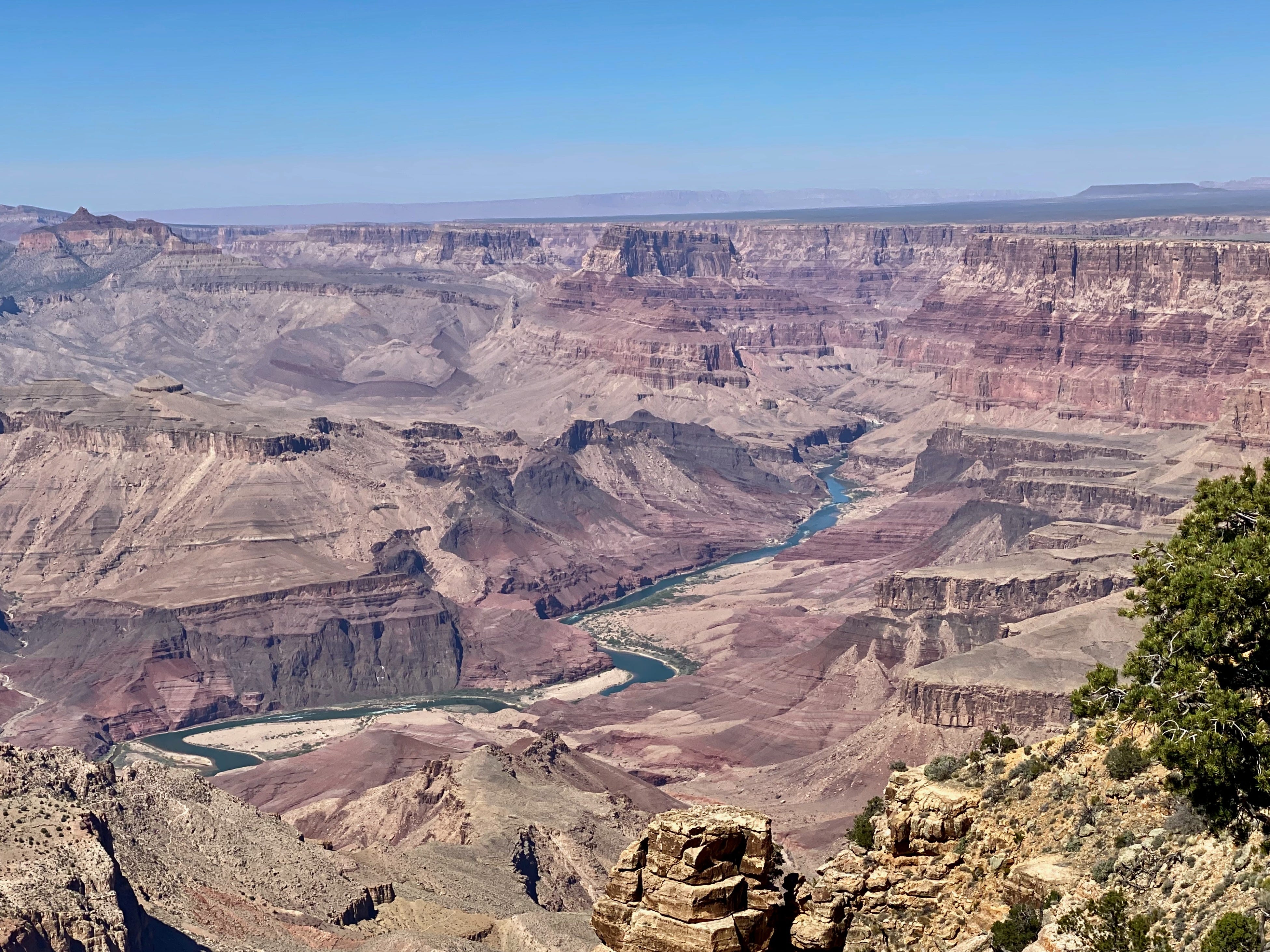
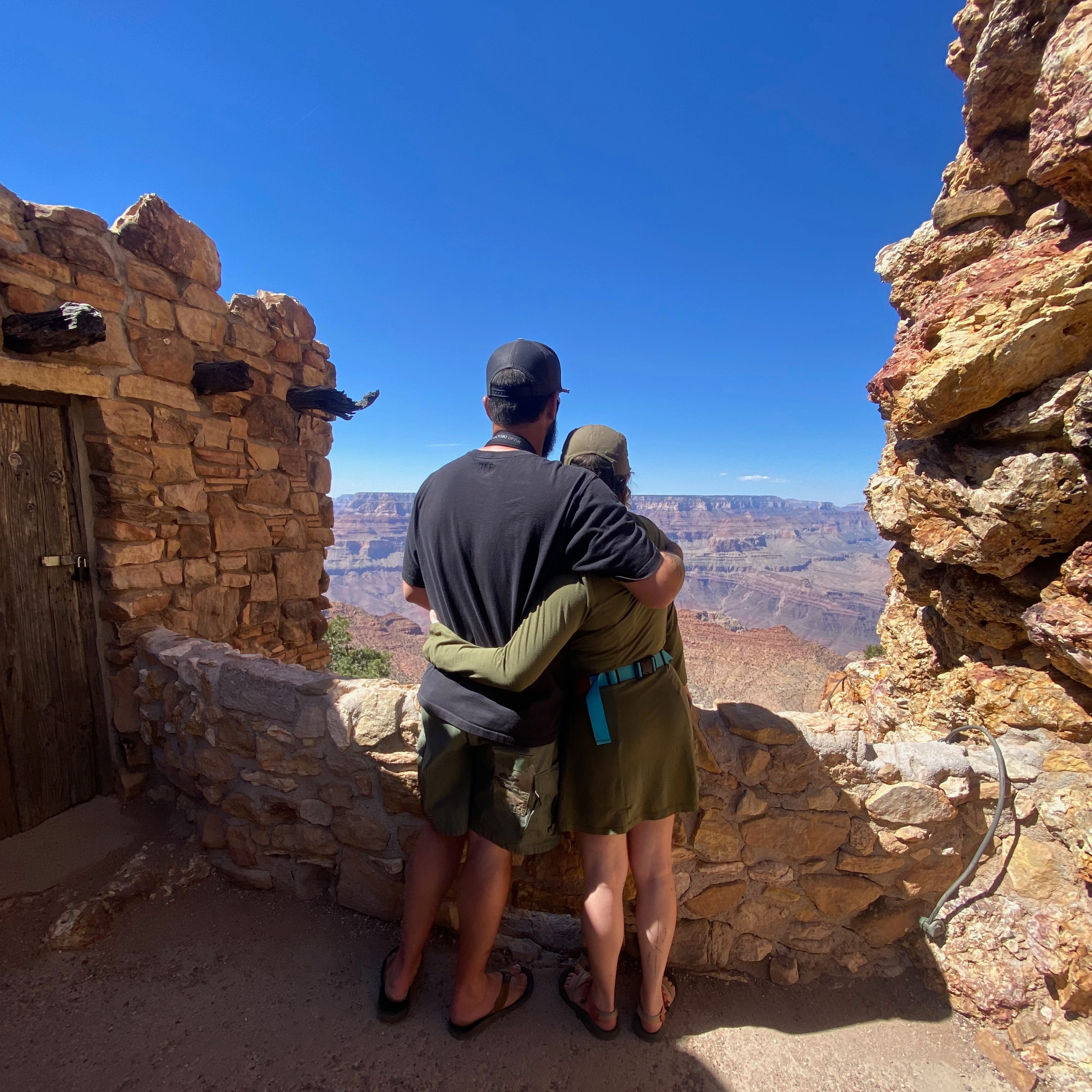
My husband and I flew across the continent last week to spend five days with our older daughter and her partner in Flagstaff, Arizona. It had been more than a year since we’d seen them. This is what family life looks like when your children grow up and scatter. You pack your signs for the No Kings protest into the bottom of your one checked bag, you fly two thousand miles, you soak up the time together, hug them hard, and then you come home.
I would not trade those five days for anything. I also can’t help noticing what I’m missing, in the larger sense: the proximity, the drop-in culture, the assumption of nearness some families take for granted that we can only approximate with flights and careful scheduling.
The four of us drove back from the Grand Canyon on a two-lane road less suited to those in a hurry, and I was grateful for that. It cut through the southwestern corner of the Navajo Nation, and I found myself pressing my face toward the glass the way I did as a child on long car trips, trying to take it in.
By the metrics we usually apply to landscapes, there isn’t much there. Miles of desert scrub under a sky so unobstructed it’s like driving across Mars; simple wire livestock fences tracing a pencil-thin line between the road and the beyond; modest structures planted on dry soil that look impossibly isolated, save for a few clusters that give the appearance of small neighborhoods; along the roadside, stalls for folks selling native crafts, punctuated by billboards for gun shops.


The Navajo Nation stretches across 27,000 square miles of Arizona, New Mexico, and Utah, an area roughly the size of West Virginia, or Scotland, or Tasmania. It is the largest Native American reservation in the United States, and the federal government has spent the better part of two centuries making clear how little that matters.
The numbers, when I looked them up, have the flatness statistics always have. They don’t put human faces behind the one in three homes that lack electricity and running water, or convey that these families drive, sometimes miles, to fill barrels and jugs to haul home. On average, those living on the reservation use roughly seven gallons of water per day, compared to the average American’s eighty to a hundred. There are only around a dozen supermarkets in the entire territory. Unemployment runs as high as 50%.
And yet, despite the poverty and lack of modern services, there is a particular kind of life that comes from being rooted to the land and to each other. A Navajo commenter I came across put it this way:
“The desert and the wildness bring a peace that convenience cannot understand…We've lived here from time immemorial, and our songs and beliefs are tied to the land. So we stay because we want to.”
I catch the vaguest scent of that in the March wind.
Where I live, there are still watermen who work the Chesapeake Bay the way their fathers did. For them the estuary is more livelihood and identity than science, or scenery, or recreation. Belonging to a place and way of life can be a form of wealth.
The essential difference for the Diné—the name the Navajo use for themselves, which translates roughly to The People of the Earth—is the history of trauma layered beneath that belonging. Most people rooted to a place weren't marched off it at gunpoint, or made to win back their homeland from the people who had nearly destroyed them. Their children weren’t stolen and sent to boarding schools with explicit instructions to strip away their language.
In World War II, the Navajo gave their country something only they could give: an unbreakable code built from a language the government had spent decades trying to destroy. That service was classified until 1968. The original Code Talkers did not receive the Congressional Gold Medal until 2001, nearly sixty years after the war ended. And in 2023, the Supreme Court ruled five to four that the federal government has no obligation at all to help the Navajo Nation access water.
I think about what has been taken from the Navajo, and then consider how easy it might be to reach for what numbs the pain. Alcohol and drugs are readily available and fill the voids made by settler hands. The Diné have a genetic predisposition to addiction that compounds generations of damage. Of course they do. We should stop being surprised by what deliberate erasure leaves behind.
But that is not the whole of the story, and it is not where the spirit of these people lives. What I felt driving through the Nation was a sense of the desert as a presence with its own gravitational pull. The Diné concept of hózhó—balance, beauty, harmony—is one that knows hardship intimately and has always found a way to reach across it. Clan connections, reciprocity, devotion to the land and to each other are as vital as breathing.
Now that I'm back on the Bay, the contrast is even more evident. We fly across a continent to hold our family together across distance. The Diné have always understood family as inseparable from place, from the land itself, from the tribal framework that tells them exactly who they are and who they belong to. From the road, to someone like me, it can look like desolation.
But the desert doesn't give itself up that easily. It holds what it holds, and so do the people who call it home.
~Elizabeth
Resilience is easy to admire from a distance. Harder, and more interesting, is thinking about what it actually costs and what it makes possible. So much of the Diné’s resilience is inseparable from the land itself. Which makes me wonder:
Is there a place you’re rooted to, or wish you were? Somewhere that holds you and tells you who you are?
And how do you hold family together across distance? What are the rituals, the small things that substitute for proximity? I’m always looking for ideas, and honestly, for company in the feeling.
If this resonated, I hope you’ll consider leaving a comment, sharing the post with friends, restacking it (find this button ♻️), or leaving a small tip. It all helps me reach more readers and is a driving force that keeps this space going. And if you’re not yet a subscriber, I’d love to have you join me here.
Afterward:
I'm including this section as a way to turn reflection into action, if you're so inclined. Each week I share small, concrete ways to make a difference, because our spheres of influence are wider than we sometimes think, and even simple actions have a way of compounding.
Try this:
This week, pay attention to your water use. Just notice it, without judgment. And if you find yourself moved to do more, DigDeep works to bring clean running water to communities without it—on the Navajo Nation, in Appalachia, and in communities along the Texas-Mexico border. Even small contributions matter. For readers in other countries, the equivalent search would be for your regional water access or drought relief organizations.
See you next week!
Beautifully written as always, Elizabeth! Next time you go, which I understand may be years… Though I hope not, I can’t strongly encourage you enough to go deeper into the Navajo nation to the Hopi nation that is located within the Navaho lands. There you will find villages called first second and third Mesa. First Mesa has been in existence as a village for hundreds of years.. You can do a guided tour and it is an original village. It is remarkable.
Sense of place is indeed incredibly important!
Taproots find water,
eventually, so we hope.
Inconvenient truths.