

Prefer to listen? You’ll find an original audio recording here. ⤵️
In a matter of hours, our latest heatwave will turn the air into something closer to molten, but it is still early in the morning and comparatively cool when I take myself to the community garden to water my two beds and toss a little fish emulsion at the cucumbers, whose yellowing leaves tell me they’re hungry for something.
I see that the rabbits, undaunted by the bricks I positioned to keep them from climbing under a loose edge, have chewed a hole in the new fencing, helping themselves to a third planting of beans. Most tomato plants are doing well, but several are dwarfed and misshapen.
The lettuce plants, now three feet tall and given over to reproduction, provide a tower of flowers for bees of all sizes. If I leave them in place long enough, seeds will form, then scatter and germinate without much extra effort from me. This is the point. I am a gardener taking full advantage of an opportunistic kind of sowing, though it looks for all the world like I don’t know what I’m doing.
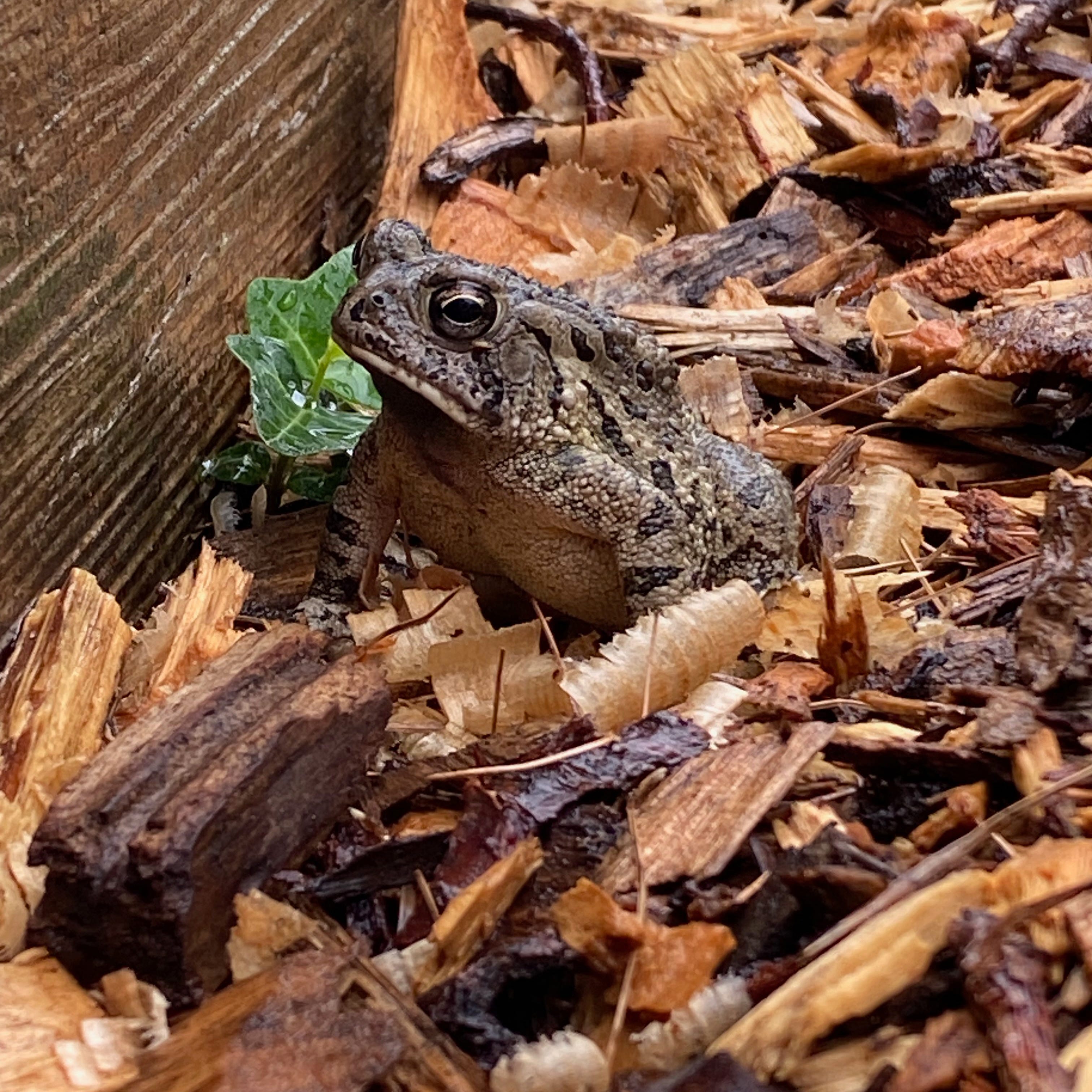
I am about to head home, to breakfast, and my husband, and the one unhurried morning we have together most weeks, when a toad leaps into the spray of the hose and stops, blinking. I see her throat pulsing and realize she’s having a drink.
It takes some looking, once I am home, to learn it is a Fowler’s toad. Commonly mistaken for American toads, the difference comes down to the number of warts clustered in each dark spot on their backs. More than one or two, it’s the former, according to every source I find except one herpetologist in Virginia who’s convinced it’s not that simple. He’s not wrong. He maintains that wart count is a symptom of the difference and not the difference itself, or something like that. The two species hybridize often enough that a given toad might sit anywhere on a spectrum rather than cleanly on one side of it.
It’s the patronizing, mansplainy certainty he wears while making his case that puts me off. At one point, he goes so far as to tell his readers to calm down, a directive made safer, I’d guess, by the fact that his comments section is disabled. I can’t remember the last time, or any time, I calmed down after being told to do so. It occurs to me he might be a toad who only recently got his kiss, new enough to being noticed that he hasn’t learned how to do it without insisting on it.
The actual toad is named for Samuel Page Fowler, a nineteenth-century man from Danvers, Massachusetts, who joined every cause his town had to offer: overseer of the poor, selectman, delegate to the state’s constitutional convention, first deacon of his church, trustee of the local bank and library, a fire warden, a historian of his own town’s witch trials. It’s a strange thing, learning that a damp, warty creature carries the name of someone who appears to have spent his entire life indoors, building institutions out of other people’s attention. Nothing suggests he ever once waded into a garden bed to watch a toad drink, but it’s possible he did that off the record.
The toad, for her part, wants only the water. Captivated by her bumpy unbotheredness, I find myself murmuring, in the cadence of William Carlos Williams, an apology to my husband, whom I assured, upon leaving the house, would see me soon.
I have lingered
in the garden
to shower
with a toad
though you
were probably hoping
I’d be home
by now.
Forgive me.
She was
so alive
and so thirsty.
She didn’t answer, of course, just turned her face back toward the wooden frame of the bed, then walked backward into the soaking mulch until the crown of her head, like a stone, was all that showed.

Thousands of miles from my garden, male Asian common toads are usually a dull, unremarkable brown. But when the first monsoon rains fall across their part of the world, the males flush a sudden, startling yellow, a color that lasts only about two days before fading back to brown for another year. Researchers recently confirmed why: in the crush of the breeding pool, with hundreds of toads scrambling at once, the vibrant alternative makes it easier for a male to tell, quickly, which shape nearby is actually a female.
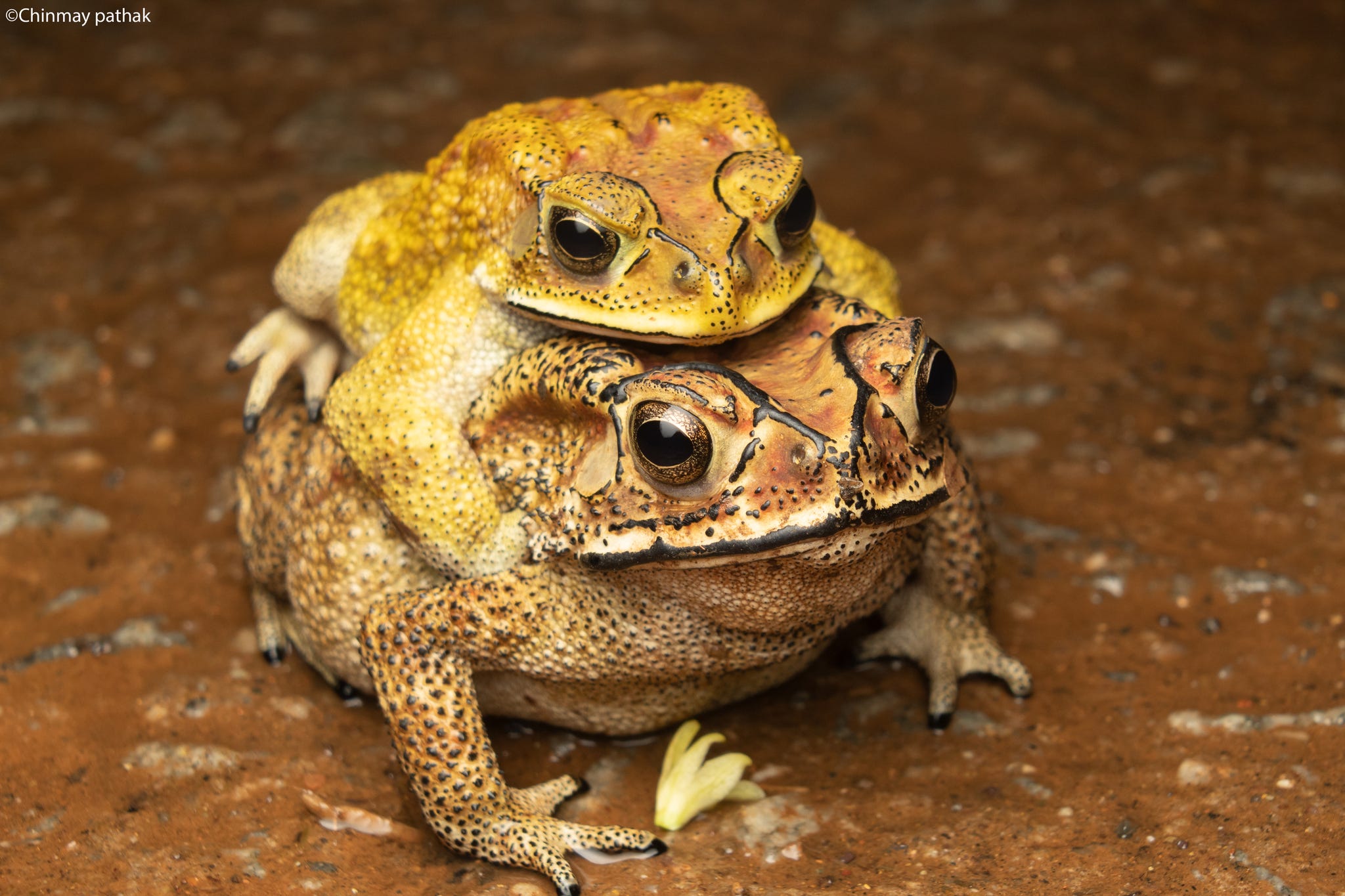
Without it, urgency wins out over accuracy, and the male toads grab at almost anything within reach—other males, nuts, fish. Scientists set out doppelgangers, painted decoys, some yellow, some brown, among the chaos of these breeding toads. The real males ignored the yellow replicas almost entirely, mounting brown ones far more often.
I recognize that scrabble, minus the canary-colored exuberance. We have a limited number of days in which to make our presence on the planet matter. As humans, we can’t know what it’s like to be an amphibian among many, or whether there is any similarity in our urges. But we are all driven by our own desires. I get the sense that what we’re reaching for isn’t really the object nabbed in the crush of the pool. It’s connection, acknowledgment, some proof that another creature can tell we’re right for them. Maybe that’s what sent Samuel Page Fowler into every institution his town would let him join, longing dressed up as usefulness. It could also be what compels a man in Virginia to assert his authority like a rooster at 4 a.m.. If you’ve gone unrecognized for a day, or a year, or a lifetime, you might seize onto something adjacent instead.

Gathering my basket of tools and watering can, my now empty jug of fish fertilizer, I think about how far my husband and I are from our own version of these seasons of consequence—the drink in a heatwave, the raving toad orgy—when a missed opportunity might have cost us more than we could afford to lose. Potable water flows from a filtered tap at our kitchen sink. We share our discoveries and frustrations, we repeat our stories. We’ve been together a long time now and know how to identify each other.
On a Sunday morning, chores mingling with conversation, our love is made tenderly and in no particular hurry, two people who have the luxury of quenching our stubborn thirst.
~Elizabeth
Afterward:
If you’ve been here for a bit, you’ll know that I like to end with small and actionable ideas, to give us all something to swim toward. I’m convinced it matters.
Try this:
Find your toad. Outside in the yard, in the sidewalk crack, in the office parking lot (it all counts) find one overlooked living thing and give it a drink of your full attention for a few minutes. No phone, no multitasking, just you and whatever’s there for you to have a conversation with. Who knows? It might inspire a poem.
I stand by the toad. I will always stand by the toad.
Now, dear readers, allow me to bring you a glass of lemonade and a comfortable chair over in the comments. It’s such an inviting space!
Is there someone in your life who is really good at recognizing the color of you?
Have you grabbed at something recently that turned out to be the wrong shape entirely?
What are you thirstiest for these days?
This kind of writing takes time and dedication—noticing, drafting, refining, and occasional arguments with the websites of complete strangers. 😅 If you can help me keep Chicken Scratch going, becoming a paid subscriber is the most direct way to offer support.
A one-time tip does the job, too, if the commitment of a subscription makes you jumpy. 🐸
I respect and appreciate all the ways you show up here. I’m just glad you do, and hope you’ll encourage others to find their way here by liking, 💚 sharing, and restacking ♻️ these essays.
See you soon!
Toads mate, mansplain, croak.
Thirsty for attention all.
Some just need water.
Wow!!! "Toadally" captured my attention this morning... I love toads.... And I will now become a more observant fan... Just now I returned on this early morning Wednesday from my vegetable garden... Did not see a single toad.... But after scratching around in my beans I did see an unusually strange jumping-like worm... I looked it up and was told by a worm authority on AI that it's possibly one that would damage my crop... I wonder if everyone else knows about this worm.... Maybe it could become the Barry worm... But then again I would only wanna be a nice worm..namesake 😁