

If you prefer listening, I offer an audio version here. ⤵️

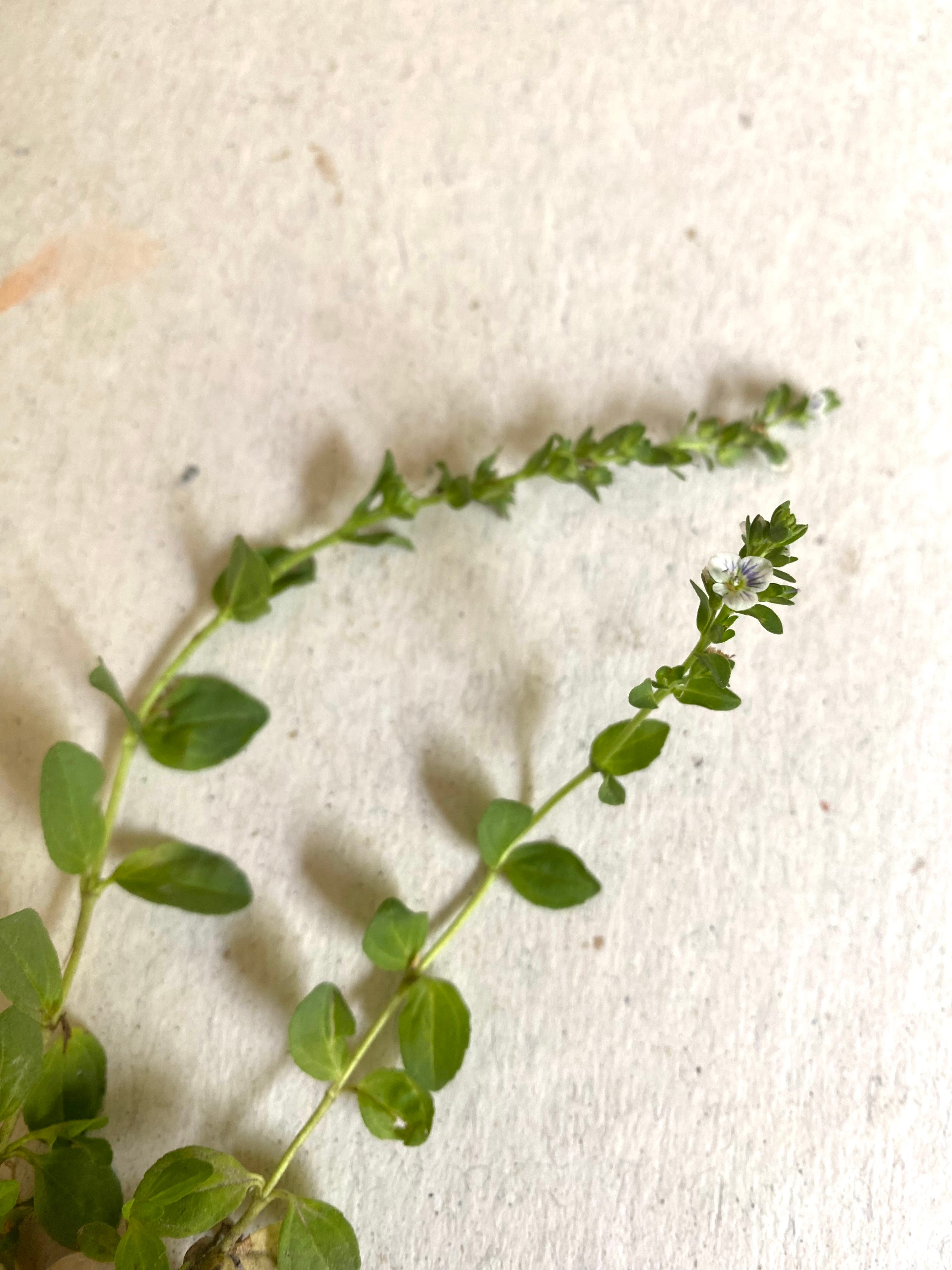
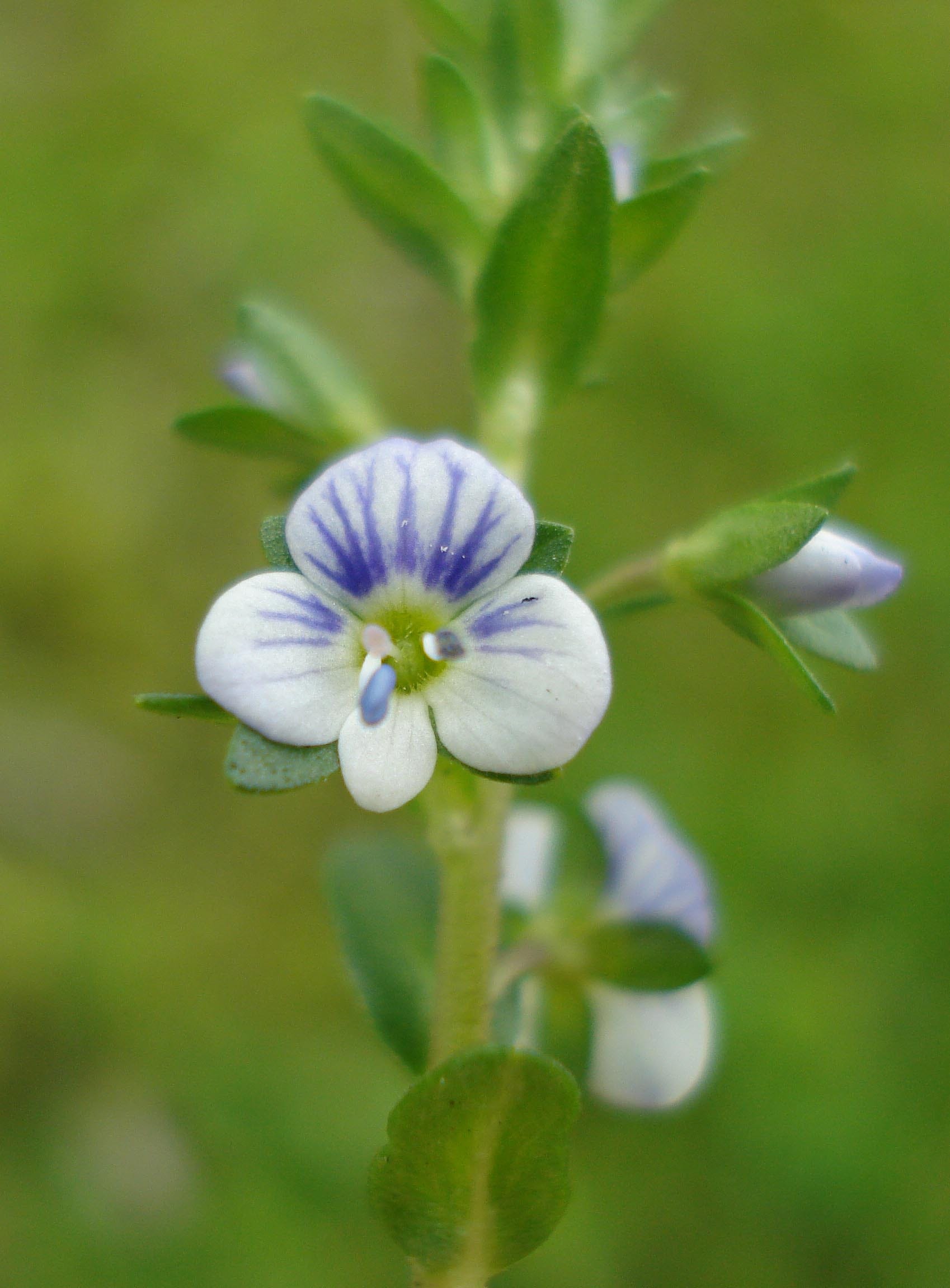
There is a plant threading through my yard that has been in North America longer than the United States has existed. I crouch down to look at it on the way back from hanging a load of wash and find a stem no thicker than a piece of string, paired leaves that I imagine as a ladder for a tiny beetle, and a flower so small I have to bring it inside and grab my magnifying glass to see it properly. Four petals, white shading into pale blue, with violet veins converging at the center like tributaries feeding a sunlit lake.
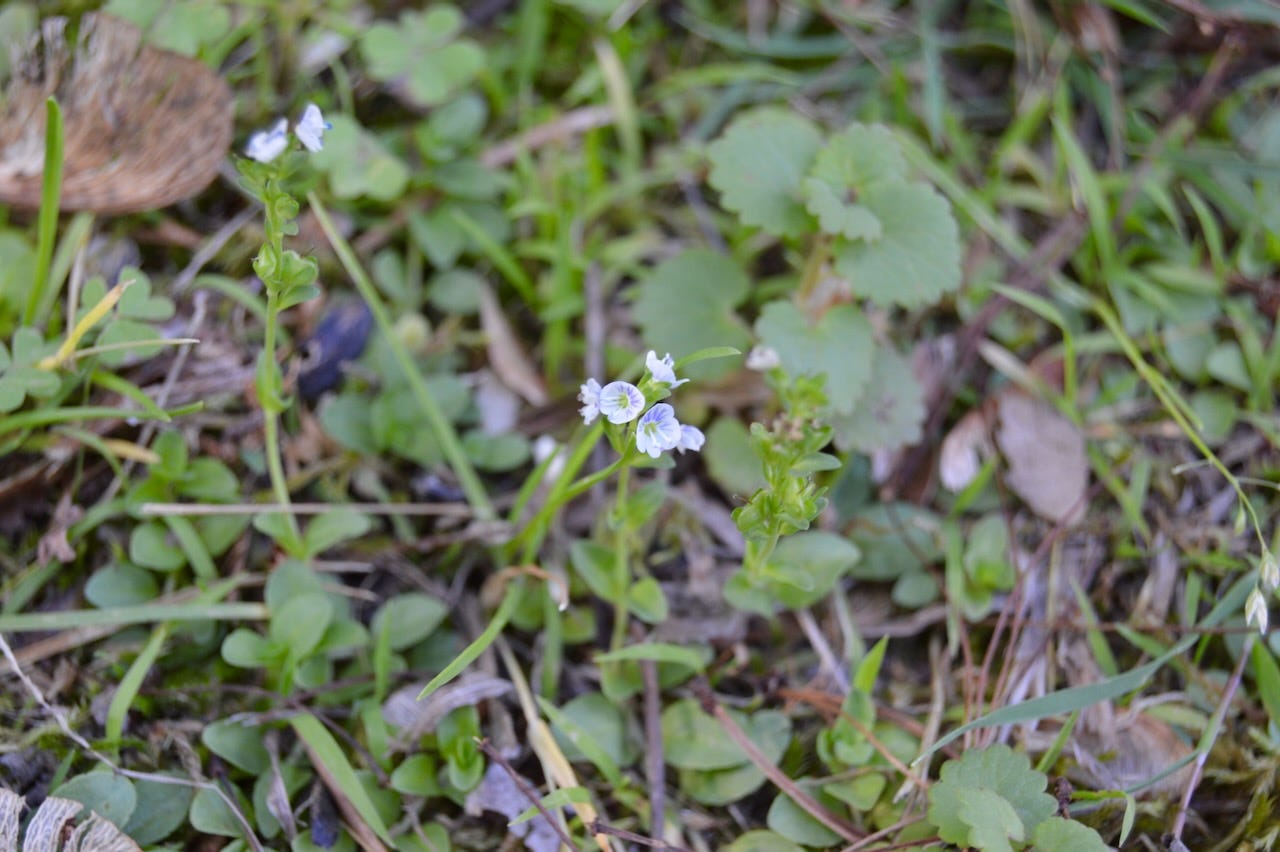
Identifying it as a type of speedwell was easy, but it took much longer to home in on which one. Some are native, some naturalized, some hybridized. I pored through the details of two wrong guesses before landing on Veronica serpyllifolia, thyme-leaved speedwell, a plant that arrived on this continent with the earliest European settlers, almost certainly on purpose. It was used for respiratory ailments, for skin conditions, as a tonic for the general difficulties of being alive in a harsh new place. Someone packed it deliberately, having learned through long experience that it was worth having nearby. Four centuries later, it has naturalized so thoroughly that it’s now thought of as a weed, which says more about our appetite for monocultures and control than it does about the plant’s value. As it turns out, a native speedwell also grows nearby, the two of them winding through the yard together, unbothered by the question of who got here first.
The name speedwell is thought to come from an old farewell blessing, speed thee well, associated with safe travel and quick healing. The plant was embroidered on handkerchiefs, pinned onto lapels, tucked into pockets. It was the kind of thing a person carried because they understood that protection arrived in many forms, and that you could not always predict in advance which ones you would need.
Scientists have a name for what those settlers understood instinctively. It’s called the Insurance Hypothesis, and it holds that biodiversity functions the way a well-designed insurance policy does: its value isn’t obvious until something goes wrong. A diverse ecosystem has what ecologists call functional redundancy, meaning multiple species perform overlapping roles, so that when one is stressed or lost, others absorb the work. The system doesn’t unravel because no single thread is responsible for holding everything together. The biologist E.O. Wilson, in his 1992 book The Diversity of Life, wrote that biodiversity "has eaten the storms, folded them into its genes, and created the world that created us. It holds the world steady."
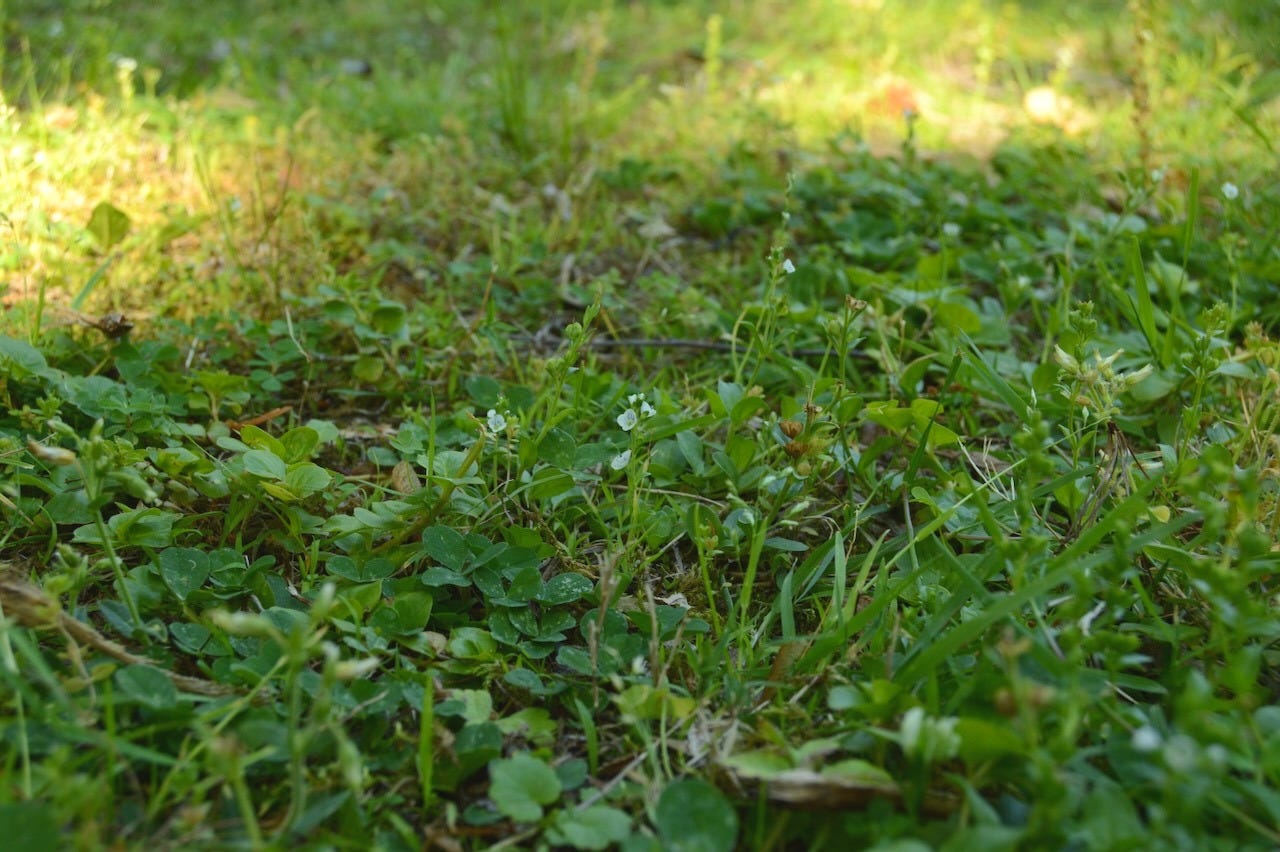
The Insurance Hypothesis is a story about what holds up when things go wrong. It is less interested in what was happening before the crisis, in all the unremarkable daily exchanges that made the system worth saving. The diminutive sweat bees and flies visiting those violet-veined flowers—veins that turn out to be landing guides, the flower’s way of saying here, here!—aren’t providing a service to the plant in any transactional sense. They are participating in something ancient and interwoven. The plant, and the bee, and the soil, and the rain, and the human crouching down to look aren’t separate things that occasionally interact; they are a system that cannot be understood by only examining the parts.
A monoculture is what happens when we decide, or allow systems to decide for us, that only certain species belong. In agriculture, the familiar consequences are thousands of acres given over to corn, or wheat, or broccoli and a resulting catastrophic vulnerability. Every one of those plants shares the same genetic weaknesses, and a single blight or pest can take them all down. And monoculture logic doesn’t stay in the field. It moves into yards, into policy, into the stories a culture tells itself about which things are essential and which are expendable, about which presences are load-bearing and which ones the system can do without. The problem is that no one really knows which is which. The species doing nothing visible in an ordinary year may be the one the whole system is waiting on when something goes wrong—a yeast no one is tracking turns out to be the only organism capable of scrubbing mercury from a Pennsylvania watershed. Subtle is not the same as without function.
Most people aren’t making conscious decisions against biodiversity. They’re participating in systems designed to make ecological consequence invisible, to push it to the microscopic, the distant, the delayed, the someone else’s problem. Industrial agriculture, suburban lawn culture, the supply chains behind every flat of annuals at the garden center in May (and I am no stranger to that seasonal tendency) function best when you can’t see what they’re costing. Efficiency and health aren’t the same thing, as fifty years of ecosystem research makes clear.
Recently I visited Melody, a woman I’ve come to know through my writing here, whose yard is a designated Bay Wise property. She has committed to managing it in ways that support the health of the Chesapeake Bay watershed, a region so networked with waterways that nearly every resident lives within a half-mile of a tributary. I brought her two plants from my yard; she had collected four or five species in nine or ten pots for me. Standing in her garden felt like standing in the middle of a demonstration against the idea that any one thing is dispensable. There was no lecture or virtue signaling. She was just tending what she felt belonged there and passing pieces of it on, which is how this has always worked—when it worked.
Among the containers we nestled into my trunk that afternoon were a pair of giant purple hyssop plants, one significantly larger than the other. I decided to put the smaller of the two in the ground just as our long, cool spring suddenly turned the corner into summer. The heat came on fast, but the plant looked like it would pull through until a rabbit, which I watched from my kitchen window, stood on its hind legs and methodically chewed off all the leaves.
In a frustrated search for novel deterrent ideas, I came across something I hadn’t considered before: transplants are especially vulnerable not because they lack defenses, but because they are still re-establishing the resources that make those defenses effective. A plant that has been in place long enough has rebuilt its underground network, its water balance, and its capacity to recover quickly from damage. A new transplant has all the same mechanisms but lacks the reserves to sustain them once challenged. It needs time in the ground before it can defend itself, and it needs external support in the meantime.
My yard is less of a lawn than it is an experiment. Except for potted plants, what grows here is what shows up every spring, as nature designs. I do what I can to pay attention, to ask questions, to listen and learn. When conditions grow too harsh, I offer a hand, just as I’d want someone to do for me. We are travelers among travelers, threading our way across disturbed ground, the visible edge of a vast and breathtaking network. Speed thee well.
~Elizabeth
Afterward:
Each week I close with something small and doable, because I believe in the power of tiny actions taken by a lot of people. Our spheres of influence are bigger than we give ourselves credit for, and doing something, however modest, beats the paralysis of feeling like nothing is enough.
Try this:
Next time you’re outside, crouch down and look at something growing that you didn’t plant. Take a photo of it. Download the iNaturalist app (free, iOS and Android) or visit inaturalist.org for help identifying almost anything you point it at. Then, if you want to go further, find someone nearby who grows native plants and ask if they have anything to spare. The exchange itself is the point.

I have to tell you that when my husband came home and found me lying face down on the grass, he wasn’t at all sure what to make of it. The things we do for love, right?
What’s growing near you that has a great story? Do you have a Melody in your life? Is there a place where you’ve watched the logic of “weed management” do its damage, or somewhere you’ve seen the opposite—where diversity is holding something together that might otherwise have fallen apart? The comments are a good place for all of it, and I truly appreciate every one.
If this essay found you at the right moment, passing it along might do the same for someone else. A heart 💚 or a restack ♻️ helps more people find their way here.
Chicken Scratch shows up week after week because you’re here for it, free or paid. If today’s the day you become a paid subscriber, or leave a one-time tip, I’d be honored. Every bit of support keeps this space going and means so. dang. much! I’m grateful for you, always.
See you soon.
Naughty rabbit!! But this plant obviously served ‘him’ well too, so we can’t really complain. ‘Weeds’ are such a funny thing. Things that grow where we don’t want them to grow. We have glorious vivid yellow-flowering wattles here in Australia that are deemed weeds in some areas and are just a total joy in others. And then there’s serrated tussock which takes over paddocks and leaves animals starving as there’s absolutely no nutritional value in its foliage. Nature’s a funny thing. We just need to understand how to work best with it because it will always win out in the end. Another lovely read. Thanks so much.
This felt like listening to a sermon in church. Only maybe better than listening to a sermon in church. Nearly 15 years ago, I found a book in the library about replacing front lawns with more diverse gardens. It wasn't such a common idea then. I brought it home with me and shared it enthusiastically with my husband. We'd just bought a house in a suburban town, and to him the idea was preposterous. Now, we live in a city neighborhood. That house, too, had a front lawn when I bought it, but it doesn't now. It's a mix of natives and other kinds of plants that I probably wouldn't choose now. My knowledge and understanding is evolving; it's nice that the garden can evolve with it. I so appreciate writing like this, that helps me with that growing I need to do.