

Prefer to listen? You’ll find an original audio recording here. ⬆️

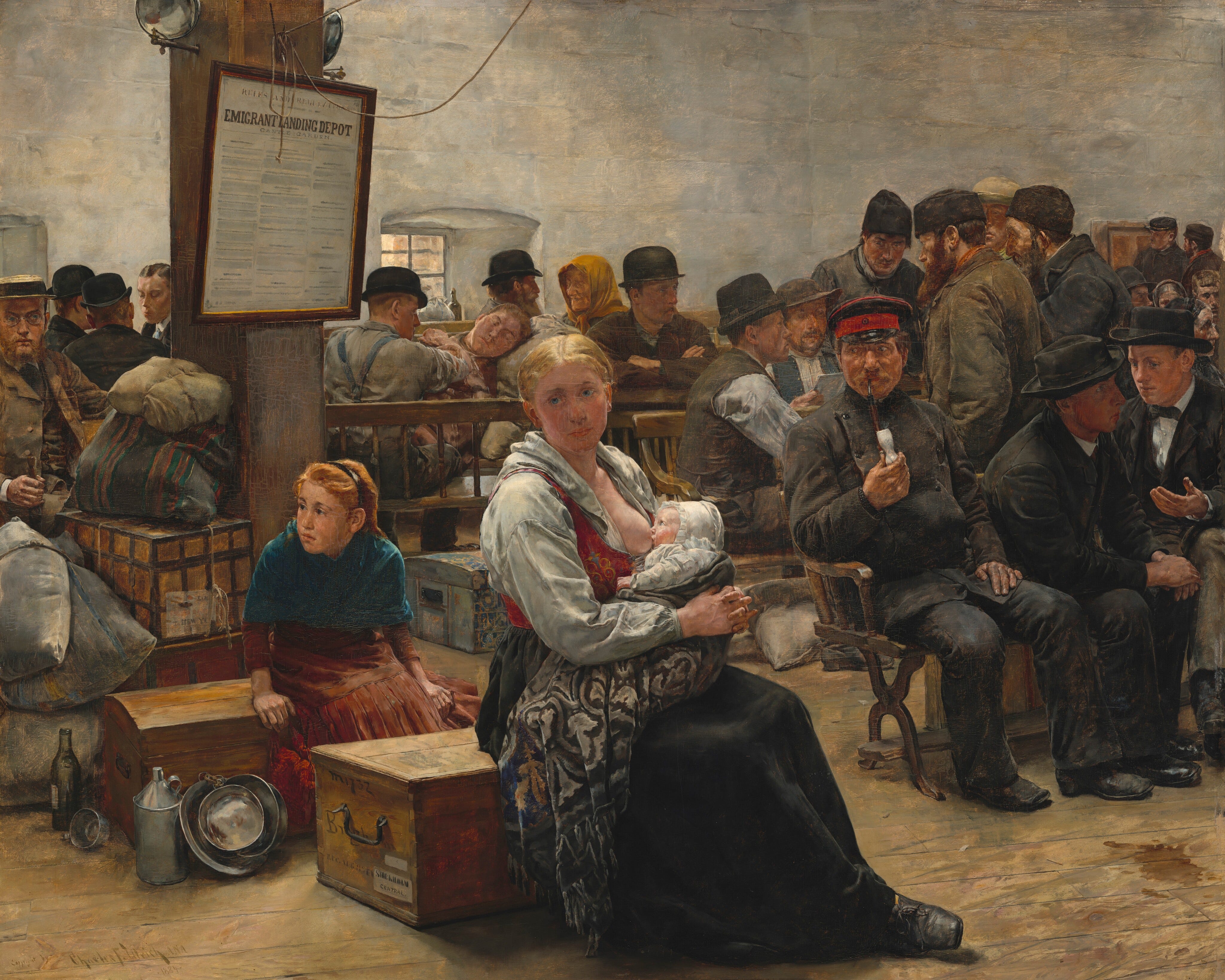
My whole adult life, I’ve believed that immigration is everyone’s story. Trace a family back far enough and you’ll find people who left their home with a bundle of hope and not much else. My husband and I have roots in England and Scotland, Ireland and Germany. You’ve likely got your own version of how you came to be where you are. We are, most of us anyway, the residue of others’ enormous leaps of faith.
So when the news overflows with images of people being plucked off streets and out of government offices, people who showed up to routine check-ins, who’d lived here for decades, I ache for them and their families. I write checks, sign petitions, feel the helplessness of seeing horrible injustices unfold but still go to sleep as I do any other night. You might call it privileged awareness.
The deaths force me to reckon with privilege more directly: 31 people died in ICE detention in 2025, the highest number in two decades. One man succumbed to a tooth infection because no one arranged a dentist appointment. Still, it took my daughter’s phone call from the lobby of a consulate office in Perth to make the stakes feel terribly personal.

She had been living in Sydney for a few years when she met and fell in love with a Brazilian man. They moved in together in a matter of weeks, building the life of young people who are far from folks who love them, sustained by each other, optimism, and a tolerance for small apartments. Last September I flew to Australia to see them both. He is warm, and funny, and he looks at my daughter the way any parent hopes a partner will. It was a lovely visit.
For awhile, their plan was to move to the United States when their Australian visas expired. I was thrilled at the prospect of having my baby girl back home. Then in January 2026, the U.S. State Department issued a directive pausing all immigrant visas for nationals of 75 countries, including Brazil. An immigration attorney in Australia confirmed what we feared: a door had closed. So, we shifted to Plan B.
They would both come to Maryland in mid-May for a brief transition visit. He’d shake hands with her father and hug her sister. She’d stay three weeks, he’d stay two, flying ahead to Brazil a week earlier to start getting things set up for their new life there, where his family lives, where he has roots. It seemed like a reasonable second choice.
In preparation, they gathered and organized papers into a color-coded binder, with tabbed sections and sheet protectors. My daughter comes by her organizational tendencies honestly. They included his Brazilian visa, letters of support from parents, their flights into and out of the U.S., his bank statements, and a signed relocation statement from her confirming that she was, in fact, moving to Brazil. Look ma! No surprise American immigrants!
They scheduled the only appointment they could get with a U.S. Consulate before their visas expired. They practiced how he would answer questions in English, and tried to calm their nerves before flying six hours from Sydney to Perth. She was required to wait downstairs while he went up for the interview. His documentation also showed that his father owns a business in Brazil, that his mother and sister are there. He had everything he thought he needed to prove that he had a life waiting for him in Brazil.
The consular officer asked two questions—what was the purpose of his trip to the U.S., and was he married?—before sliding a piece of paper across the desk. Interview over.
The denial letter was in English. He needed my daughter to translate it to fully grasp what had just happened. He was ineligible for a nonimmigrant visa because he had failed to demonstrate sufficient ties outside the United States. Ah, the irony. The officer never looked at a single supporting document.
I will not share here what I said when my daughter called to tell me. It was not my most measured moment, and I regret nothing.
The rejection wasn’t legally required. The immigrant visa pause that closed the door on their moving here explicitly, repeatedly states that it does not apply to tourist visas. The officer made a discretionary decision on the basis of a too-brief inquiry, a glance at the Brazilian passport, and preconceived ideas, or orders, that this 27-year-old was not a suitable candidate.
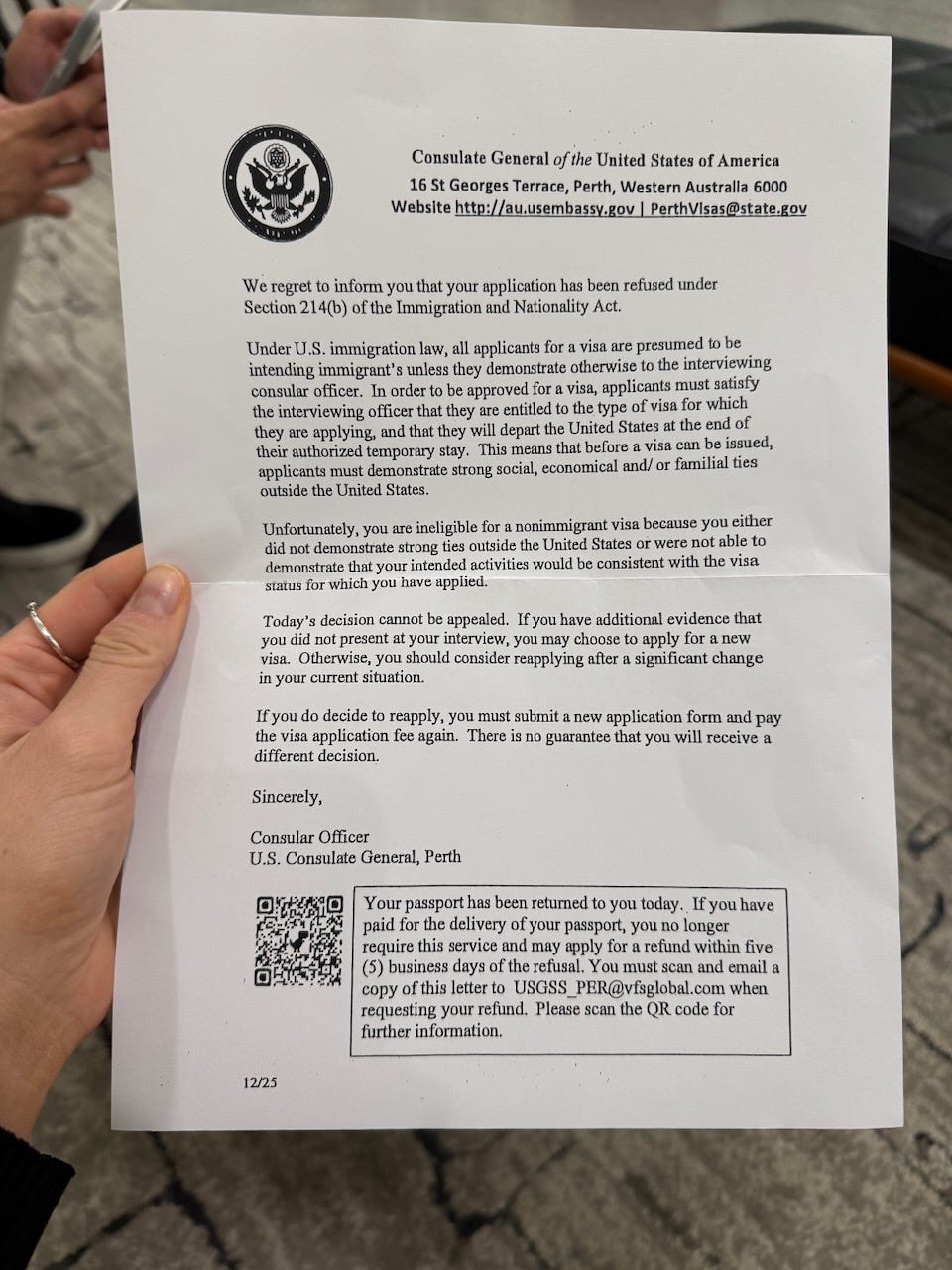
I’m sulky because not only did I not get my kiddo back for good, she ended up shortening her already short visit home. I’m worked up because our family missed out on meeting a guy who means the world to her. And I’m angry because the decision appeared to be preordained. Why bother with the consulate interview, and in this case the cost and time spent getting there, if the answer was already no?

I had come to terms with the idea of all this being one small story in a large and ongoing injustice, until a friend sent me a New York Times piece that painted an even weirder picture.
The Trump administration is in a diplomatic war with Brazil. In July 2025 it declared the country a national emergency, slapped it with 50% tariffs, and described the Brazilian government, in an executive order, as “an unusual and extraordinary threat…to the national security, foreign policy, and economy of the United States.”
This extraordinary threat is one of the largest economies in the Western Hemisphere, and the U.S. has considered it an important partner for decades.
The real grievance at the center of the political tit-for-tat, is that Brazil’s October presidential election pits a leftist incumbent against the son of Jair Bolsonaro, the former president, who was convicted of plotting a coup. The Trump administration wants Flávio Bolsonaro to win, has been sending envoys to meet with the Bolsonaro circle and making its preferences known in ways that the current Brazilian government views as election interference.
Brazil pushed back, and the U.S. upped the ante by canceling the Brazilian ambassador’s visa—a tool, one political scientist in the Times piece notes, the U.S. “normally reserves for unfriendly or authoritarian regimes.”
So, we have an administration already engaged in a geopolitical standoff with Brazil, an executive order that frames that country as a threat to national security, and a consular officer working for that same administration who hands my daughter’s boyfriend a rejection letter without looking at his documents. Correlation is not causation, but there’s a definite hmmmm in the air.

The people in power in the U.S. justify the immigrant visa pause, saying it will remain in effect until the administration can ensure newcomers “will not extract wealth from the American people.” No one has offered proof that the 75 listed countries were doing that. Brazil, for one, is hardly a hotbed of food stamp tourism, especially since visa holders generally have to wait years before they can access public benefits, a restriction federal law has imposed since 1996.
But in the current policy environment, proof is optional.
My daughter and her partner are finding their way, from scratch. They have a cute, 375 square foot apartment in a decent neighborhood in São Paulo. The only readily available hot water is in the shower, which, I’ve learned, is just how things work there, even in modern buildings. The space came with cold water laundry and kitchen sinks and nothing else: no refrigerator, no range, no cabinets, no countertops, no closets.
They got a puppy and named him Max. She is learning Portuguese, which is harder than Spanish, not that she spoke that anyway. So far, Max is speaking English.
The only path forward for them is the K-1 fiancé visa, a narrow gate that remains open for now and might eventually allow him to come here, live here, sit at the table with us every now and then. The timeline is long, the paperwork its own endurance sport, and even if all that were to work out, I feel my breath catch when I think about the continued risks to him and them in a country where having brown skin is treated as probable cause.
My job remains what it’s always been—to support her and stand by—and maybe help people understand that political decisions have tentacles long enough to stretch from executive orders and political quid pro quo all the way to a ground floor lobby in Perth, where a girl stands waiting for the boy she loves to come back with a letter he can’t read.
And as for me and my awareness, let’s just say there is a difference between watching the smoke through a window and having it fill the room.
~Elizabeth

I’ll be honest. I wasn’t sure I was the right person to write this piece, since I’m not an immigration attorney, a policy expert, or a political journalist. But maybe that’s exactly why it seemed important to do it anyway.
I’d love to know where this lands for you. A few questions to get the conversation going:
What do you understand differently these days, and what prompted the shift? Is there a story in your own family’s immigration history, recent or long ago, that you think about differently now than you used to?
Come find me and a community of friends in the comments. I read and appreciate each one.
Everything at Chicken Scratch is free to read, and with rare exception, there’s always an original audio version to enjoy as well. If personal essays, research rabbit holes, and the occasional puppy update matter to you, paid subscriptions and one-time contributions are what make it possible for me to keep showing up. There are links below if you’d like to join in on that. And if you’re already there, you have my genuine, wholehearted thanks.
On the subject of species showing up where they're not wanted, this piece on the American bullfrog feels newly relevant. Funny how that works.
Afterward:
I believe in the power of small actions taken by a lot of people, so I close each week with an idea. The way I see it, doing something modest beats the paralysis of feeling like nothing you do could possibly be enough.
Try this:
The Immigrant Legal Resource Center offers a Red Card, a wallet-sized slip of paper explaining the constitutional rights anyone in the U.S. has if approached by immigration enforcement, regardless of status. Ten million cards have been distributed since November 2024, in 59 languages, including Portuguese. Download and print your own for free, order physical cards to share, or donate to keep them in circulation. Putting a reminder like this into someone’s hands, or in a place they might pick one up, is not nothing.
See you soon!
I feel lucky to have such an amazing mom (who happens to be a spectacular writer) put a glimpse of my story into words. How privileged are we to be able to still have constant communication and the ability to see one another regularly, despite the distance. 🩷
I think you are exactly the right person to write this...a powerful account of making the universal personal. Sometimes hearing one family's story is more enlightening than a million hours of soul crushing news.