

Prefer to listen? You’ll find an original audio recording here. ⤵️

If I had my druthers…
The phrase is part of my lexicon in the same way that y’all, bless your heart, and a hitch in my gitalong spill out of me with ease. Expressions rooted in my Southern heritage, I use them without second thought.
If I had my druthers, all y’all would learn to love y’all. If I had my druthers, more folks would understand the subtle but invaluable difference between a smack down bless your heart and a hype up bless your heart. If I had my druthers, a hitch in the gitalong would be the worst thing that happened to any of us all week.
If I had my druthers, there’d be fewer assholes in the world.
I realized, recently, that I had no idea what my druthers actually were, or are, or ought to be. What the hell is a druther, and how am I supposed to have one if I can’t say what I’m looking for?
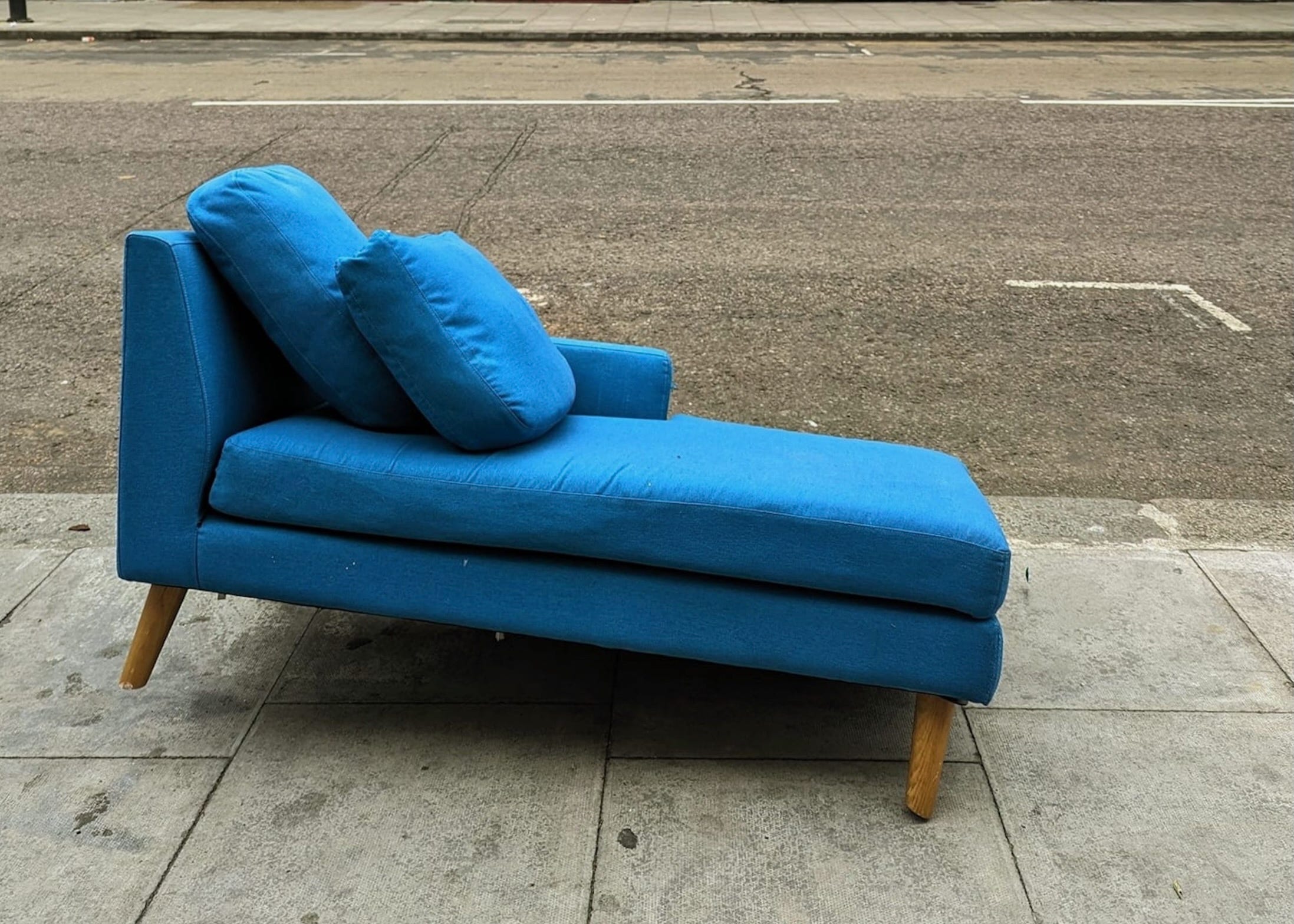
I figured druthers was a cousin of chaise lounge, that terrifyingly American mangling of chaise longue, in which we swap unfamiliar French words with a pair of close enough words that kind of make sense, converting a long chair to a lounging chair. The new term gets woven into the vernacular, and sticks. This is how we handle what we don’t fully understand; we reach for the nearest recognizable shape and smoosh the new thing into it.
Druthers, it seems, didn’t come from that kind of reaching at all.
The word has been around since the late 1800s and grew out of a more colloquial mashup. Somebody said I’d rather, and between that person’s mouth and another person’s ears, the sound of the /d/ came loose from I’d and drifted over to rather. So, I’drather, or in some cases, I’druther. You see where this is going.
There’s a wonderful early sighting of the word in Benjamin Shillaber’s 1859 sketches of Mrs. Partington, a fictitious New England widow whose chief comic gifts were distorted common phrases and social blunders. Musing on fate and the futility of wanting things, she moans,
“…however much we may say we’d rather have this and we’d rather have that, we can’t any of us have the druthers we want.”
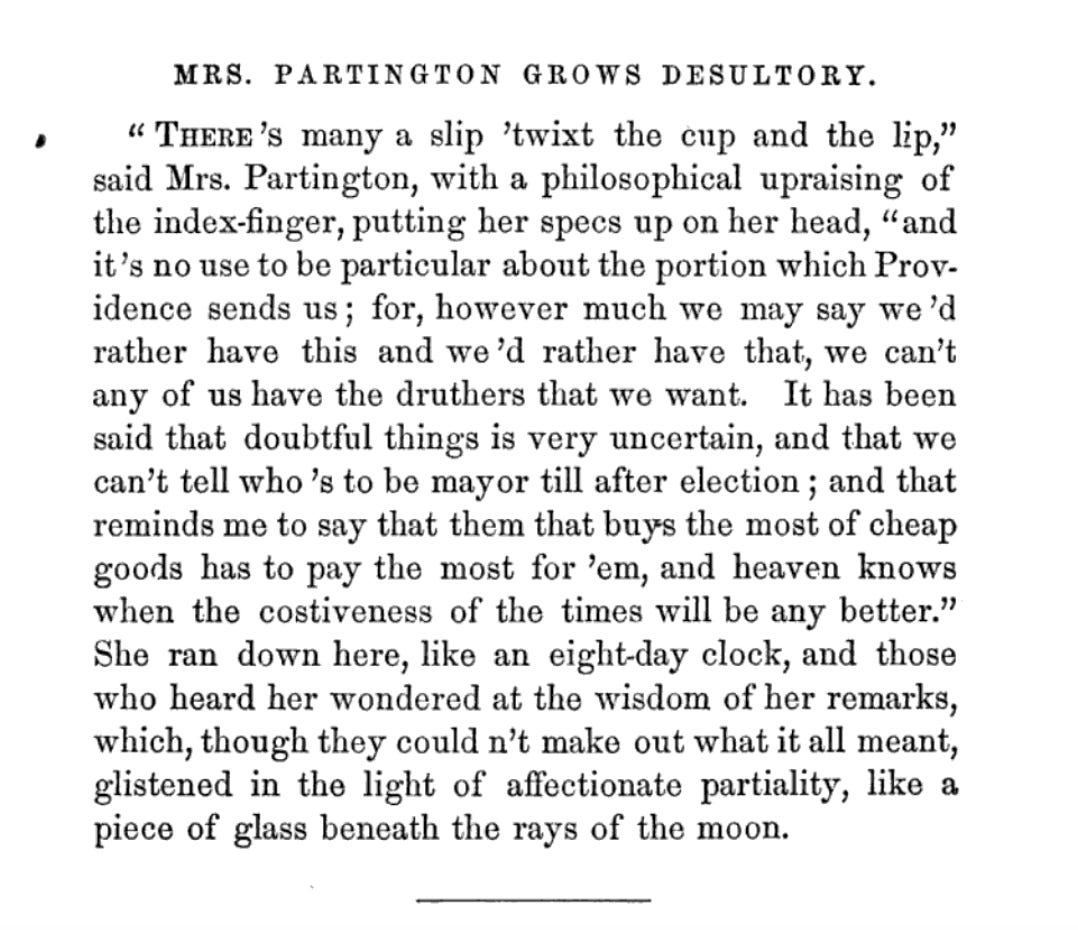
Shillaber was from New Hampshire and spent his adult life in Boston, which runs counter to the notion that the term is bone-deep Southern. In fact, its earliest paper trail runs straight through New England satire. Mrs. Partington’s malapropisms were popular enough that they helped shape Mark Twain’s Aunt Polly a couple of decades later, so if druthers has a literary grandmother, she talks like a Yankee.

When the seam between words moves, language scholars call it metanalysis, or resegmenting. In this instance, the word on the far side of the swap stopped behaving like a verb and turned into a noun you could have, or want, or lack—plural and countable, like money in the bank. I’druther became druthers, and druthers became something a person could long for.
I’m impressed by how different that is from chaise lounge. In this instance, nobody went mining for a more reasonable or recognizable word. The transformation occurred organically, like when song lyrics morph into what we think we heard.
‘Scuse me while I kiss this guy!
Anyone engaged in a long term relationship, where selective hearing can be passed off as age-induced impairment, understands that there is a veritable jungle between what leaves one person’s face and what enters another person’s head. It’s not about imposing order. Neither individual notices a chance mutation, because the sentence still works both ways.
We’ve all lived through more recent versions of the same shifts. Imma, hafta, kinda, sorta, lemme, gimme. A grammarian might wince at every one of them, and a lot of nonfiction writers keep them out of print entirely, but we understand them instantly, speak them constantly, and text them without confusion. I have to appreciate the generosity in that, and the collective power.
Language is borrowed, not owned. We take in words from other centuries, other cultures. Meanings meander, pronunciations vary, edges smooth imperceptibly, like the wearing down of mountain ranges.
For a long stretch of the nineteenth century, druthers wasn’t a single, settled term. It took several forms at once: druther, ruther, ruthers—all of them living fulfilling lives, none more correct than the others. Correctness wasn’t even a consideration until people who hadn’t been in the room for any of the original back and forth put one version on a page, editors let it stand, and next thing you know druthers landed in the Oxford English Dictionary.

I think a lot of what people want follows a similar trajectory. A person born in a place that’s run out of opportunity, or become lethal, wants to raise a family somewhere with more promise. That desire doesn’t need defending until it runs into terms like asylum or illegal, as though the wanting itself weren’t identical either way. A woman wants to walk a trail through ancient hills without having to calculate which parts are safe and which aren’t. That want is about as plain as a want gets, but it still has to prove itself to people who say what she should have expected, what she shouldn’t have worn, where she shouldn’t have gone alone.
A whole lot of us want fewer assholes in the world and a lot more people waking up to the fact that greed is going to be the thing that finally does us in, but according to some that’s considered naive and unserious. We yearn in the same language, but those with more power hear something different.
Not every want gets discounted so loudly. Some fade the way ruther did, dusty, unattended, nobody troubling to write it down or reflect it back. The Dictionary of Lost Words by Pip Williams tells a version of this about actual words, the ones the original OED editors let go because nobody with enough authority thought to safeguard them.
I don’t think that’s so different from wanting mental health to be treated with the same intensity as high cholesterol, wanting to walk into a government office without being treated with indifference, wanting to normalize grace for missing a green light or saying the wrong thing. And gosh, if I had my druthers, I’d want more of us to wait for a real answer when we ask someone how they’re doing.
I like that druthers began as I’d rather. It’s such a tolerant way of stating a preference, one that assumes there’s another alternative worth making space for. A word doesn’t need a dictionary’s consent to keep circulating. I don’t think a want does either. Saying it out loud won’t make it materialize, but it might keep it from disappearing completely.
~Elizabeth

There’s a thread here I opted to not explore, which is that I played the part of Aunt Polly in a seventh grade production of the Tom Sawyer musical. I figure I’ll tell that story another day.
Do you have a druther that’s gone a little dusty from disuse? Is there a want you need to say out loud, or one you’re sick to death of having to defend? The comments are open for your ideas.
If this piece gave you something to chew on, passing it along might do the same for somebody else. A heart 💚 or a restack ♻️ goes a long way toward getting it in front of more people.
Chicken Scratch shows up week after week for you, whether you’re here as a free or paid subscriber. If today’s the day you’d like to become one of the latter, or leave a one-time tip, I’d be genuinely glad to have you. It all matters – so very much.
Afterward:
I end each week with a small suggestion, a simple action you can choose to pursue or not. I believe little, deliberate moves matter as much as big realizations, maybe more, since they’re the ones we actually get to do something about before the week is out.
Try this:
Think about something you’ve been treating as just how it is. A rule you follow, a “should,” an assumption. Pick something small enough to actually get your head around this week. Ask yourself where it came from, and whether you ever really had a say in the matter.
See you soon!
Happy belated, dear Elizabeth.
A favorite book of mine is "Et Cetera, Et Cetera: notes of a word watcher" by Lewis Thomas.
I remember talking to someone about my love of etymology, but somehow he conversation became about bugs (entomology). Very different.
I like the idea that "pease" was once a collective noun, like "corn". Somewhere along the line someone heard the plural in the sound of "peas". And it stuck.
How does culture decide whose druther wins out over another druther? A question for adrother day!
I am now going to buy a copy of the Dictionary of Lost Words. Thank you, Elizabeth! You mold words beautifully. Have a splendid, happy day! (Happy Belated Birthday to you! 🎉🥳 I hope it was glorious!)☀️