

Prefer to listen? You’ll find an original audio recording here. ⬆️

Every now and then, the water goes away. It happens when the wind blows just so and the moon is doing whatever it is the moon does, and a creek that’s usually deep enough to keep its secrets becomes startlingly shallow. The water in these Chesapeake Bay tributaries doesn’t rise and fall with quite the drama of the open coast, so I don’t always notice the tides. But there are times when it all rushes out and the shoreline changes, exposing things that have been hidden beneath it.
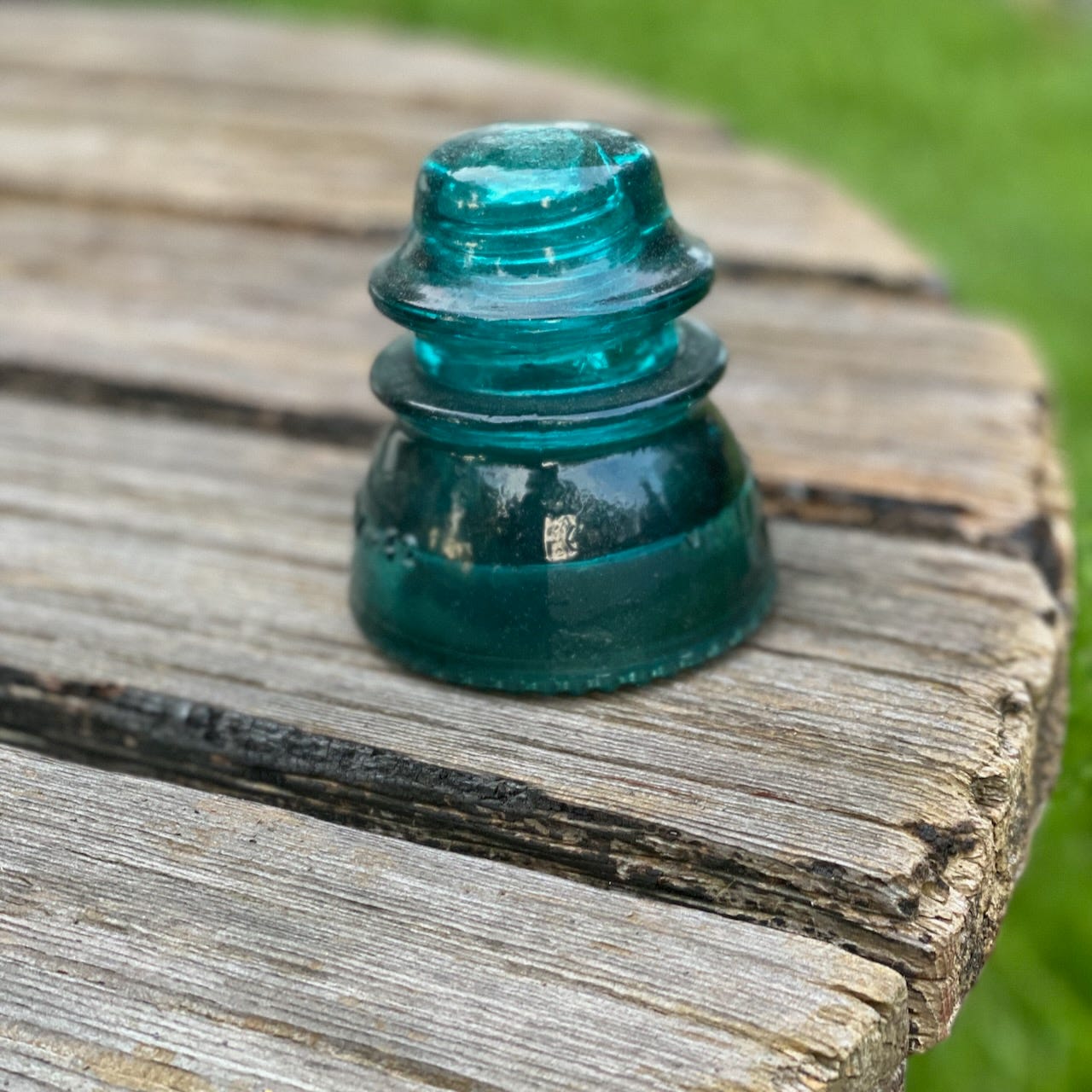
There are bottles and shards of pottery, electrical insulators and broken glass worn to translucence by years of tumbling in a wash of sediment, items whose original purposes are sometimes obvious and sometimes not. Every piece I’ve found has been at the water’s edge. I have heard stories of shipwrecks and automobiles, vintage tractors and cow skeletons, each making clear how long people regarded the water as a convenient place to discard anything they no longer wanted to keep. Out of sight, out of mind.
The people who disposed of their belongings this way weren’t thinking about artifacts. They were just living ordinary lives with no reason to imagine someone, generations later, standing on a muddy creek bank trying to figure out what the hell they were thinking, or what they might have once done with the relic now in someone else’s hands.
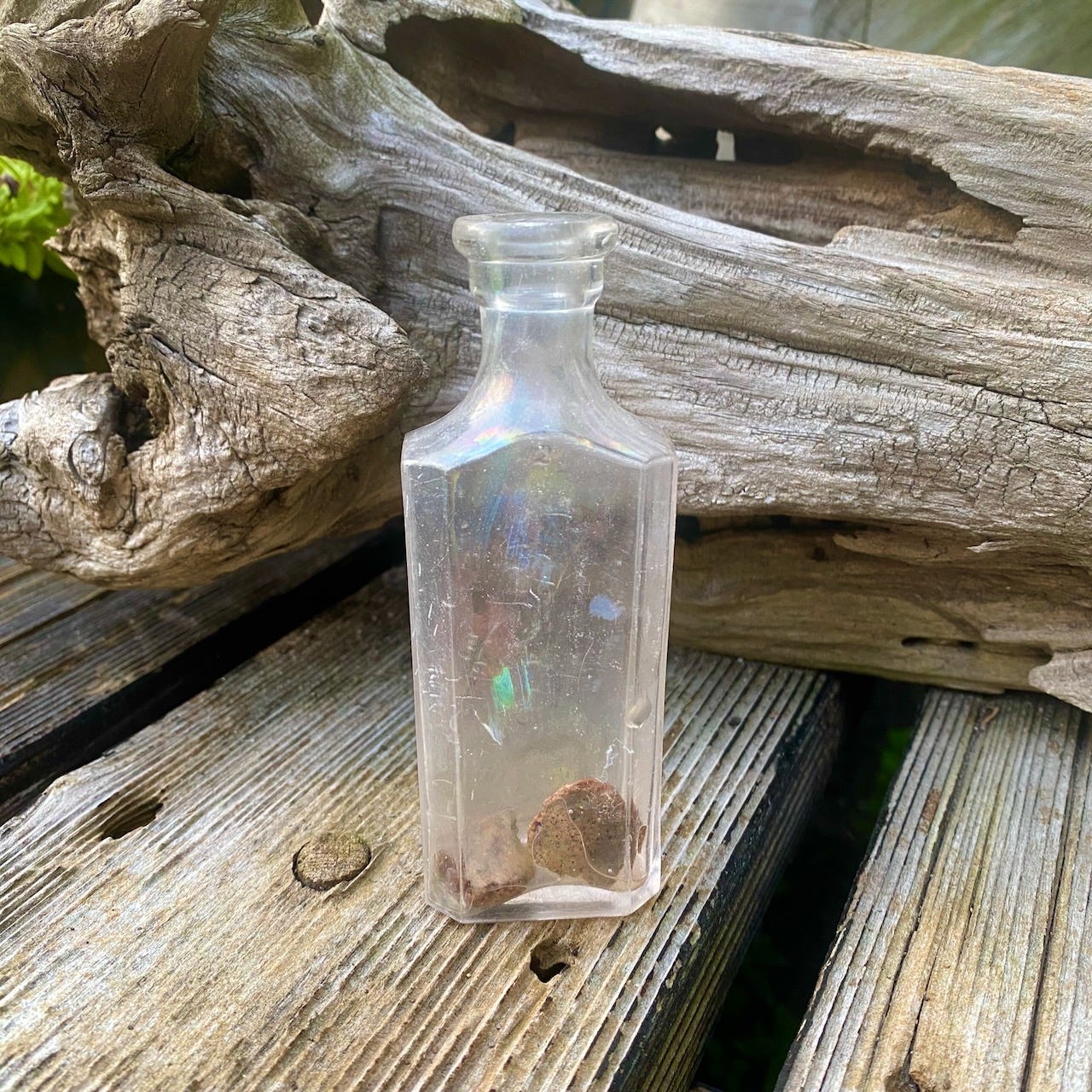
I have a small bottle old enough to have required a cork stopper. The colorless glass flashes iridescent blues and purples from its place on the kitchen windowsill, a byproduct of the manufacturing process used for clear glass plus years of UV exposure. Other than a tiny, curvy numeral 2 up around the shoulders, there are no markings. Inside are two solid pieces that, when they line up, look like they once conformed to the slightly irregular shape of the bottle bottom. Surprisingly, they float in water.
For the longest time, I thought they were shells, remnants of a living creature who escaped to a larger vessel. More recently, I learned they’re likely just the solidified sediment of a desiccated liquid medicinal treatment. The internet has a propensity for turning a handful of loosely connected clues into a story, and in this case it led me to a supposed pharmacist who filled the bottle with an antacid, sold it to a customer with an unsettled stomach, who eventually tossed it out with the dregs of its original contents still floating around inside.
Or maybe a person who cared for someone with a cranky gut tossed the bottle into the creek, long after their beloved passed the point of needing any medicines at all.
A bottle with two delicate chunks inside is a physical reminder of a life, but it tells me almost nothing of the life itself. I don’t know who bought it, what they were sick with, or whether they were sick at all, whether they were happy, or kind, or difficult, or loved. I don’t know what they believed about the world or what they hoped the future held. From this one artifact, I can construct a thousand possible lives, none of which I can verify. The trouble with looking backward is that we can so easily mistake evidence for understanding.
It feels almost too obvious to say anything about Dolly Parton now. Since her death, there has been such a sweet rising of mourners and memory makers, people surfacing to tell stories about what she meant to them, what she gave them, how her music touched them. Anything I might say has been said already, and better.
She was a force and a unifier, but her life was far from uncomplicated. She made a fortune and unapologetically spent a sizable portion of it on refining her natural appearance. Living with endometriosis meant she was physically unable to have children. Goaded by jealousy over a bank teller’s flirtations with her husband, Dolly wrote the song “Jolene.” Over the years, both her sexual orientation and her marital fidelity were scrutinized.
Dolly understood the machinery of celebrity and used it effectively. She wanted to be successful, she wanted to be beautiful, she wanted to make money, and she wanted to use that money to do good. She believed in herself and seemed genuinely interested in helping other people do the same. She set out for Nashville with a dream and made it happen, becoming tremendously wealthy without letting wealth itself be the point. She was famous without needing everyone else to become less important. She loved her family, loved her work, knew who she was and what she stood for.
I think that may be what so many people appreciated most in her. Wouldn’t we all like to get to the end of our lives having become more ourselves rather than less, having made something from whatever we were given, having loved the people we were given to love, and having done something beneficial along the way? Surely there is a version of the promise we were handed as children that still works: trust in yourself, be diligent, take a chance, and you can make something of your life.
Dolly made that promise look less unlikely.
The day after she died, the order came down to fly flags at half-staff. The one at the school near me was set below the halfway point. I’m sure somebody just lowered it too far, but to me it felt right. The world had lost something more precious than the usual practice could convey. In the aftermath of the loss, we make official gestures, tell stories, write tributes, try to make a record of what someone meant while they were here, but there is always more to the story.
We can’t measure the effect of one life on another. What matters most is the most difficult to preserve, and there is so damn much we don’t know. But we do know that praise can come easily, that kindness compounds. Dolly put the obligation like this: “You just do stuff not realizing…but as soon as you realize that it is a problem, then you should fix it. Don’t be a dumbass. If it’s a problem, fix it. That’s where my heart is. I would never dream of hurting anybody on purpose.”
I wonder what people a hundred years into the future will realize that those of us alive today will never understand. I hope in among all the ridiculousness, they find bits and pieces of the marvelous. I hope they are forgiving enough to recognize that obviousness can be a privilege of hindsight.
Dolly will leave recordings and photographs and books and businesses and buildings and all the other tangible remains of a very large life. Part of her will be here long after everyone who knew her personally is gone. But what I think we feel right now is the absence of someone who made space while also standing her ground, someone who could, in one way or another, tell a person: You get to be here, too.
~Elizabeth

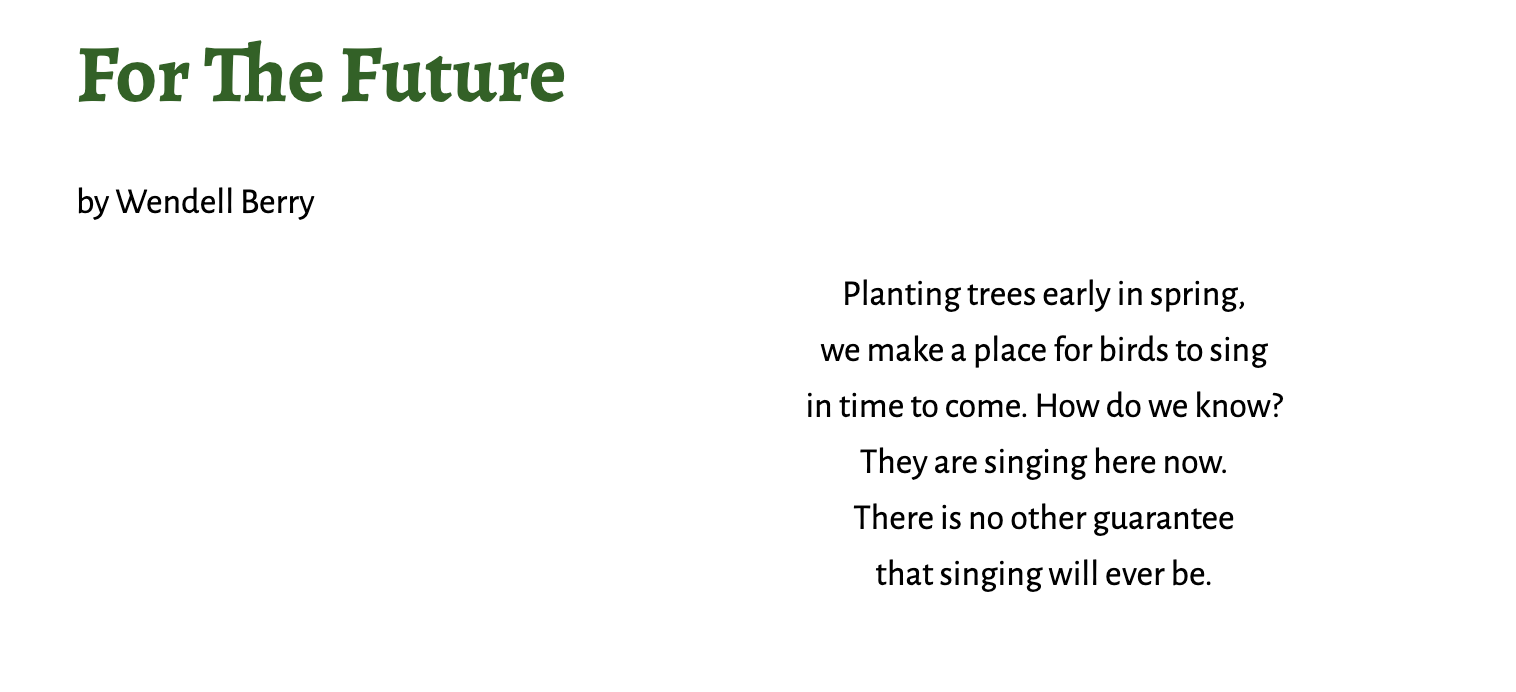
As I was putting the finishing touches on today’s piece, I learned that Wendell Berry had died. Berry and Parton seem like people who could hardly be more different. One spent his life on a Kentucky farm, writing poems and essays about land, limits, community, and the obligations we have to the places we inhabit. The other built an enormous life in music and entertainment, in rhinestones and television and theme parks and songs everybody knows.
But both believed that living a good life was partly a matter of what you do with what has been entrusted to you. A piece of land. A community. A talent. A platform. Other people. Berry spent his life asking us to take care of the ground beneath us. Parton spent hers making room for the people around her. And both were arguing against the idea that we’re here simply to consume what we find.
If you enjoyed what you read today, please leave a heart or a comment behind. Tell me about someone whose absence has made you realize how much room they took up in the world, for better or worse.. And if you’d like to keep these conversations going, come on in as a paid or free subscriber. I’d be deeply grateful.
Afterward:
Each week, I end with an idea, a concrete way to engage, because I believe in the power of collective action.
Try this:
Think about something you know more about now than you once did—something you said, did, overlooked, didn’t understand. If there’s something to fix, fix it. (My friend and fellow Substacker, Don Boivin , offers a touching example here.) And if there’s someone who deserves a little more room, a little more kindness, or a little more understanding, make room.
See you soon!
What when kindness leaves?
Lower flag below half-mast.
Stand ground ‘gainst dumbass!
Yes something so excruciatingly sad about Dolly's passing (such genuine, authentic goodness)and I am always impressed with how private she remained. (Note to other whining celebrities: it *can* be done!) Thanks for this very thoughtful essay, Elizabeth. I enjoyed reading about the "Mud Lark" activity too as I am a big devotee whenever the opportunity/search presents itself!