

If you prefer to listen, I offer a recorded version here. ⤵️
A few weeks ago I read an essay called Fuck Farming. There was no asterisk. Out of habit, and a certain fear of my Puritan ancestors, I started to soften it here, then thought better of it.
The essay was written by a farmer trying to explain the economic realities of sustainable agriculture for people without inherited land or family money, and it ran through Substack like a shit through a goose. The writer was thoughtful, sharp, and deeply frustrated, but what interested me almost as much as the argument was his chosen title—that one word. Before I clicked, it had already established that this would be a tell-it-like-it-is exposé. It promised exhaustion, anger, and most importantly, honesty.
My expectation says something about the strange cultural journey of the f-word and its cousins. Somewhere along the way, profanity stopped functioning primarily as profanity and started functioning as a marker of authenticity. These days, when a writer drops an f-bomb (and from here on I’m spelling it out, because this essay has no business hiding behind an asterisk), it tells me that the speaker has stopped performing, that things are so bad he no longer needs to be polite. Fuck right there in the title says: I am too tired, too exasperated, too cornered, too fed up with reality to package this gently for your comfort.
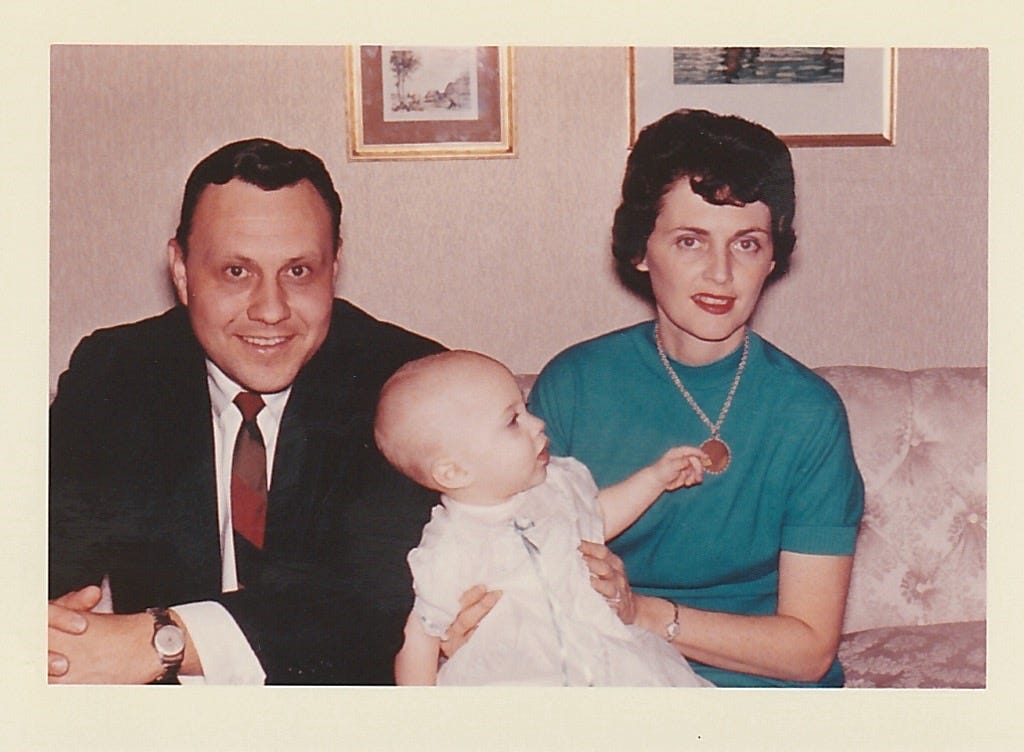
Historically, this is a remarkable transformation. My parents, born in the 1920s, would have regarded such a title as evidence of moral decline. In their world, the word belonged to drunks, soldiers, sailors, and men working loading docks. It was not language for educated people, and certainly not language for book covers. Mom was a Gone With the Wind devotee and thought Clark Gable’s “Frankly, my dear, I don’t give a damn” was about as far as a civilized person needed to go. The film’s producers famously agreed to pay a $5,000 fine rather than cut the expletive from the final scene.
Picture my mother dropping a dish, watching it smash to pieces on the kitchen floor. Now see her stamping one foot and shooting out an emphatic dammit!. That was the extent of it. My father, being a father, had a wider repertoire, but certain words never crossed his lips in front of us kids.
I was similar if slightly less diligent with my own children and lucky that I happened to have a cat named Puck on whom I could blame any slips of the tongue.
One of my favorite creative non-fiction writers here, Ramona Grigg, announced not long ago that she blocks commenters immediately if they use either the f- or the c-word on her page. Her decision wasn’t framed as prudishness; it was about maintaining an old standard, a line others, including me, have wandered across without much ceremony.
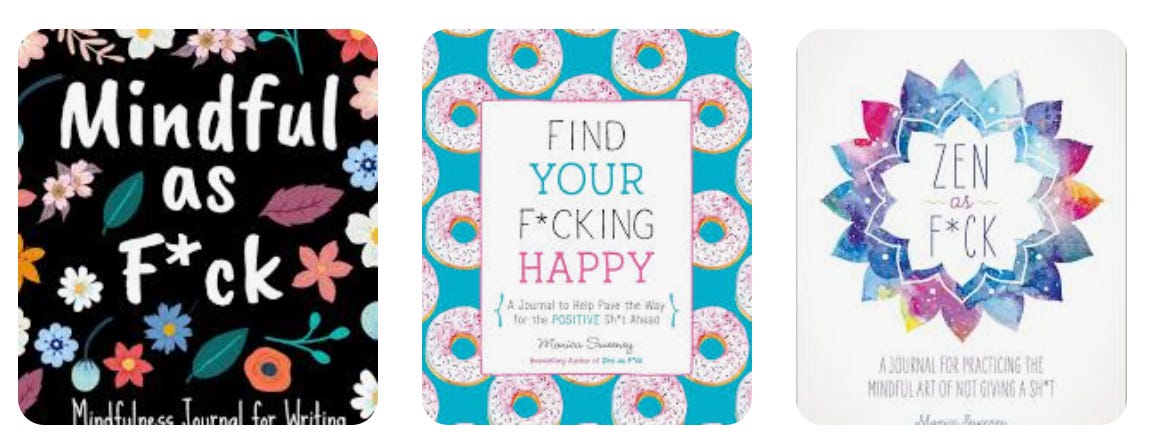
The word has become so commercially successful it practically qualifies as its own literary genre. There are enough profanity-titled self-help books to stock an entire airport kiosk. Notably, all have an asterisk in the title: The Subtle Art of Not Giving a F*ck, Unf*ck Your Brain, Calm the F*ck Down, Buy Yourself the F*cking Lilies, F*ck Feelings, Tired as F*ck. There are profanity-forward coloring books, gratitude journals, and cross-stitch pattern collections. The word now appears in pastel fonts beside watercolor flowers. We have thoroughly domesticated the beast and put it on a tote bag.
The modern publishing moment seems to begin in 2011 with Adam Mansbach’s Go the F*ck to Sleep. Mansbach, wrecked by a toddler who refused to go to bed, posted on Facebook about writing a children’s book with that title. Friends told him he had to. The joke became a manuscript, the manuscript leaked online before publication, and the book became a phenomenon to the tune of millions of copies, forty languages, and Samuel L. Jackson narrating the audiobook with the gravitas the subject deserved.
What made it work wasn’t shock value. Every exhausted parent immediately recognized the emotional truth behind it, the gap between the tender performance of bedtime parenting and the private mental state underneath. Rather than feeling vulgar, the book felt like finally being told the truth.
Research has since caught up with what readers already sensed. A study titled, and I am not making this up, “Frankly, We Do Give a Damn,” found a consistent positive relationship between swearing and honesty, though subsequent researchers have argued about what that actually means in practice. What nobody disputes is the perception: people associate profanity with authenticity, interpreting strong language as evidence of genuine feeling rather than polished persuasion. Whether swearers are actually telling you the truth may be an open question. That we read them that way is not. In other words, fuck now functions as proof that someone means it. (Dammit!)
Which brings me to a complication, and what it does to everything else.
The trouble is that every successful rhetorical strategy eventually gets absorbed into marketing and then leaks back out into ordinary speech. Authenticity becomes aestheticized, rebellion becomes branding, and instead of lighting up the sky in moments of genuine trouble, our heftiest expletive flares now sit in gift shops next to scented candles. When every emotion is delivered at maximum volume—a delayed flight, and a failed marriage, and a disappointing latte all arrive calibrated to roughly the same pitch of intolerable—the volume stops meaning anything.
What people are hungry for is the feeling that a writer is telling them the truth. Profanity became the fastest available shortcut for signaling it. The pointing is the point.
My mother and Ramona Grigg would say the word is simply vulgar, that they were taught to think of it as beneath a certain kind of person. They’re right that it costs something to say it, but I think the cost is no longer moral. Now, it’s more like currency: spend it everywhere and it buys you nothing.

This past weekend I hauled a hose across my yard to add some much-needed moisture to my vegetable garden. The whole state is under a drought warning, and our two bird baths get as much use as drinking sources as for splashing. As I directed a steady spray onto peas and potatoes, a female ruby-throated hummingbird shimmied at the edge long enough for me to have a little conversation with her. Hello, friend. It’s good to see you again. How can I help? Are you thirsty?
She hovered, slid sideways and back again, considered, and left.
On the way to a recent farm meeting, at a school bus stop on the far side of town, I watched scores of children from different families and different backgrounds make their way toward the curb. A ball-capped man in a Vans t-shirt stood in the street to make sure the kids on the opposite side crossed safely. More than a dozen children were headed to a school where teachers will do their considerable best to help them learn in a system that does not, if we’re being truthful, especially prioritize them.
Soon after, I sat in conversation with farmers, all women, growing vegetables and flowers, raising chickens and pigs, women with families, with and without spouses, with and without land they own, who sell at farmers markets and restaurants around the region and who work, I would say with confidence, harder than everyone I know. Food farming requires the stamina of an athlete, the patience of a saint, and the ability to solve problems continuously while running on too little sleep and entirely too much coffee. It is one of the only professions where your entire year’s success can be undone by a late frost, followed immediately by someone asking why strawberries are so expensive.
Driving home, I thought: If anything deserves the word it’s this. The hummingbird making her case at the edge of the spray, the people at the bus stop, the women who go out in the dark to check on the chickens, who watch the sky the way the rest of us check our phones, all matter as much as the guy who’s fed up with farming. It’s hard to tell those stories in ways that cut through the fuck-it-all noise. They’re not packaged for outrage but they are as real and honest as anything gets.
The farming essay earned its title because the exhaustion was visible in every paragraph, not just the headline. The word was a symptom of the argument, not a substitute for it.
But what if it works the other way too? Look at this fucking hummingbird! Look at this fucking man standing in the street in his Vans t-shirt! Look at these fucking farmers who do what they do so the rest of us can eat!
I’m not sure the word has ever been asked to carry that kind of freight, but I think it can. I think it should. If we’re going to market it to death anyway, why not give honest beauty at least as much air time as honest fury?
My mother would have hated this essay. Ramona Grigg may never speak to me again. I’ll admit, it even scared me a little to write it—which, after everything I just argued, is either deeply ironic or exactly the point. Probably both.
So, did you read this?
~Elizabeth

Afterward:
Each week I close with something small and doable, because I believe in the power of tiny actions taken by a lot of people. Our spheres of influence are bigger than we give ourselves credit for, and doing something, however modest, beats the paralysis of feeling like nothing is enough.
Try this:
Pay attention to the words you reach for when something matters to you, good or bad. Notice when you’re amplifying, when you’re understating, and whether either one is actually telling the truth about what you feel. Then find one thing, just one, that deserves more of your honest attention than it’s been getting. It doesn’t have to be grand. It might be a person, a place, a problem, or tiny bird at the edge of a garden. Acknowledge it, even just to yourself, with the awareness it deserves.
Well. We made it to the other side of that together, Puritan ancestors and all.
I’d love to know what you think, and I mean that more than usual this week. What word has lost its power for you through overuse? What do you wish people would do with their strongest language? The comments are open and I’m eager to meet you there.
If today’s essay made you think of someone who’s been a little too deep in the noise lately, passing it along might be the kindest thing you do this week. You can also leave a heart or restack the post to support my work.
Chicken Scratch exists because you show up for it, free or paid. If you’ve been thinking about becoming a paid subscriber, or leaving a one-time tip, this is a fine week for it. Every bit of support keeps this space going and means so very much.
Thank you for being here. Genuinely.
See you soon.
OMG, Elizabeth, this made me laugh so hard. Okay, I admit I almost didn't read this because, you know, that title... And then to find that I'm included as the other side of your argument! I'm not angry, I'm kind of flattered.
And feeling a bit lonely here. But I'm used to that.
Yes, it's a word I cringe over, even now with all of its insane overuse, and I'll put up with it but never get comfortable with having to be exposed to it. And I can safely say I'll never say it out loud or in print.
I'm kind of proud of that, going against the universal grain and all. I suppose it's my age (ancient) and the fact that millions of us went for generations without once finding the need to use it, but I've given up trying to explain just what that one word (okay, two words--the C word, too) does to me. (Except for that one blog where I wrote about it, but don't want to hijack your essay with a link.)
It's just visceral. I've stopped having to clench my teeth, which was getting hard on my jaw, but I'm still eye-rolling. 🙄
Yes, I read it.
I ‘d be happy to erase “have a blessed day” from the vernacular.