

If you prefer listening, there’s an original audio recording here. 👆
Some routes to weighty destinations are direct, but mine rarely are. This one runs from a napkin full of Chex Mix, through a room full of good-hearted women, me among them, to rape culture. So, take care. I’ll move carefully and begin with myself. Before I do, I should explain why a story about hair and clothes ends up somewhere so consequential.
I spend most of my writing life (indeed the rest of my life, too) seeing both sides. On topics that divide us, I can usually find something in an opposing argument that overlaps with my own. For that reason, I rarely take someone to the mat over an opinion. Sexual abuse and rape are not opinions. There is no gray there, and I’d rather be clear about that now than tiptoe toward it.

This journey begins with a good friend who asks if I’ll join a fashion show. She is a dear soul who has offered her support and hospitality freely over the years, which makes it harder to say no. Volunteers are fewer and farther between these days, and at 5’7” I can wear pants that would drag the floor for others. Sure, I need my weekends for writing and recharging. That and a vague reluctance about having to peel myself out of my comfort zone almost keeps me home. But I figure a Sunday among new acquaintances could be a kind of inoculant against my shrinking tolerance for society in general.
At the appointed hour, I arrive to a dressing room teeming with activity. It’s blowing a gale outside, so our plan has shifted to an indoor set-up. Four other fashionistas are packed into a narrow space that must moonlight as a storage closet. An old couch with room for two takes up most of a wall. In a single chair, at the midway point of two folding tables, a woman is applying eyeliner and talking up a storm. A volunteer stylist refreshes the hair of another woman by the opposite wall. Cardboard boxes and plastic totes envelop us, yard signs lean precariously and spill onto the floor, name tags and ribbons are scattered about. Somebody tosses Chex Mix onto a napkin and cracks open a bottle of prosecco. It is not quite noon and we’re slated to appear at 1:00. Various people, mostly men, wander in searching for this or that, so we lock the door and have to unlock it whenever a new someone needs to find something new.
It is conceivable that a group of women in their fifth and sixth decades, sequestered for ninety minutes, could cover serious conversational ground. This crew sticks to relevant topics: fashion, hair loss, back pain, aging skin, and red light therapy. I’ve never heard of such treatment, but one woman says she wraps a device around her neck for “the wattles,” and I’m astonished because she has nothing of the kind. (As a former chicken tender, I’ve seen my share of wattles.) She knows it works because the hair at the back of her neck has grown like crazy. Someone else has bought a half-price light to use on her head.
There is show-and-tell for a hat that went for upwards of $500, appreciation for a faux-alligator belt said to be the most expensive in the room, and talk of gifts they buy themselves that cost more than a little, but whatever, they have a birthday coming up, or one just passed.
My shoes are probably in their second decade. Since I bought them at a consignment shop I can’t be sure. My earrings, though, are solidly in their third because I wore them the weekend I got married. I understand the argument that we work hard and deserve nice things, that the finery shows off our faces and our curves, and that somebody has to support the small businesses that sell it. The voice in my head and I go around on that several times that afternoon, and neither of us ever wins.
Unexpectedly, there is time for me in the stylist’s chair after all. She asks whether I want to keep my side ponytail, and I say yes. We agree, vaguely, that she’ll help the curls along. I’ve watched her adding soft spirals to other heads. My hair coils of its own accord, so I’m unaccustomed to the brush running across my scalp, the hot wand near my right ear, the tightness of the elastic band meant to hold it all in check. Somewhere around the second pass of the iron, I understand we pictured different things but say nothing. When she finishes, my bouncy springs have become wide, draping tresses that more or less match everyone else’s, kept in place by a styling product so thorough that I can’t get my own fingers through it. I say thank you, and mean it, position a badass black hat on my head, and see in the mirror a woman who could pass for any of the others—refined, elegant, and, dare I say, predictable.
I struggle to find a reason for the whole experience feeling a little off, and my internal monologue will not shut up about it. The women are funny, warm, generous, and I like them. Nobody pressures me to spend money or tells me that any part of my ensemble is inadequate. I am along for the ride, but the backseat makes me feel a little queasy.
I don’t know whether anyone else in that room was having second thoughts. It seems likely that a few of us were running over the same ground, though none of us said a word, myself included. My older daughter tells me that in the aerial silks studio where she trains, posters on the wall ask for no negative body talk, and the regulars will gently correct you if you slip. I could have used a poster like that in the closet, and I would have loved to be the one to say so. Someone has to go first, and in that room, nobody did.
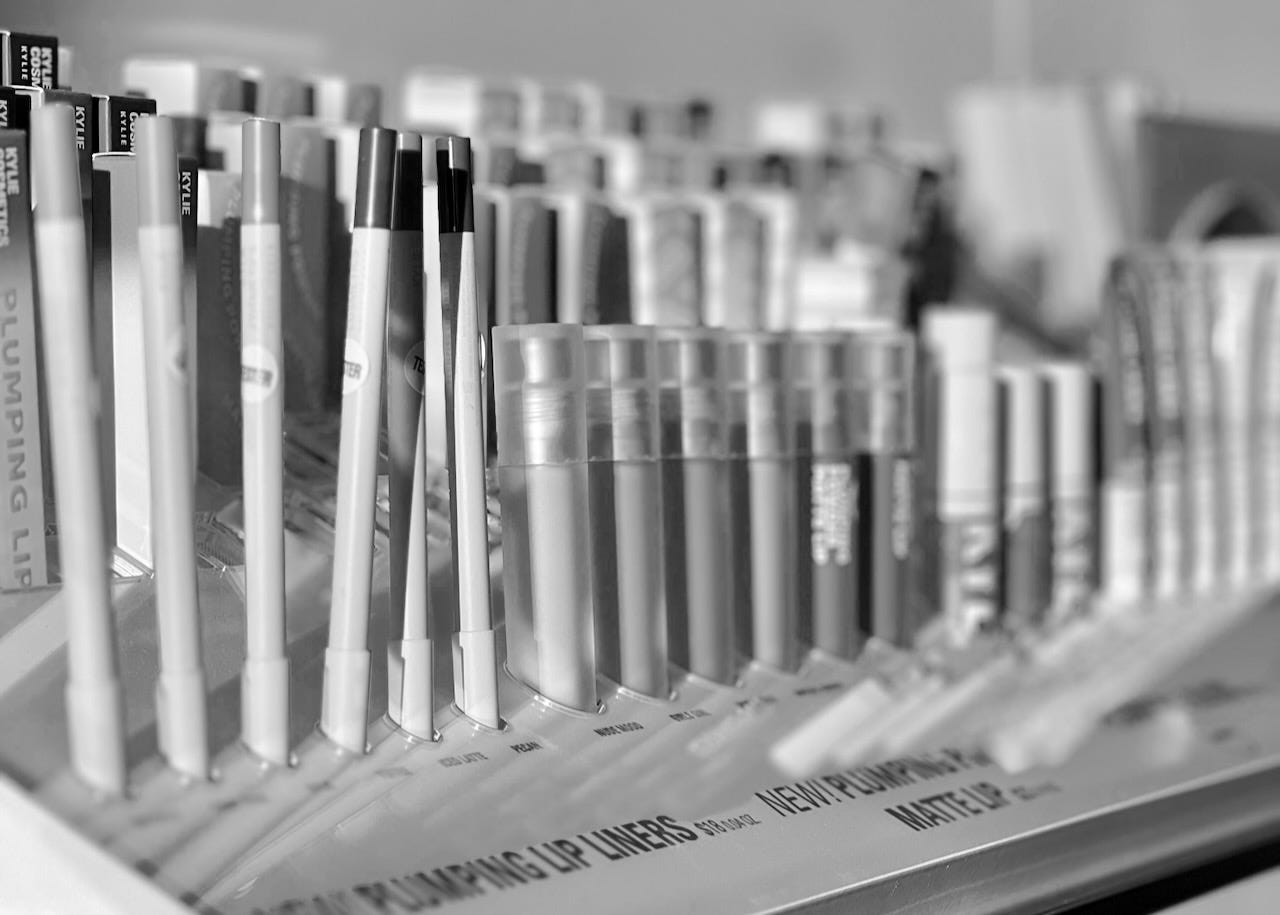
The beauty section at my Target takes up countless aisles, and I have stood in the middle of it staring vacantly at items different only in price and packaging. The shelves are organized by what's wrong with us: circles, spots, dullness, thinning. The labels speak the language of repair, with goods that firm, lift, plump, correct, reverse. Shoppers like me are just trying to finish our errands, but what we absorb subconsciously is the notion of women as projects, permanently in need of improvement and priced accordingly. In my lifetime I've watched the shelves multiply, along with the ads that support the products on them.
The executives with the spreadsheets and the stock shares know that abundance passes for choice; it works on me like it works on anybody. They’re selling a promise: We can gain or retain beauty, desirability, youth, and acceptance. All we have to do is spend money to get there. The logic follows us from the skincare aisle to the clothing rack. Our heels, hemlines, serums and salves are funneled to us by an industry that decides what’s wrong with us and then plies us with the fix. Underneath it all is the implication that we have to be beautified to be worthy.
Women’s clothing has long been entangled with power. Who gets to decide what a woman should look like, what her appearance says about her status or respectability, and what happens when she refuses to obey the rules? Some restrictions were once imposed openly by families, communities and governments. Today, many masquerade as personal choice.
Fashion is not, in and of itself, oppressive, and women who enjoy it have not necessarily been duped. A corset, high heels, lipstick or cosmetic procedures can be restrictive, expressive, pleasurable, empowering, or some combination of all four. But what social systems make these choices desirable? Who benefits from the expectation? And how much freedom do we actually have to say no?
Women have more formal liberty than they did in earlier eras, but that can coexist with pressure, and pressure can feel normal if it’s been in place long enough. Nobody would have stopped me if I had kept my curls for the fashion show, but in the moment, a cultural expectation did a bang-up job of feeling like my own preference. At what point do we become so accustomed to the standard that we no longer question it?
The same appeal reaches men by dangling different carrots: the right car, the right watch, the right body, and the implication that if they use them to demonstrate achievement then respect, status, security, and sexual or romantic success will follow. The sales pitch is different, but it belongs to the same economy of worth.
Set the two pitches side by side and you get women who are encouraged to become desirable, while men are encouraged to become the sort of men who deserve desirable things. Advertising rarely says the quiet part out loud. It doesn’t have to. A system can be practiced by people who have never consciously agreed to it.
The fashion show was a lighthearted event run by kind people. But the trace of an outline was there. I was, for one afternoon, a mannequin with opinions. We wore the clothes so that other people could picture themselves in them. The stylist matched our hair so the outfits could do the talking, which made us part of the display. Nobody who took part in the show designed the system. We were all just standing inside it.

Marketing explains a lot about what we buy and what we believe, and it excuses nothing. No man gets to blame a watch commercial for what he does to another person. My bathroom is full of potions, and I sat quietly for the brush and the curling iron. I wanted to be agreeable and was trying to be a good sport. I could have spoken up for my natural hair, but I didn’t. Had I told the stylist I liked my curls, she would have set down her tool, and I would have walked the floor with a fluffier ponytail under my hat.
Here I want to be careful, because I know a curling iron and a rape are not cousins. In the dressing room, a “no” would have been heard. My stylist was doing roughly what I had agreed to, and the decision remained mine. There was no violation in that room. There was only a familiar lesson about how quickly we trade what we want for being acceptable.
Rape is something else entirely. At its center is a person whose autonomy has ceased to matter to someone else, whose “no” was ignored or silenced. The danger comes when that disregard is treated as normal, when the people around a man decide that his reputation matters more than a woman’s account, or when the social cost of stopping him outweighs the cost of letting him continue. That is where individual violations becomes larger than the individual, because the culture can make it easier for him to do it, harder for someone to stop him, and harder for the people around him to see what they are seeing.
Rape culture is the name for the habits that protect that behavior: excusing him, doubting her, minimizing what happened, treating coercion as a misunderstanding, and debating who owed what to whom.
Which brings me to the recent Cornell case. Jane Doe has filed a civil lawsuit alleging that she was drugged and raped by seven men at a fraternity house in 2024, and that the university failed to protect her. The Tompkins County district attorney initially brought no charges, then reopened the investigation in September after the lawsuit and the resulting public outcry. On October 1, New York Gov. Kathy Hochul appointed Attorney General Letitia James as special prosecutor, saying she had lost confidence in the county district attorney’s ability to oversee the case. James has said her office will investigate fully and fairly, and Hochul said it would present evidence to a grand jury if warranted.
All seven of the accused have denied wrongdoing, and the allegations remain allegations. The original investigation and the reasons no charges were brought are disputed, and those questions will have to be resolved through the legal process. I don’t intend to decide them here, but this is a tragedy whatever the outcome.
What I can’t unsee is the fraternity group chat, allegedly showing one member advertising “free” sexual access to a woman upstairs. Other members replied, one chiming in later to ask whether the “shop” was still open. The response: “Yeah” with a devil emoji.
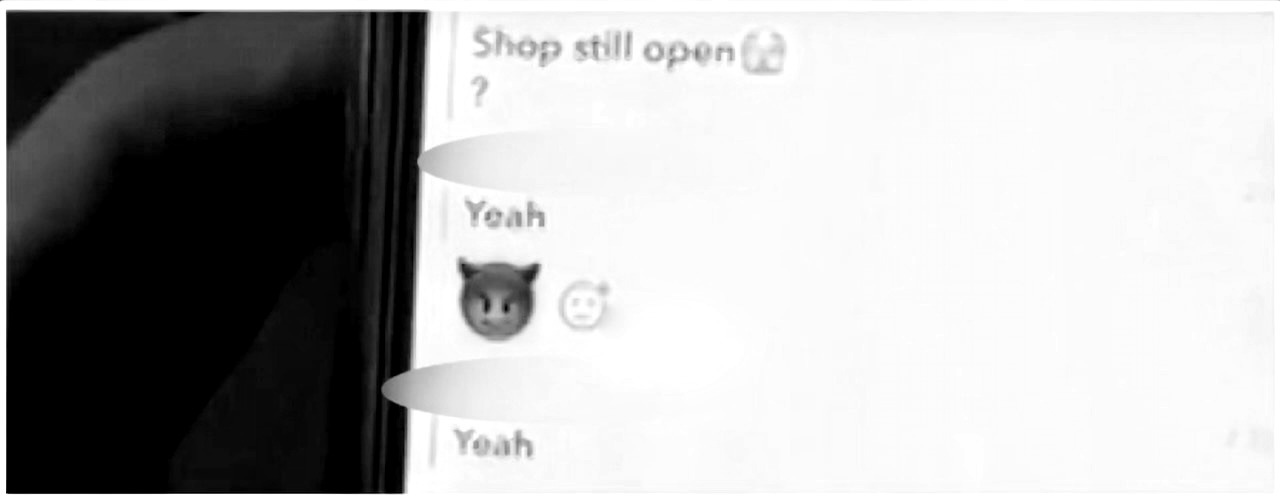
That language is repulsive no matter what the court decides. A woman became merchandise, her body an item to which other people could be directed, like a product on a shelf.
These stories never stop coming. The CDC’s most recent national survey found that 21 percent of women reported completed or attempted rape in their lifetimes, and about 20 percent reported sexual coercion. Do the arithmetic on any room full of women, including a storage closet jammed with hats and prosecco, and the numbers remind us that survivors are not some distant population. They are among us. They are us. We are Jane Doe.
What is wrong with men?!
There is a premise held and acted on by some that a woman’s body is a purchasable asset, something they can rent, trade, and advertise. My older daughter had a word for all this when I went shrieking to her: patriarchy.
Men who rape are responsible for raping, full stop. No makeup, clothing, advertising campaign, fraternity, watch commercial, childhood lesson or cultural norm gets to absorb that responsibility on behalf of the person who committed the crime.
But I can’t get past the feeling that the beauty industry and a culture that permits sexual entitlement are based on the distorted assumption that a woman’s worth is something other people get to assess, and that our bodies are objects to be graded, improved, displayed, desired, or acquired. An industry that profits from teaching women to see themselves as unfinished does not cause men to rape. A culture that teaches men that status, achievement and sexual success are measures of their worth does not cause men to rape. But when those messages meet, they can create a particularly dangerous bargain: women learn to expect evaluation, while men learn to mistake their standing for a claim on someone else.
What is wrong with men? The question is broader than fashion, and bigger than any one man. They don’t invent their ideas about masculinity in isolation any more than women invent theirs about beauty. We inherit them, reinforce them, sell them, reward them, and even resist them, mostly without noticing. That doesn’t absolve anyone. Quite the opposite. If the culture around us helps shape what we expect from one another, then we all have some responsibility for what we reinforce, for noticing when something we have always considered normal is actually serving a hierarchy we would never consciously condone.
The good news, if there is good news, is that systems, which are made of people, are not the laws of physics; they can change. History gives us plenty of evidence that they do. The record is full of people living inside systems and refusing to behave as expected. But a system is hard to see because we are all swimming in it. When you’re a fish living in water, you don’t spend much time wondering what water is. Patriarchy is extraordinarily good at making itself look like ordinary life.
In Feminism Is for Everybody: Passionate Politics, the late bell hooks described men’s side of the bargain this way:
Most men find it difficult to be patriarchs. Most men are disturbed by hatred and fear of women, by male violence against women, even the men who perpetuate this violence. But they fear letting go of the benefits. They are not certain what will happen to the world they know most intimately if patriarchy changes.
I don’t know exactly what change involves. We can’t change what we can’t see, and we can’t see what we don’t talk about, so it starts with conversations that do more than tell women to be careful and men to behave. I kept my monologue to myself in that dressing room. For my two daughters, and for everyone’s sons and daughters, I’m starting by bringing it here, to you.
~Elizabeth

Afterward:
If you or someone you know needs support, RAINN’s National Sexual Assault Hotline is free and open 24/7 at 1-800-656-HOPE (4673), or online at rainn.org.
Thank you for staying with me for this one, for showing up and standing up. You are how change gets started. You read carefully, you think things through, and you keep asking how we get from noticing to doing. That’s the conversation I hope we keep having. Your support is everything.
Thank you in advance for letting me know I’m not shouting into the void.
(This is where you get the opportunity to do that…)

Valuable sharing