

I'm on the move and ran out of time to record an audio version for this post. It'll be back next week. ☺️
A note: the person at the center of this essay is real. Though I have reached out, I haven't connected with her, and I'm aware her story has already been told in ways she couldn't control. I've tried to approach it with care.
A nurse working at the Irwin County Detention Center in Georgia files a complaint with the Department of Homeland Security alleging that detained immigrant women are subjected to invasive gynecological procedures without informed consent, that COVID protocols are ignored, and that management retaliates against those who speak up. A Senate investigation later confirms that female detainees have been subjected to excessive and often unnecessary medical interventions, and that there have been repeated failures to secure informed consent.
It’s 2020, and the whistleblower’s name is Dawn Wooten, a single mother of five.
She will pay for her courage in ways that are hard to sit with. Despite a nationwide nursing shortage, she spends years afterward unable to find full-time work. Her family receives death threats serious enough to require security guards. She and her children move from hotel to hotel, and some of the media coverage inspired by her complaint is later said to contain false statements, complicating the story further. NBC eventually settles a defamation suit brought by a doctor named in the coverage.
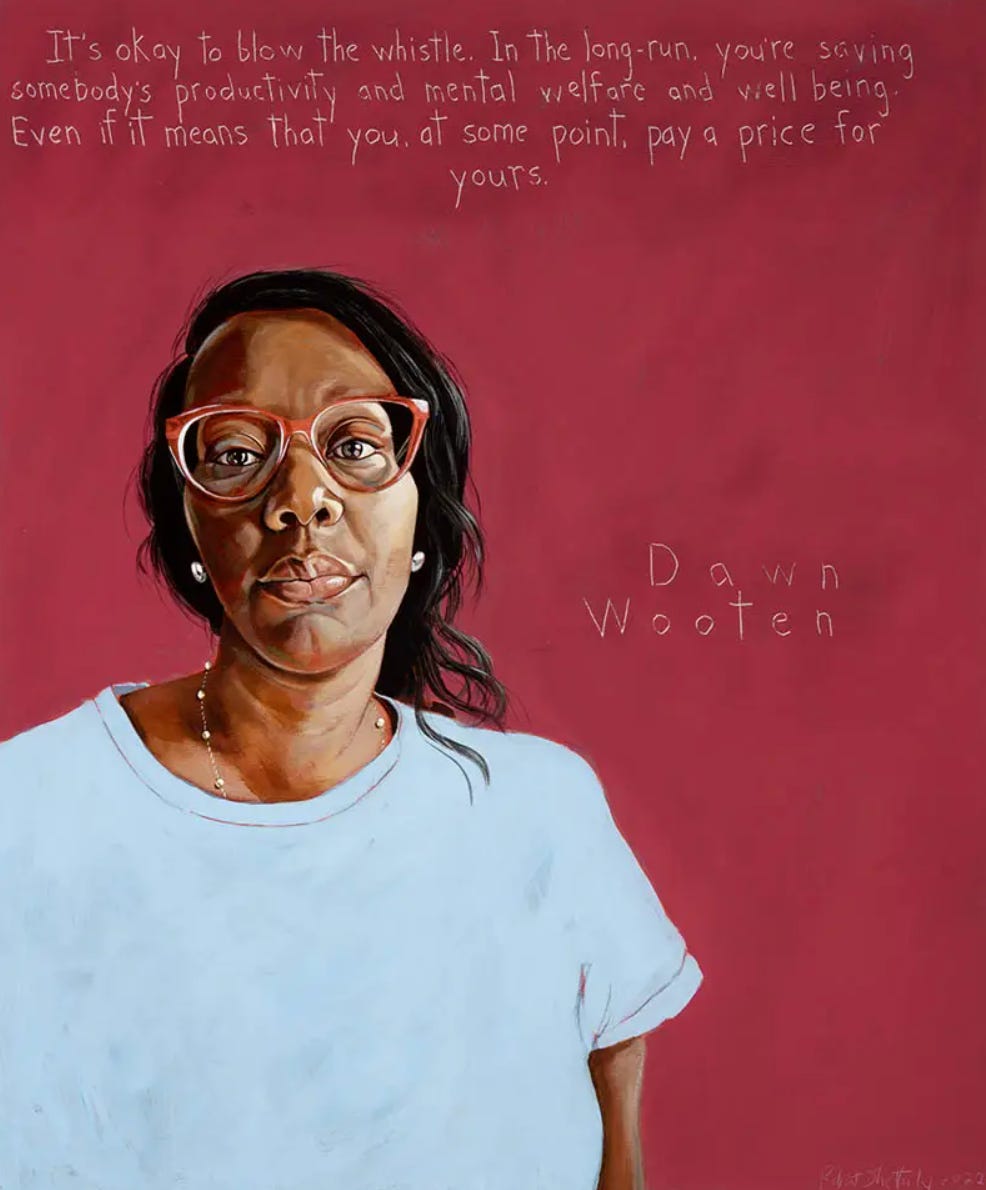
The truth Wooten told was real, as were the consequences of telling it. And the recognition she received was partial, contested, and eventually overshadowed by legal proceedings most people stopped following.
I’ve been thinking about Wooten because I’ve been thinking about sacrifice.
The thoughts arrived, as so many things do, through a piece of writing, in this case an op-ed describing a gathering of purposeful men, debating patriotism and the Iran War while welcoming a “left-center” dissenting voice into their circle. They were modeling the kind of civil discourse we’re told we need more of, and I read with genuine interest, which turned to unease, then to a specific frustration that arrives when I sense that a conversation is being held in a room that wasn’t built for everyone, about questions that affect people who weren’t invited to answer them.
Among the things this contingent of predominantly older, white men agreed on was that people have "become soft" and unwilling to make sacrifices. By people, they specified Americans, and I can’t tell if they meant younger Americans, or that people in general, other than themselves, are less willing to endure hardship for the common good, less capable of sacrifice.
I don’t think the men who made these comments are wrong to care about the future or to want something more from we, the people. Individualism has never been more evident than it is right now, and that’s not necessarily a good thing. But coming to terms with the word sacrifice feels like trying to wrap my hands around a hornet.
As it is most commonly used, sacrifice comes with a recognizable shape, a clear before and after. It asks something enormous of a person in a concentrated moment, and in return it offers recognition, honor, or at least a sense of accomplishment. We build rituals around this kind of sacrifice, name holidays after it, give up our favorite indulgent habits in service to it. We know how to speak about it, and we rarely struggle to agree that it matters.
But there is another offering that doesn’t come with a ceremony or a shared vocabulary and rarely comes up in conversations about whether or what we are still willing to give. This kind of sacrifice looks like the ongoing work of holding things together when the structures around you are unreliable or absent. It looks like the willing reorganization of a life when the needs of another have to take precedence. It looks like navigating systems that weren’t designed with you in mind and spending enormous energy on that navigation, energy that might otherwise have gone somewhere else entirely. It looks like a woman who sees something wrong, reports it, loses her livelihood, moves her children from place to place under threat, and watches the story she told become more complicated than she intended—without anyone calling any of that a sacrifice. It’s a form of giving that is sustained across years without recognition or endpoint.
It’s not that these kinds of sacrifices are less significant, just that they’re harder to see, particularly if you are not the one being asked to make them.

A few days before the op-ed above, another local letter described how the only woman in a county council race was excluded from her own party's event by a loyalty scoring system she'd had no hand in designing. This story is one of the oldest ones around.
I am not interested in assigning blame for this. I am interested in the question underneath it, which is the same one I ask when I hear confident pronouncements about sacrifice and common good and what Americans are no longer willing to give.
Who decides what counts?
Because if sacrifice looks like risk taken in a particularly visible moment, you will find it in certain places and not others. If it is a cost absorbed imperceptibly across a lifetime, you will find it somewhere else entirely. If it is loud and finite and comes with a flag, it’s easy to point out, but if it is cumulative, forbearing, and woven into the texture of ordinary life, it may disappear from view, despite its persistence.
We are in a season, liturgically speaking, that many people associate with the idea of sacrifice. I no longer practice those traditions, but I spent enough years inside them to remember how they felt. What strikes me now, from the outside, is how specific they are: one person, one moment, an audience, a death and a resurrection, and a meaning that radiates outward from that center. It is a powerful story. It has organized enormous amounts of human experience and human history. But it is not the only story about what it means to give something up, and I wonder sometimes how much it has narrowed our ability to see the other ones.
I am not taking a stand on whether we have or haven’t gone soft (as if softness is a weakness in the first place). Before I reach that conclusion, I need to ask, and answer, a harder question, which is whether our definition of sacrifice is constrained by the stories we already know how to see or tell.
There is no reliable recognition for what Dawn Wooten gave up. She stayed true to her convictions anyway, living with the consequences—professional, financial, and personal—long after the news cycle moved on.
If we’re serious about the common good, that’s where the conversation has to start. People are willing to give. They do, every day, in ways we haven’t learned to honor. But we’re overdue for a reckoning with who gets a seat at the table, whose endurance we build rituals around and whose we take for granted. What would it mean to widen the frame enough to see what has always been there?
That feels, to me, like a discussion worth having. In a much bigger room.
~Elizabeth
Afterward:
I include this section as a way to turn reflection into action, if you’re so inclined. Each week I share one small, concrete way to make a difference, because our spheres of influence are wider than we sometimes think, and even simple actions have a way of compounding.
Try this:
This week, spend a few minutes with the portrait of Dawn Wooten, and others, painted by artist Robert Shetterly as part of his Americans Who Tell the Truth series. Take in her story. Support his art. Then, as you’re thinking about voice and how we use it, jump over to Shy Guy Meets the Buddha , where Don Boivin writes beautifully about what it means to approach others—and ourselves—without the need to prove anything. Both are worth your time.

Thanks for reading and for thinking alongside me on this one. Do you know that your likes 💚 comments 💬 and restacks ♻️ help more people find their way here, and how genuinely grateful I am for each one? Consider yourself reminded—and appreciated.
A few things I’m curious about, if you’re inclined:
Is there a form of sacrifice in your own life that you feel goes unnamed or unrecognized?
And on the other side of it, is there someone in your life whose quiet giving you’ve never quite found the words to honor?
I look forward to meeting you in the comments.
Chicken Scratch is and will remain free, because good things should be accessible to everyone regardless of circumstance. If you're in a position to support the work, a paid subscription or a contribution to the tip jar makes a real difference and is always deeply appreciated.
See you next week.
Elizabeth, I appreciate the way you have been able to wrestle the difficult idea of sacrifice into this beautifully cohesive, and challenging, essay that calls us to both look inward while also creating a wider lens. Thank you for calling our attention and demanding that we open our eyes.
I need to question myself about the sacrifices I think I make but which might be more like playing the martyr or victim. I hope I have done the inner work to move beyond this but I will be moving the whole idea back under the microscope.
I often think about what the parents and children and regular folks in the war-torn countries are called to bear and sacrifice just to get through the day and it gives me a massive reality check.
Massive blessings to Dawn Wooten who is an angel in disguise.
Ditto Donna M's comment: a "beautifully cohesive, and challenging, essay." Like a fine needlepoint. Amazing. Thanks.
Some sacrifice feels objectively virtuous: any of the examples of service beyond self, living in service to others. Some is, as you note, invisible. I imagine also that some is subjective: was it a worthy cause that one gave up something for? did the person really give something up? or are they spinning their own tale of sacrifice that others see through? We might disagree as to the worthiness of cause, the degree of sacrifice, or even the intent of the person.
Another thought: there are those who hear Dawn's story as a cautionary tale - see what happens when you act on what's right? And there are those who are inspired by it, and who ask "where could I step up my game even a bit to sacrifice - really give up something?" As with many things, ones worldview will determine if you think there is more of one type and less of the other.