

Prefer to listen? You’ll find an original audio recording here. ⬆️

Sometime in the summer of 1990, still living nearby and in touch with the people who might show up, I decided to attend my 10th high school reunion. I was newly single, having participated in the final dissolution of a six-year relationship just a month or two prior, a partnership that had, if I’m honest, been fading for a long time before it finally let go.
I was headed into a room full of classmates most of whom were already married. My sense was that most also had kids. A lot can happen in ten years. Or six.
In high school I’d been an unremarkable kid, never profoundly good, never profoundly rebellious, not a straight arrow but not exactly living dangerously either, not the most popular, but close enough to spend years thinking I had a shot at the inner circle. What a waste of energy that turned out to be.
I needed to walk into that reunion as a single woman with my head held high, and I decided to make my case with clothing.
Looking back, the outfit wasn’t nearly as bold as it felt that night. By today’s standards, it barely registers, but at the time, it was a declaration: a white leather dress from Hugo Buscati, discovered in the pages of the Victoria’s Secret catalog during the years the brand was building itself into a luxury label. Silk slips, velvet gowns, structured party wear, the works—and more money than I’d ever spent on an article of clothing. With its portrait neckline, hem just above the knee, and close-fitting cut, it was ideal for showing off a tan from a summer’s worth of poolside weekends born of having no other plans.
Lacking the confidence to forge ahead without reassurance, I invited a friend to weigh in, someone I figured would tell me the truth. The dress might be too much, I told her, too attention-grabbing, too suggestive. She squared her shoulders, looked at me sternly, and said, “If you don’t wear that dress, I’ll never speak to you again.”
My date was a British guy I’d only just started seeing. He turned out to be a bit of a killjoy, insisting we leave the event much earlier than I’d planned. He had a great accent, though, and it wasn’t about him anyway.
Minutes after we arrived, the dress earned its keep. A fellow I hadn’t seen in years greeted me, took a step back, and said, “Whoa. You’ve changed.”
These days I might hear those words differently, as if my clothes had given him license to assume something about who I was or wasn’t. But the message I was going for that night was closer to metamorphosis, and I took his reaction as exactly the validation I’d gone looking for.
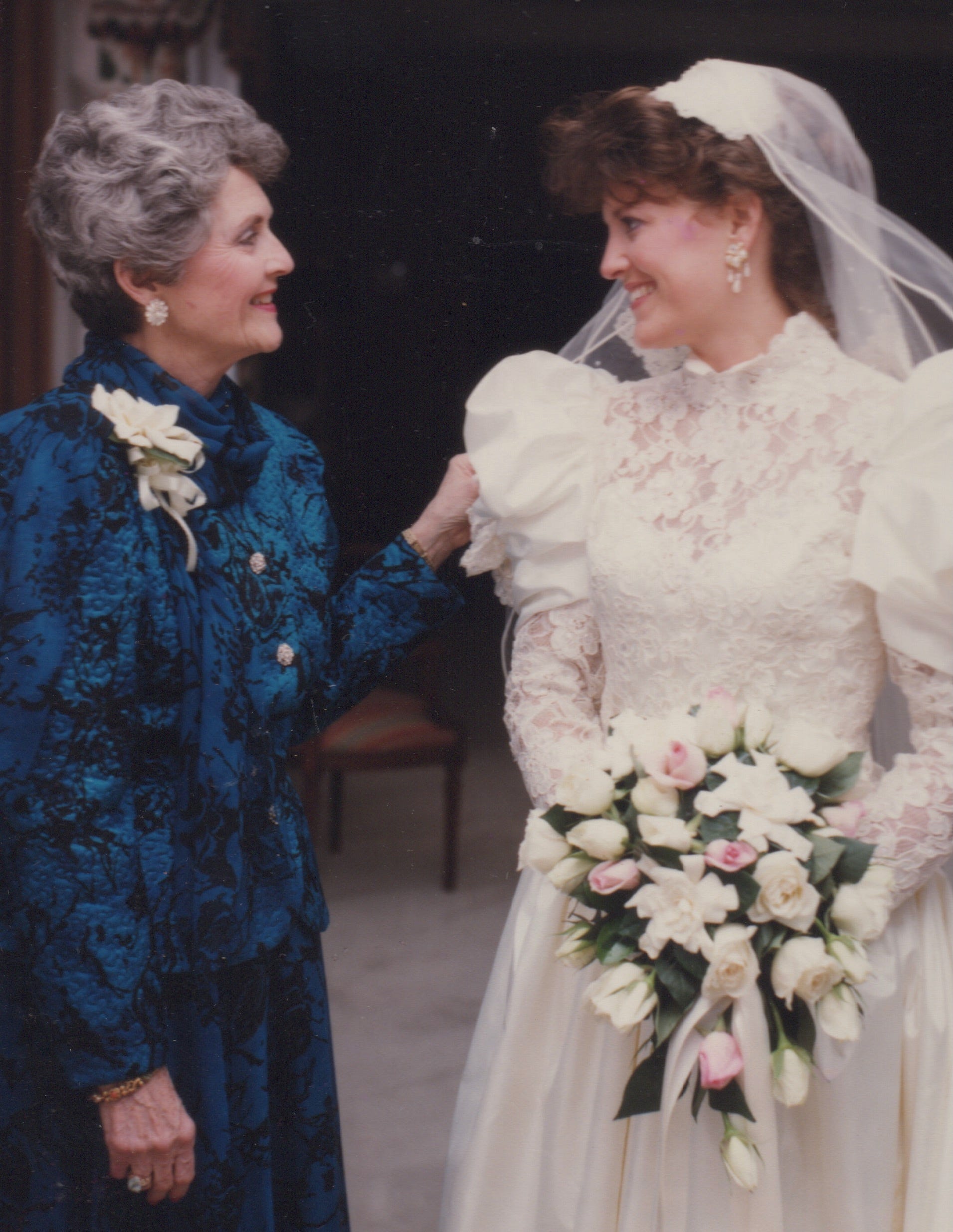
Seven months later, not for the Brit or the former boyfriend, I walked down a church aisle in the second most memorable dress of my life: a wedding gown with sleeves reminiscent of the ones ballooning off Princess Diana’s arms a decade earlier. Fashion trends apparently take their time reaching the South, or leaving it. I wore my big ‘80s hair quite proudly well into the 90s.
It would be a few more years before Diana stepped out in her so-called “revenge dress.” Black where mine was white, but cut from comparable emotional cloth, they were the kind of dress a woman wears when she wants a room to understand something without her having to put it into words.
I understood what I was ready to say at twenty-seven in the leather dress, and again in the wedding gown, for entirely different reasons. It would be a long time before it occurred to me that my mother may have done something similar.
I’ve never seen a photograph of my mother wearing the dress she once told me she wanted to be buried in, a wish she didn’t get. My father, who died first, chose cremation and interment, and she, wanting to rest near him, somewhat grudgingly agreed to do the same. But I’ve yet to part with the dress itself.
I’d always assumed my mother’s dress was wool, or some kind of synthetic blend. I was wrong on both counts. Made in the late 1960s, it is modern cotton barkcloth, a mid-century woven textile that borrowed its name from a much older craft. True barkcloth is made by pounding tree bark into something wearable, a technique still practiced ceremonially in places like Uganda. The modern version is 100% cotton, part of a weaving tradition sometimes called momie cloth, and it’s what gave us the bold tropical prints American servicemen brought home from the Pacific in the 1940s and ‘50s.
There’s an intriguing little echo here: my parents were stationed in Hawaii after the attack at Pearl Harbor, and my oldest sibling was born there in 1952, right in the years this fabric was being shipped home by the crate. I don’t know that my mother ever owned a scrap of it back then, but she was in the right place, at the right time, to have admired it.
From Hawaii, they eventually made their way to High Point, North Carolina, where my father, a furniture salesman, would join a business partner to launch an upholstery fabric company with a singular niche: they were the sole East Coast distributors for Naugahyde. I grew up watching the man run his hands over furniture, dismissing fabrics he didn’t trust to hold up. He knew quality on contact. I imagine the two of them standing over this dress together, agreeing on it, maybe for a winter party, maybe to mark her fortieth birthday, which would have landed in the same season. Adjusted for inflation, its original price of $50 to $90 comes out to something like $450 to $800 today. I found an identical one listed on Etsy for $698.
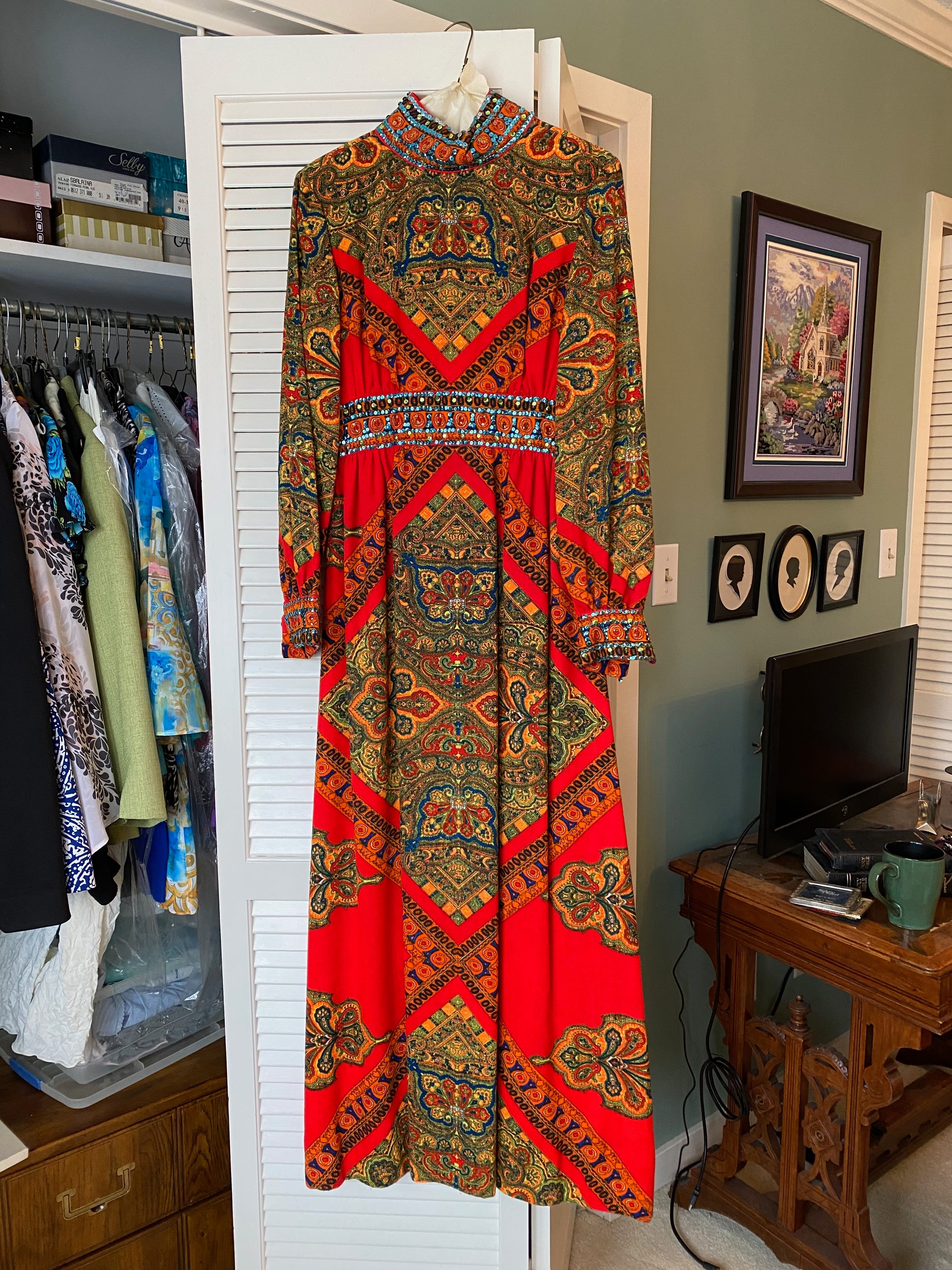
If it’s not evident already, the dress doesn’t come close to fitting me, and honestly, I have trouble picturing it on my mom. By the time it hit the market she’d already had three children. She came of age in an era of clothing built for a certain kind of shape, and by the time she was in the depths of motherhood in the early 1960s, that shape hadn’t relaxed much.
She’d had rheumatic fever as a child, and doctors warned her against gaining weight through her pregnancies. With her second baby—nine pounds, seven ounces—she gained only about ten pounds total. Still, she spent the rest of her life fretting over a mid-section that wasn’t flat enough. In my mind, she was forever wishing she could lose 10 pounds.
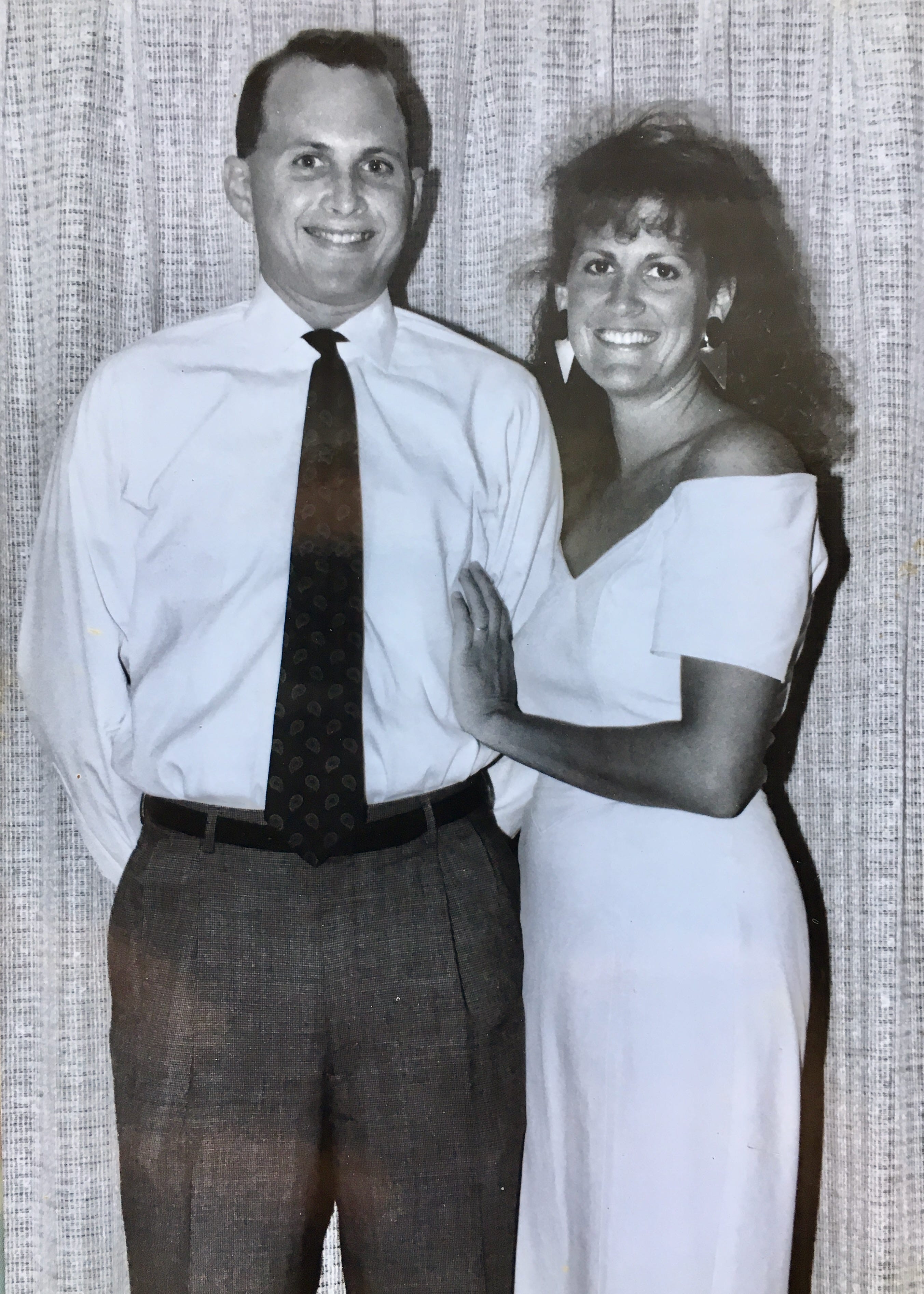
If memory serves me, I wore my leather dress three times, though only one of those times left evidence. There’s no photo of the debut, my friend’s ultimatum, the guy who said I’d changed. A few months later, at a gala with my brother Don, someone pointed a camera at us, and that’s the only image I have.
The last time I recall wearing it was on my honeymoon the following February, where its message went from look what I survived to look who wants me in the space of just a few months. It had done everything I’d ever asked of it.
Then my life turned into something the dress had no idea how to adapt to, from single, suburban, working girl to sailor, then farmer, and eventually mother. My days had almost nothing left in common with a woman who chose white leather to announce herself to a room. It wasn’t only that I stopped fitting into the dress, though that felt true, it was that I stopped needing something external to make that kind of statement on my behalf. The dress languished in my closet for more than a decade until I finally gave it away, with no real regrets.
I don’t know what my mother was declaring in her dress, what room she was walking into, or what she needed the people in that room to understand. I don’t have a photograph to help fill in the missing pieces, and I never thought to ask. All I know is that she held onto it for five decades after she stopped wearing it, and that when she thought about how she wanted to be remembered, those rich colors and sparkly sequins are what she reached for.
I imagine she was influenced by a Depression-era habit of never letting expensive things go. But I also think, knowing her, that she may have felt like her best self in it, a version of her that got to stop second-guessing her shape for an evening and just enjoy herself.
~Elizabeth

I’ve made my peace with most of the things I can’t ask my mom, but a few I really hope to get a shot at someday, somehow.
Tell me in the comments 💬
Is there a piece of clothing in your life that’s keeping score on who you used to be?
Have you let go of something lately and felt relief instead of loss?
What question did you never got around to asking someone?
Thank you for joining me today. For those who’ve newly subscribed, I’m thrilled you’re here! While my essays are freely available, those who are able to offer paid subscriptions are a backbone of support for work it takes to keep Chicken Scratch going. If the thought of one more subscription is bringing you down, one-time tips do the job too. I respect and appreciate the many ways readers show up here in support of these weekly essays. I’m glad you do, and I hope you’ll invite others to join you by sharing and restacking ♻️ these musings.
Afterward:
Regulars know I like to close with something small and doable, because I think collective action matters.
Try this:
Find something you’re keeping that might not be necessary in your life anymore. You don't have to get rid of it. Just notice whether you're keeping it for you, or for who you used to need to be.
See you soon!
I love this, Elizabeth. Took me right back to the only high school reunion I attended; my tenth, as well. I arrived, reticent. I wore my favorite outfit (I've written about it before); the hot pink linen cropped jacket, complete with shoulder pads in 1989, and the white polka-dot on black high-waisted pants, with a black turtleneck sleeveless unitard. No one recognized me. I'd lost a significant amount of weight since last spotted at graduation. 70 pounds, and I had a more refined sense of style (blue suede jazz shoes to go with). I was in the anorexic era of my eating disorder. When I introduced myself, everyone was floored and gave me that icky feeling...the "now you're acceptable, so we can treat you nicely" bullshit. I decided that night never to attend a reunion again, and I have kept my word.
I've been looking at the possibility of wearing a Jewish star, and went online looking for one. But I've decided that the one my grandmother gave me when I was 7 is the one I'll wear. I've been holding onto it for decades, and I'm glad I never gave it away. But the old clothes? Getting rid of things at breakneck speed. I'm too small now for a lot of the clothing I've tried to hide my too-big body for years. I've always held onto smaller sizes/larger sizes, because I've gone up and down so much. No more. I feel confident that I will maintain my weight loss and live in the present. And if I gain or lose more, I'll make adjustments to my wardrobe as life takes place.
Your dress was fabulous. xo
I always knew that beneath your salt of the earth veneer, there was a white leather clad minx. Glad you've come clean.